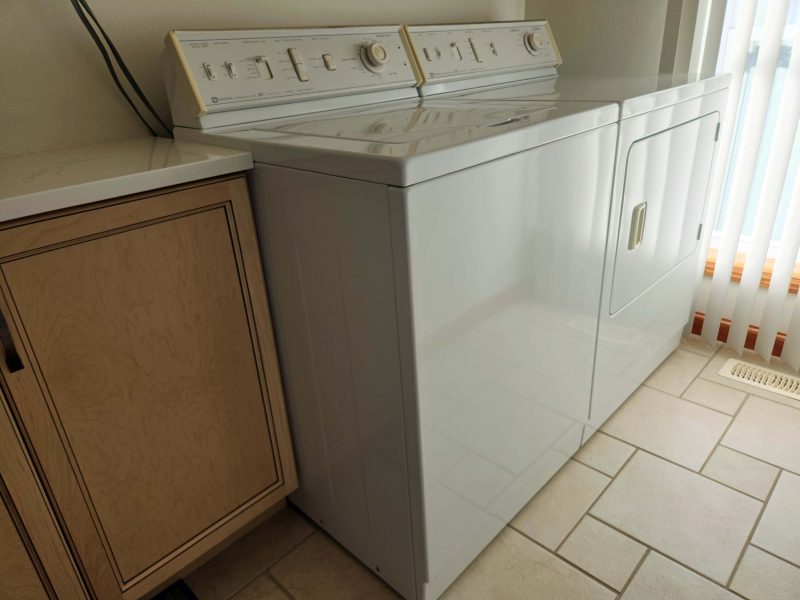
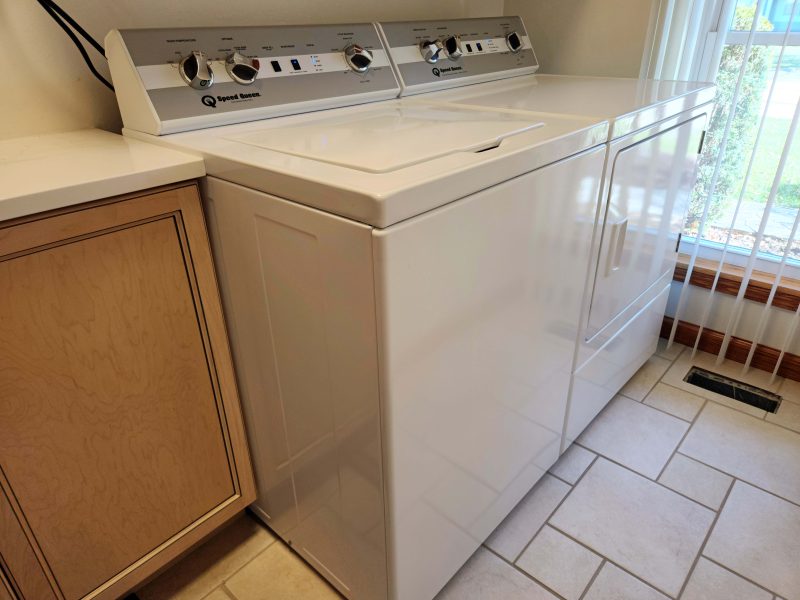
In January, we got a new washer and dryer. More than one person told me I’d hate it, because the new washers and dryers are awful compared to the old ones. I said I wouldn’t, because every consumer site I checked for reviews and ratings put Speed Queen in first place, noting that it comes with a 5-year warranty and has a life expectancy of 25 years. Why? Because Speed Queen makes a mechanical model, as opposed to a hi-tech model. I have dials to turn, not electronic panels with a zillion settings to choose from. Fewer parts, fewer things that break.
Unfortunately, my dryer did not do a good job of drying my clothes, and everything came out damp. Only the timed settings worked, so I couldn’t use permanent press, etc. Before a serviceman came to the house to diagnose the problem, we were advised to have our dryer vent cleaned out. If we didn’t, the first thing he’d tell us to do would be to have the dryer vent cleaned professionally, and he’d charge $115 for the service call to say that.
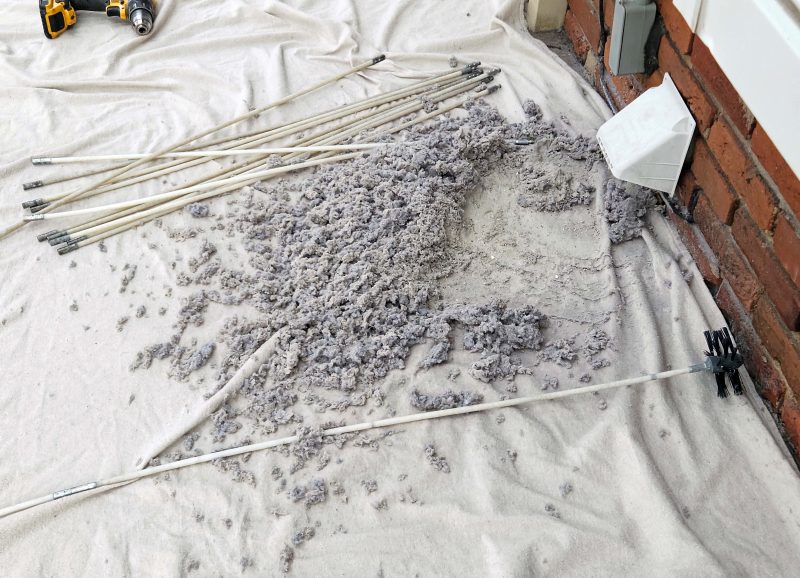
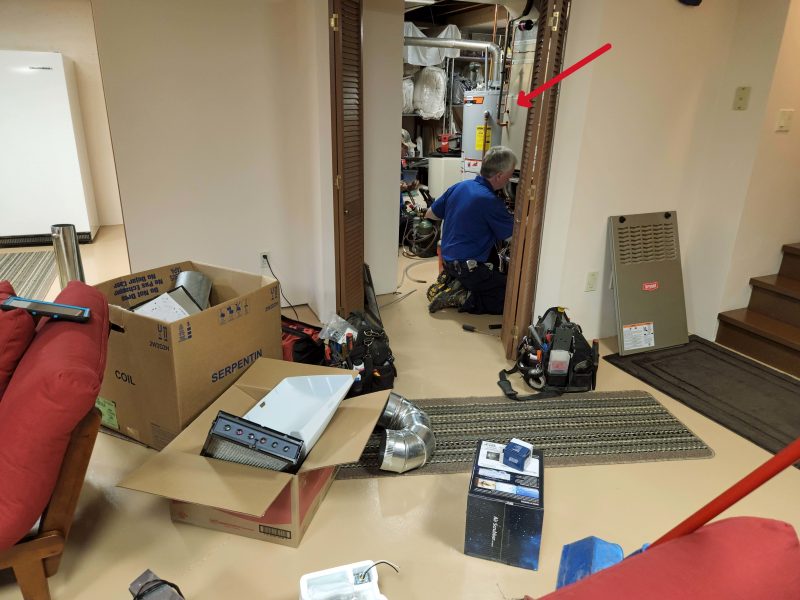
Although Ted regularly uses our leaf blower to blow out the vent from the laundry room to the outside, it’s been a number of years since we’ve had it professionally cleaned, so we made an appointment for that service. The serviceman said he wasn’t removing much lint compared to what he usually does, but he did hit a blockage at one point. This might be better than most of his customers, but I don’t think having the vent professionally cleaned was a bad idea even though, as it turned out, that wasn’t the problem with the dryer.
With that completed, the dryer warranty serviceman came to the house. Everything he checked seemed to be working properly. He asked me for a damp dishcloth that he could put into the dryer to test it and then diagnosed the problem as a faulty thermostat. How could he tell? When he started the dryer, it indicated that it was heating. He told me the heat cycle turns on and off to avoid overheating, but mine didn’t turn back on. He pointed out that there’s a barely audible click sound each time the heat cycle restarts and my dryer wasn’t making that sound.
He ordered a new thermostat, came back and installed it, and all is well. I did laundry over the weekend and all my clothes dried. Oh, happy day!
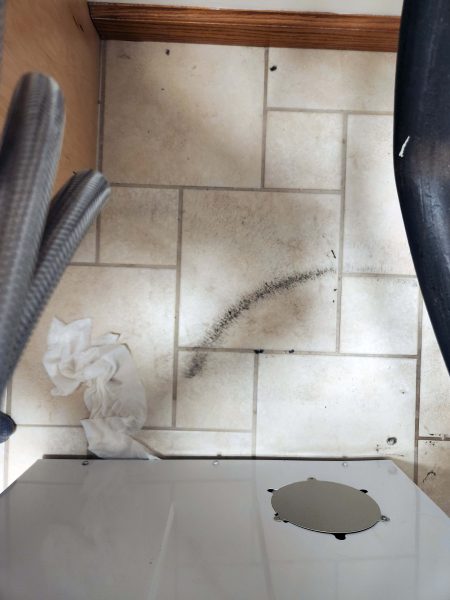
While I was doing laundry before Ted and I left home to spend Christmas with Thom’s family, I noticed water on the floor at one corner of my washer. It didn’t look like a “gusher” leak, and I only had two more loads to wash, so I put a towel on the floor to absorb the leaking water and finished the job. Afterward, Ted and I pulled the washer away from the wall to see what might be leaking. We saw this black circle on the floor. It looked like something was spinning (probably the tub) and threw out some black stuff. It wasn’t oily, and it wiped up easily, but that didn’t seem like a good sign, given that my washer and dryer were 30 years old–almost to the day! (Ted’s and my first washer and dryer–when we bought our first house–were Lady Kenmore appliances from Sears and lasted 22 years.)
I called Henry, my go-to appliance repairman (who we hardly ever need, because we buy brands he recommends), to ask if he thought the black stuff and the leak were fixable. He offered to take a look, but he thought it was probably something coming from the motor and being blown around.
For years, my washer has been missing a solenoid that shuts off the water supply when the washer is not in use. Without the solenoid, there is a constant slow drip into the washer tub. I solve the problem by flipping the handle on the water supply shut-off valve behind the top of the washer to “on” to do laundry and to “off” when I’m finished. The reason the solenoid is missing is that Henry couldn’t find the right part to replace it because solenoids now have a different number contact points than our old one. What are the odds that, 7-10 years after the solenoid part became obsolete, Henry will be able to find the parts he needs to fix the motor? Answer: Low. What are the odds, if he does find the parts, that it will cost less than $500 to repair a 30-year-old washer with a (possibly) failing motor that cost $630 new? Answer: Low. What are the odds that this is only the first in a series of failures for such an old appliance? Answer: High. Ted and I decided it’s probably smarter to buy a new washer and dryer.
Henry has constantly marveled at my old washer. One time, his son came to our house with him and asked, “Is this that old Maytag you tell me about?!” I only remember two repairs on the washer–a new hose, and a leak near the tub–and two repairs on the dryer–2 replacement thermostats–in the 30 years we’ve had these appliances. When we bought them, Maytag advertised that the Maytag repairman was “the loneliest man in town.” No one ever called him. I remember ads like the picture below (I found it online) where he sat at his desk, waiting for the phone to ring. In one ad, his dog led him to an empty dog food bowl and the repairman said, “Finally! Something I can fix!”
When we bought the washer and dryer, the store had a Maytag washer running constantly. Customers could enter a lottery in which they would win a new Maytag washer if they accurately guessed when it would stop running. Ted and I didn’t enter the lottery because we had just purchased a new Maytag washer and dryer. I don’t know how long that washer ran, but the store is out of business and my washer lasted 30 years.
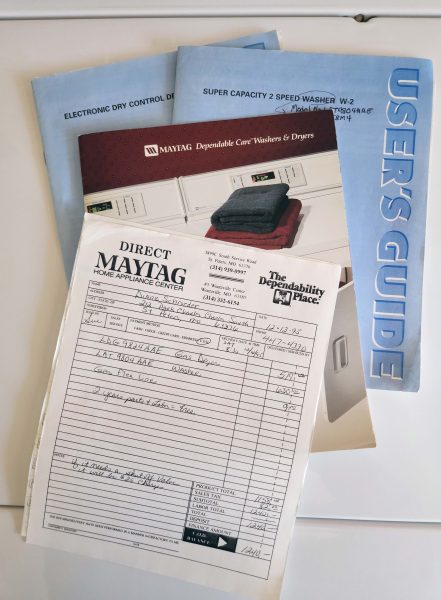
We still have all the user’s manuals and the receipt from the washer and dryer. Anyone who has shopped recently knows you can no longer buy a washer and a dryer for a total of $1,240. Note the date on the receipt: 12-12-95. I noticed the leak and the black stuff on 12-19-2025.
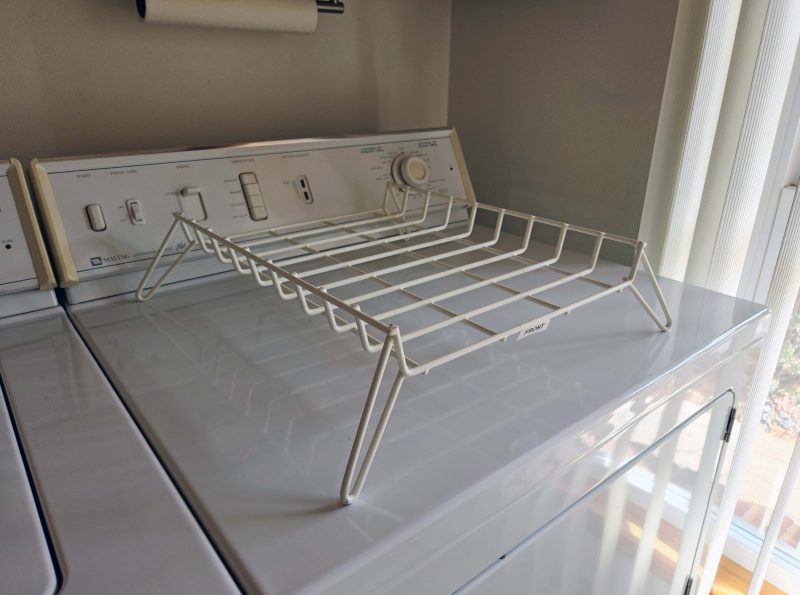
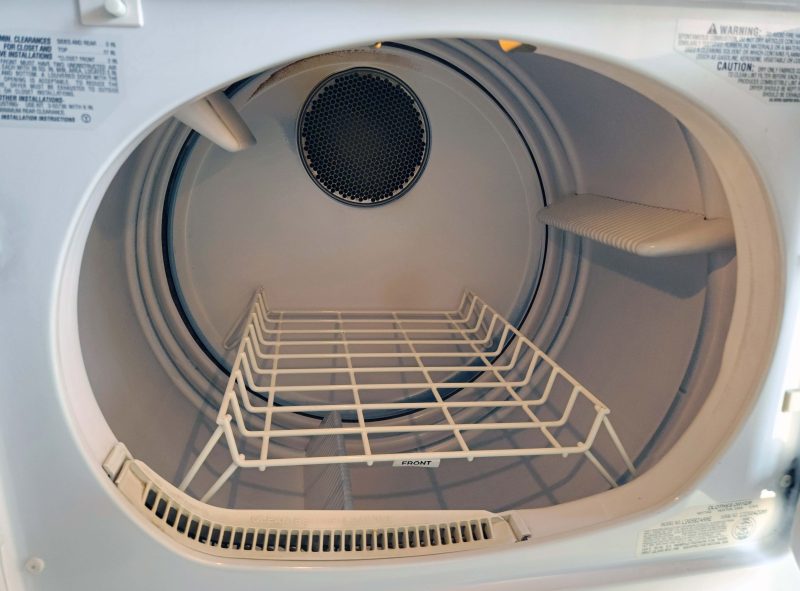
This rack was one of my favorite features on my dryer.
The rack fit inside the dryer without touching the drum, so I could set things on it to dry without tumbling. I used it for garments that need to be laid flat to dry (e.g., sweaters) and for drying athletic shoes. (Yes, I’ve thrown athletic shoes in the washer for as long as I can remember. I laugh when I see articles about how to keep your athletic shoes from smelling bad. Wash them!)
For years–probably since front-loading home washers became popular–I’ve heard nothing but bad things about new appliances from friends, family, and Henry. Henry told me he regularly fixes new appliances that are still under warranty! For a while, it was hard to even find a top-loading washer, and I hoped that my washer would last until people figured out that front-loading is a pain, and until stores included more top-loading machines in their stock. With a front-loading washer, you can’t add an additional item to the load; you can’t remove an item you put in by mistake; and, unless you leave the door ajar to dry out the interior, it stinks.
Before buying a new washer and dryer, I did some online research, hoping to find one that would last more than five years. I checked at least five consumer sites for “best washer and dryer,” and every single one had Speed Queen as the top choice, with information indicating it is expected to last 25 years. It’s not the brand I would have guessed, but when I looked into why Speed Queen lasted so long compared to other washers/dryers, I learned that it’s because they are built for commercial use and do not use electronic panels for cycle selections–just simple knobs and dials. As a result, the mechanisms are simple and have few problems. Ok, Speed Queen it is!
The next problem was finding a retailer that carried Speed Queen. I found one–one!–that had a store within five miles of us: the Slyman Brothers. Anyone who’s lived in the St. Louis metro area during the last 50 years, like Ted and I have, will recognize the Slyman Brothers as the guys who sit on top of the Arch in their ads. Yes, those goofs! I never took them seriously because of the dopey ads, but they are apparently a very reliable–as well as memorable!–dealer, and they were pleasant to work with. Ted and I went to Slyman Brothers when we returned from our Christmas visit with Thom’s family, and they delivered the new appliances two days later.
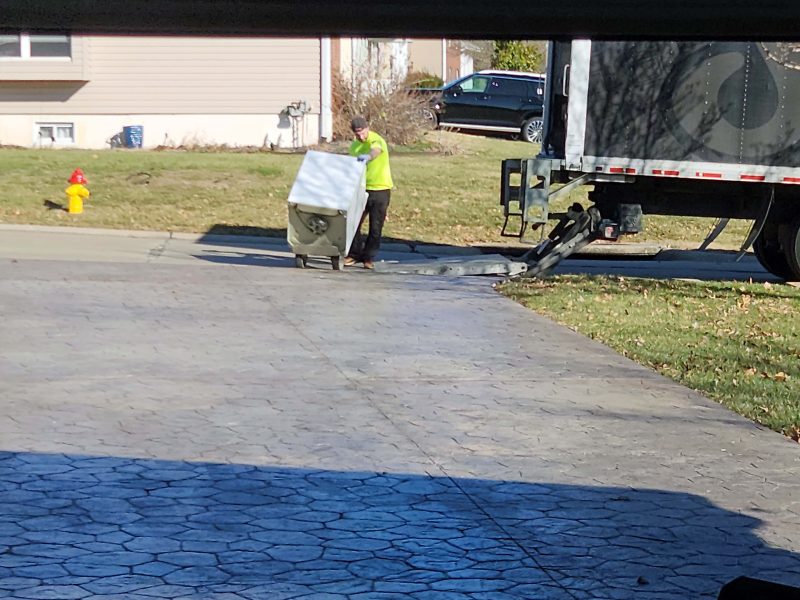
Here goes my 30-year-old washer. It made me a little bit sad, like watching an old (inanimate) friend going to its end-of-life. It was a trusty machine, and it worked hard and well for me. Thank you, Maytag washer.
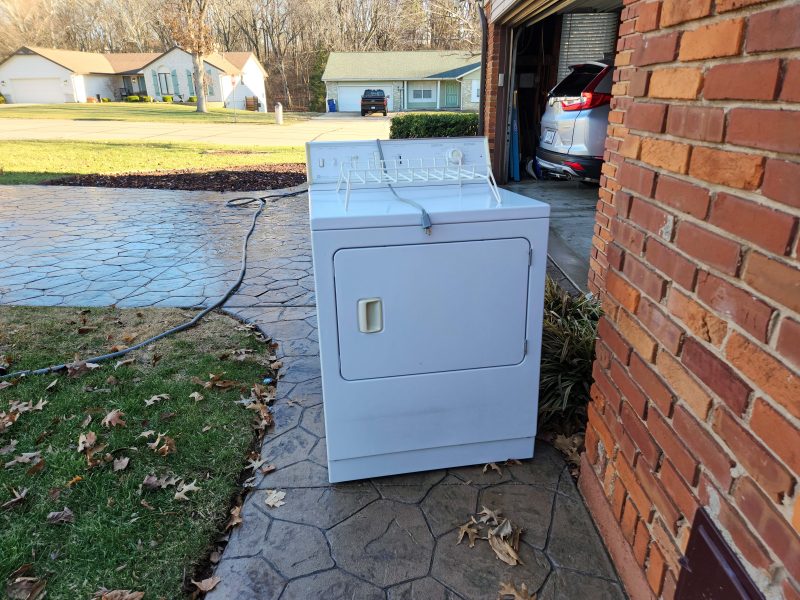
Henry repairs appliances, and he also sells used (repaired) appliances in his store. When I told him we were going to buy a new washer and dryer, he said he’d love to get his hands on my dryer, so we asked the delivery guys to leave it on the sidewalk and to deduct the dryer disposal fee from our bill. Henry’s son picked it up within an hour.
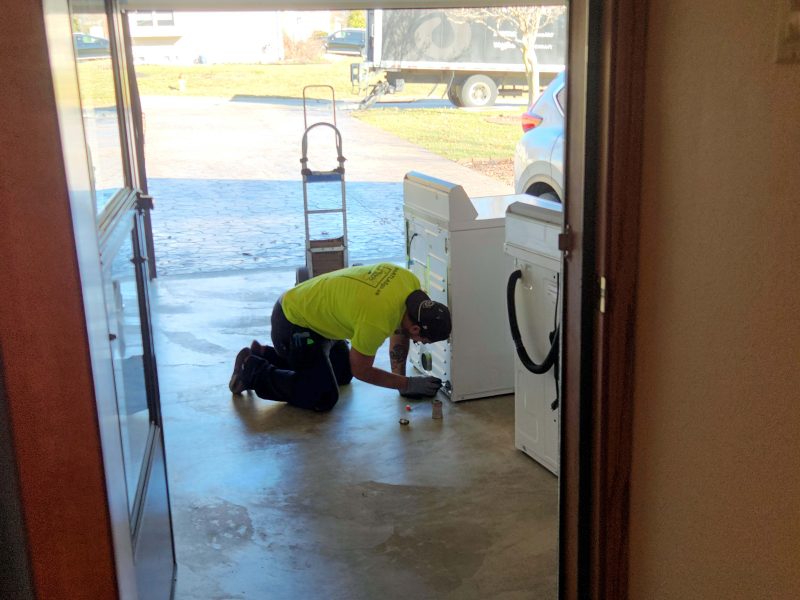
Here’s one of the delivery guys connecting whatever needs to be connected on the new appliances.
Here, they’re connecting the water line to the washer.
This is my last photo of our old Maytag washer and dryer.
Here are my third (in 56+ years) washer and dryer. Except for the updated appearance of the panels, they look and operate almost exactly like my old ones.
Of course, there are some things I’ll miss on my old washer and dryer. For example, the drying rack (above) and also the dials with timers. When I set a washer or dryer cycle on my old models, the dial would turn and I would know exactly where it was in the cycle. The new ones don’t turn during the cycle. I set them and, unless I watch the clock, I have no idea which point of the cycle they are at. On the other hand, there are things I like on the new washer and dryer. They have a larger tub/drum, so our flannel bedsheets fit better, and the dryer has a “no heat” cycle, so I can fluff our heavy down blanket (which didn’t fit in the old dryer) to redistribute the feathers without heating it.
The fact that our washer and dryer lasted 30 years is probably more surprising than the fact that the washer failed after 30 years. (The dryer still works perfectly.) Puzzling over this, Ted and I reached a possible cause. When we updated our laundry room cabinets, the carpenters took our washer and dryer out to the garage to make room for them to install the new cabinets. Then, of course, they moved them back into the laundry room. Ted and I suspect that the two moves jiggled an old, fragile part loose on the washer. (Not the carpenters’ fault.) Maybe if we’d left the laundry room with its dated appearance, the washer would still be washing clothes for us, and we’d still have the dryer too. Oh well, they had a good run at an average cost of $41.00/year.
Ted and I are finally finished with the contractor jobs we needed to update the interior of our house. We started in August 2022 and finished in November 2025. We never believed it would take this long, but life got in the way and we put things off until–in frustration–we just said, “Let’s get it finished!” And that was all it took. Sometimes, you just have to bite the bullet, or whatever.
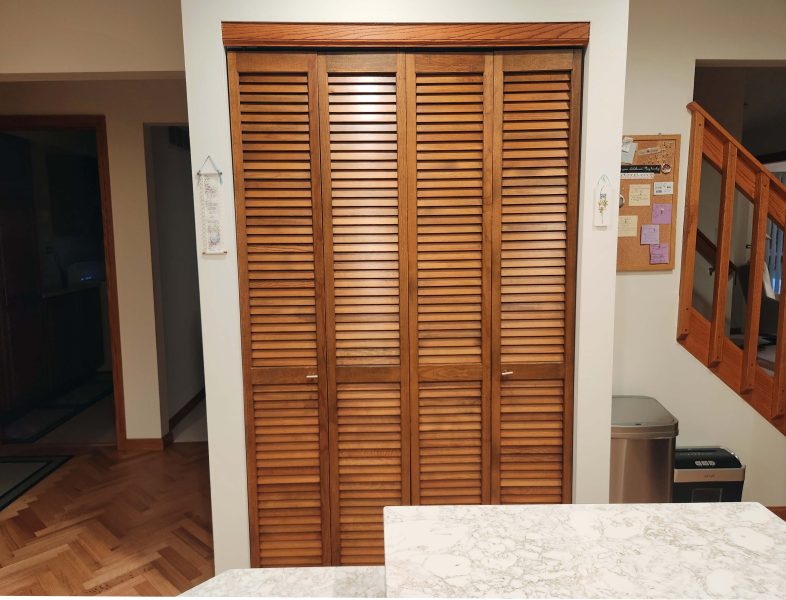
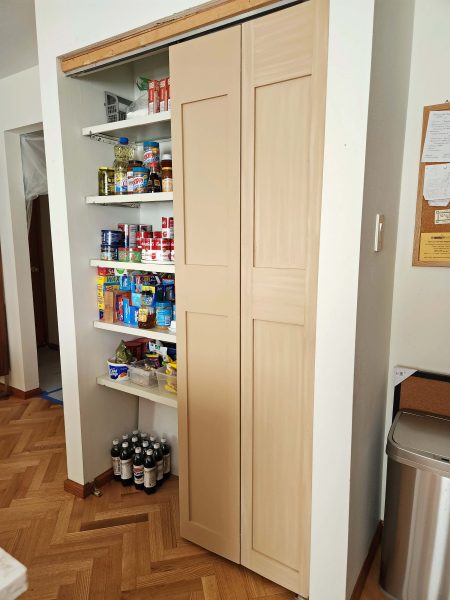
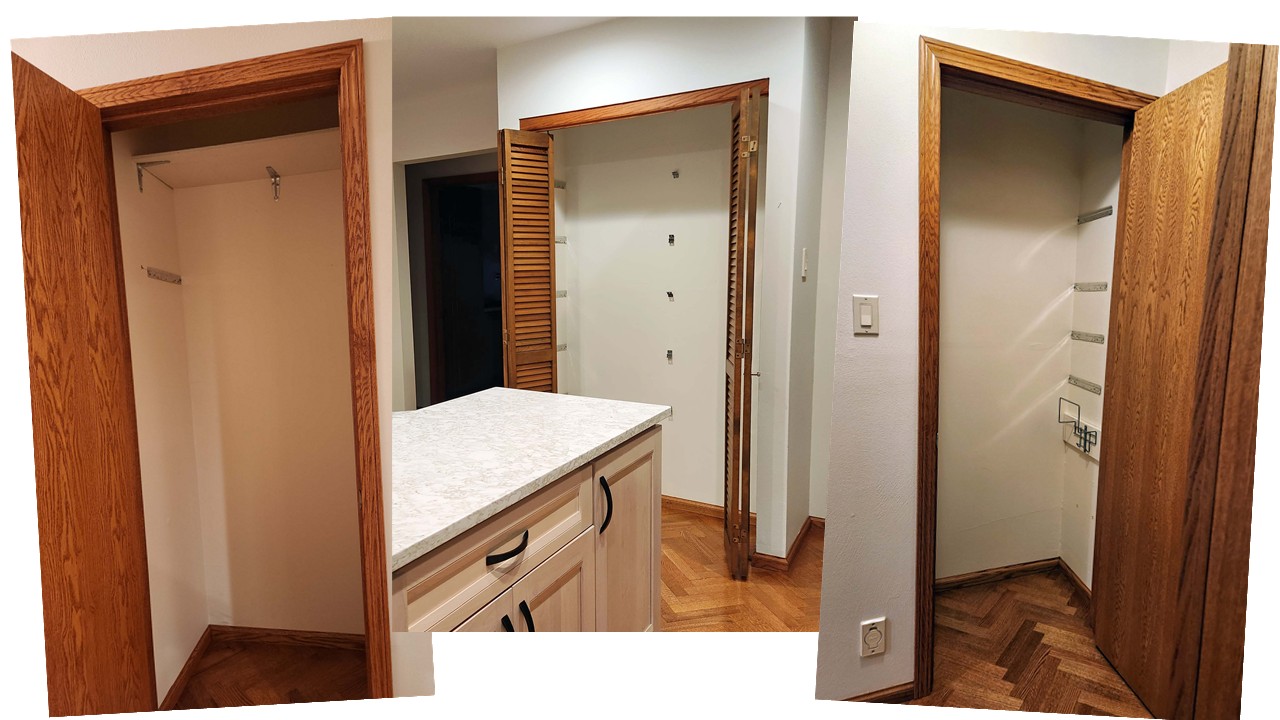
Here are the 46-year-old pantry doors that came with our new house back in the 20th century. They’re “builder grade,” but held up well. Still, 46 years! It’s time for a change.
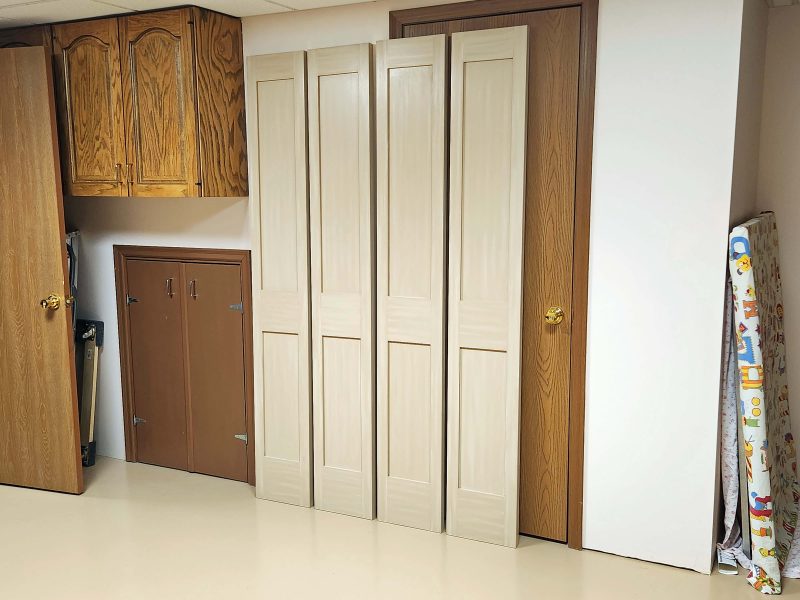
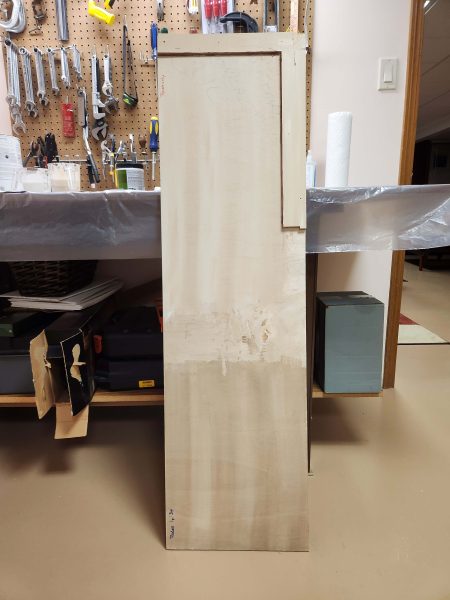
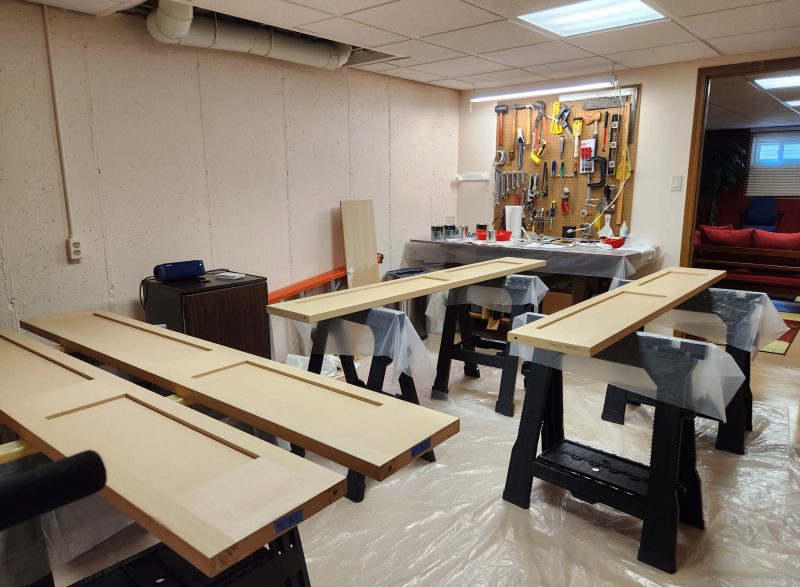
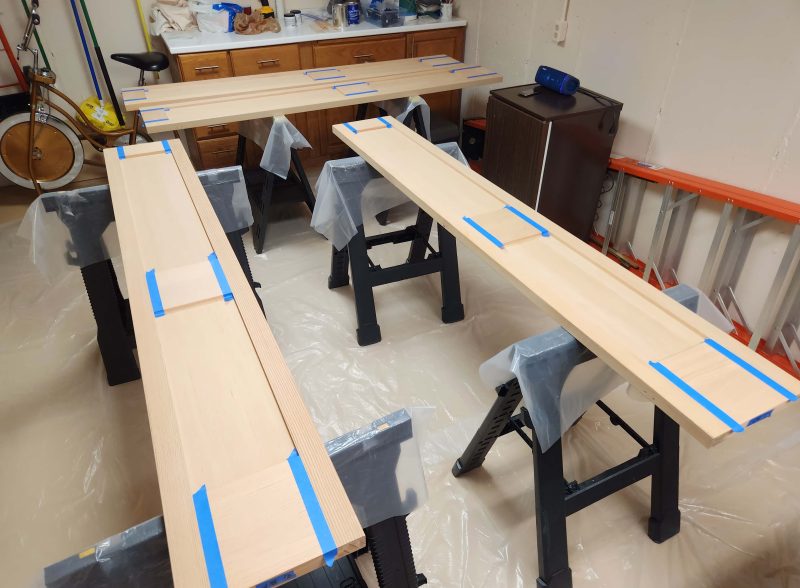
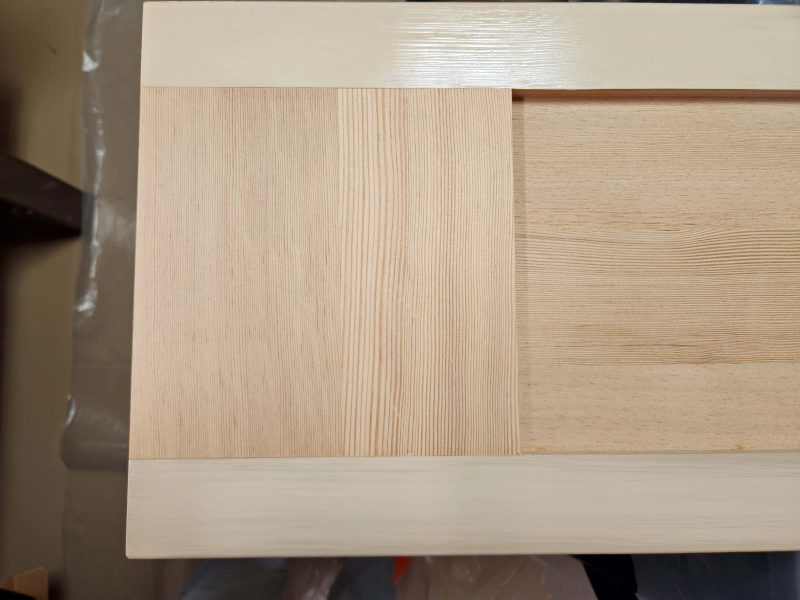
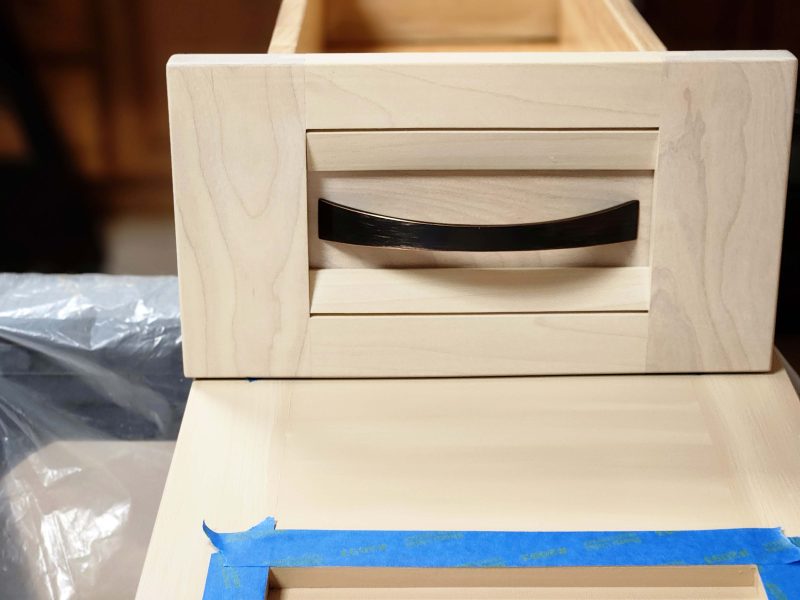
If you read my colorwashing story, you might remember that, when we finished colorwashing our new pantry doors, we set them up in the basement and marked them 1, 2, 3, and 4 with blue tape in the order we wanted them hung in the kitchen. We knew the doors were one inch too high for the pantry opening, so we painted the tops with the base color and left the bottoms bare because we knew they were going to be sawn off. In addition, I added a strip of blue tape with a message to “cut excess length from bottom.”
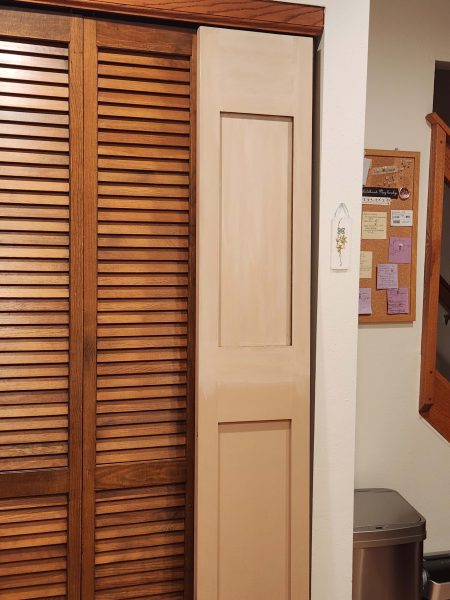
Sadly, good intentions can go awry. What’s wrong with this picture? I’ll give you a chance to look closely before you read on.
If you didn’t see the problems, look again and you’ll notice that (1) they are hung upside-down; and (2) the one on the left is hung backward with the plain side, rather than the colorwashed side, facing outward. I felt sick when I saw this.
Before speaking to Mike, the carpenter, about the problems, I went online and looked up all kinds of door images. Just as I thought, when there is trim on a door, the wider piece of the trim is always on the bottom. Confident I was right, I said to Mike, “You know they’re upside-down, right?” His response was a puzzled, “They are?” Then I mentioned that one was also backward, and he was equally mystified. To compound the error, he’d already cut off the extra inch in height at the tops of the doors, because he thought those were the bottoms.
The doors were shipped to us in pairs and were already hinged together. We removed the hinges to colorwash them. Mike must not have noticed the holes where the hinges could be re-attached, because he drilled new holes on the opposite side of each door to fasten them in this order. Now each door had three sets of hinge-holes (my term) on both sides. Since we’d had the doors standing as they should be installed, lots of nasty thoughts were running through my mind, but I managed to keep them to myself.
The problem was that Mike had only been working for Jimmy (the owner/contractor) for three months. Christopher, Mike’s more experienced mentor who was working on the laundry room cabinets, left for a short while to finish a different job, and instructed Mike to begin installing the pantry doors. Before Christopher left, he asked if Ted and I minded if they used our old door track (already installed) instead of the new one. I was puzzled, but figured, if it worked, it could be fine. Christopher went on his way and Mike kept working. Neither Ted nor I was feeling very positive at this point. In retrospect, I wonder if Christopher was trying to simplify the installation for Mike by not making him install a new track.
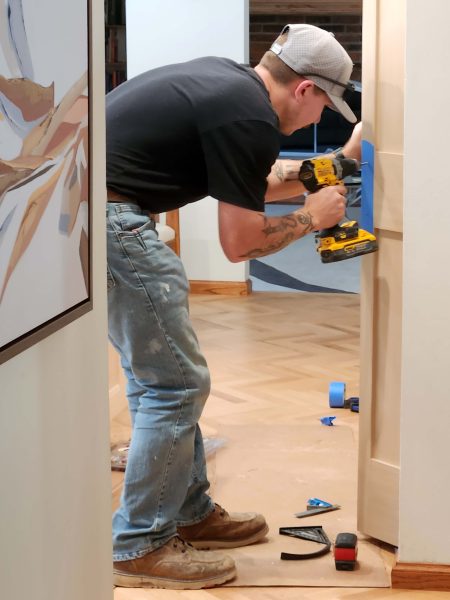
The installation was undone, the doors were turned to the right positions, the hinges were moved to where they belonged (at the original holes), and here’s Mike, drilling holes to attach the door pulls.
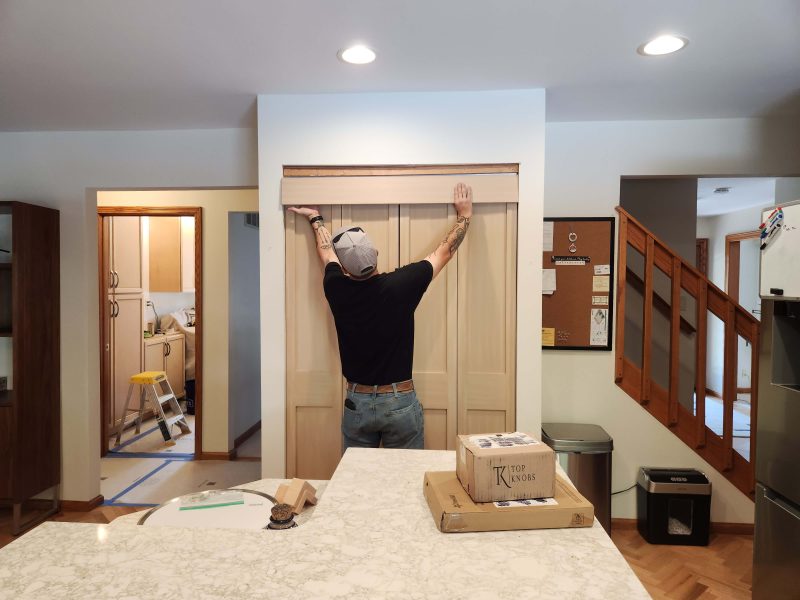
The final step (we thought) was to hang the door header. The edges on the lower edge were slightly rounded; the upper edges were cut square. At least Mike hung the header with the rounded edges at the bottom and didn’t have to re-do that too. (He apparently realized the value of my blue tape messages, so the arrows and words indicating “top” and “bottom” helped him this time.)
Unfortunately, the saga of errors continued.
(1) When the doors arrived at our house, all three hinges on one pair were bent. That package (a wooden crate) must have experienced trauma during the shipping process to shift the panels enough to bend the hinges. The guys couldn’t straighten the hinges, so they bought new ones. As it turned out, the replacement hinges were thicker than the original ones. When the doors were closed and the hinge plates on adjoining doors met, they made the doors too wide to function in the doorframe. The guys had to buy another set of thinner hinges. We were getting a lot of hinge-holes in our doors.
(2) The doors were not hung perfectly level, so when we opened and closed them, they rubbed against the outer walls of the opening and against each other in the center. Not only was this wrong; it was going to gradually wear down the wood and the walls at the contact points and scratch off our carefully applied colorwash on the center sides. Looking at the doors, it was easy to see a wider gap between the door and the wall at the top of one door and at the bottom of the other. It was also easy to see that one end was higher off the floor than the other.
(3) The new doors are much heavier than the old louvered ones. On the old track, the new doors opened too far and–the best I can describe it–backed up on themselves. They had to be pulled by hand from the wide-open position because the door pull had the wrong torque to do that. When they removed the old doors, the guys discarded the stoppers (spring-like things that fit inside the track). Without a stopper, the doors opened too far. The guys had also discarded the new hardware.
At this point, Jimmy brought in Tommy–a master carpenter–to see what could be done. Tommy did a better job of filling the extra hinge holes and he worked hard to level the doors. Unfortunately, to rotate the doors slightly to level them, he had to cut more off the top, which had already lost an inch that should have been removed from the bottom. Meanwhile, he was looking for something he could use that would provide a stopping point to keep the doors from opening too far, but he found nothing. Ted and I were becoming increasingly frustrated and unhappy. I was going to say, “Why don’t we just buy new hardware?” when Tommy said, “I think we should just buy new hardware.” He called Jimmy, who brought over some new hardware. Then Tommy rehung the doors, and made a few adjustments.
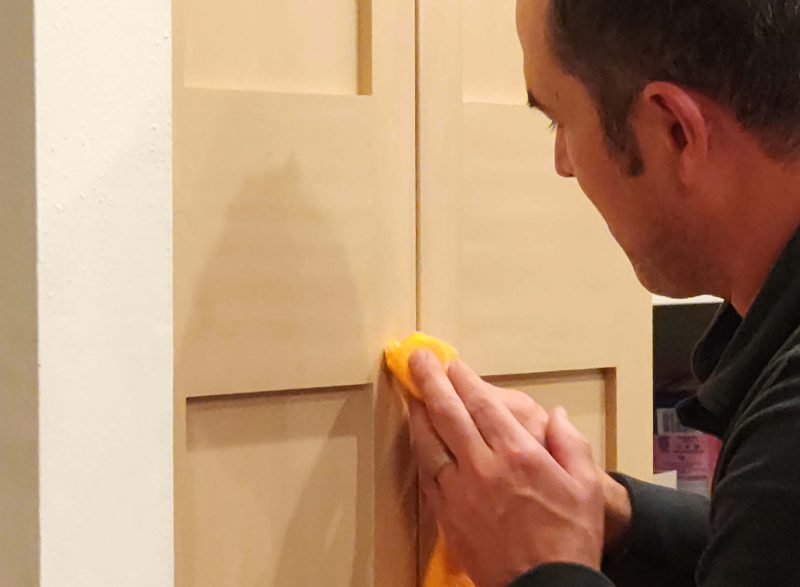
We thought the saga had ended, but the doors still didn’t work well. Jimmy came back to evaluate why they didn’t work as they should. After repeatedly opening and closing the doors using a variety of pulling/pushing touchpoints, he determined that moving the door pulls from the outer door panels to the inner panels would provide a different torque and would solve the problem. The downside: it would leave visible door pull installation holes on the outer door panels (more unnecessary holes on our doors!), but he thought he could fix that. He decided to try fixing one hole before drilling new ones. (Good idea.) Here he is, matching colors and applying them, blending them, smoothing them, etc.
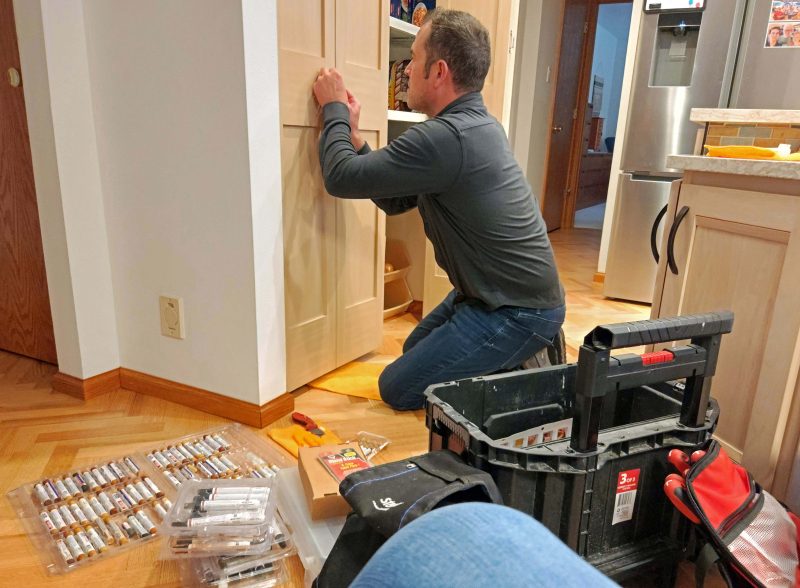
In the photo below, he’s smoothing the lower hole. The upper hole is invisible, so he did a good job. It took him about an hour to get the right blend on the first hole; in another hour, he finished all three of the other holes. Twenty more minutes covered drilling new holes and re-installing the door pulls. Again, Jimmy is a good guy. He didn’t charge us for all those hours Tommy put in correcting and adjusting Mike’s errors, nor for the new door hardware. From what Tommy said (he was a talker), Christopher now knows that he should not leave a mentee alone on a job.
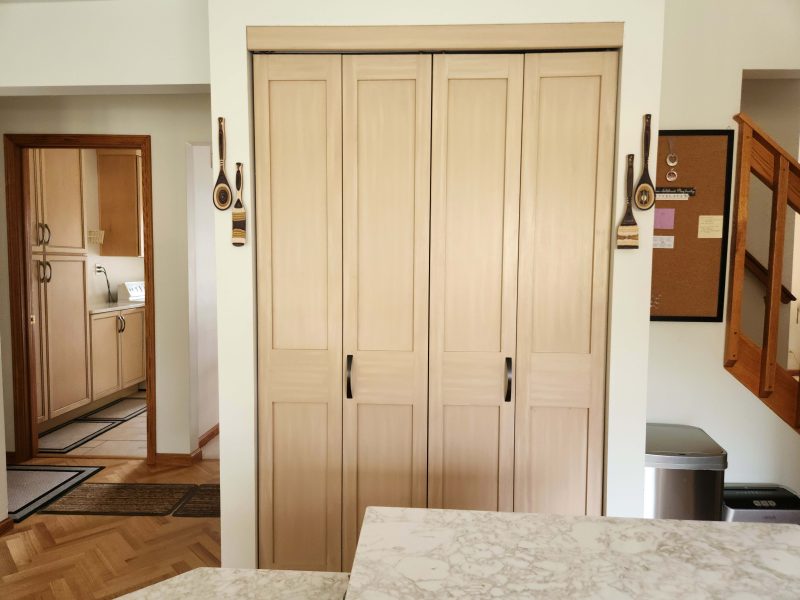
Everything works. The doors look nice. Ted and I are still disappointed with the process, but we accept the solutions. If you don’t know the saga (too late!), you won’t notice that anything was wrong. Ted and I have chosen to believe that, sometimes, things just go wrong, and this time it happened to us. Neither of us thinks it would be more fair if it had happened to someone else. Jimmy and Tommy did everything they could to make things right at the company’s expense, and it’s all good in the end. Don’t the new pantry doors look nice?
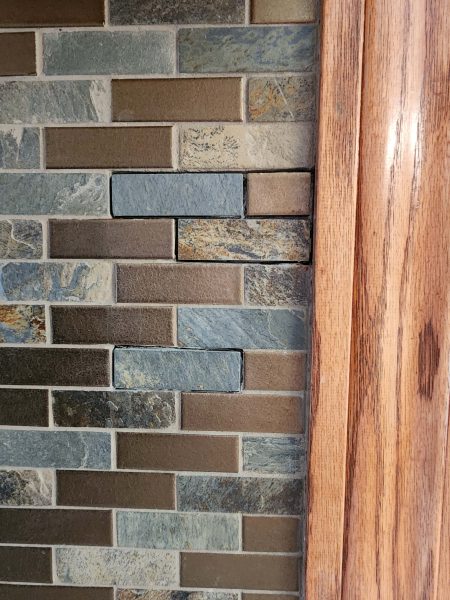
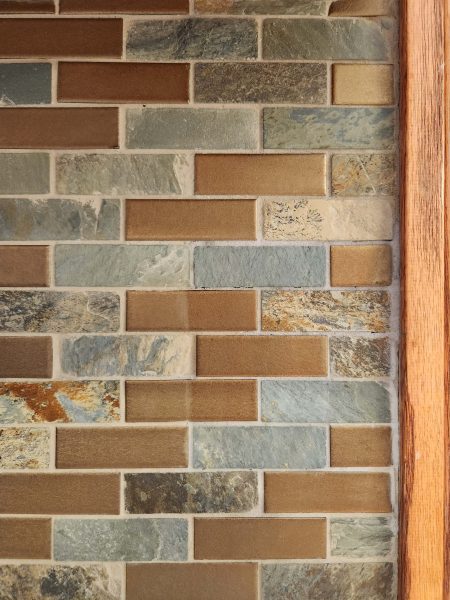
As long as we were going to have carpenters in the house, we added a little job to their list. Earlier this year, Ted and I disconnected our landline telephone. The problem: the white phone plate was still attached to the wall and it covered the hole where the phone line came in from outside. Fortunately, we have extra tiles from our 2023 kitchen backsplash update. The guys chipped out 4 tiles and replaced them.
After the grout was applied, you’d never know we had a landline on that wall, except that, out of habit, when we come home, we still look at that corner to see if the answering machine light is blinking with a message.
Ted and I are old enough to remember having the first phone installed in our parents’ homes, party lines, crank phones, dial telephones, long distance charges that were cheaper after 7:00 p.m., collect calls, person-to-person calls, pay phones, princess-style phones, wall phones, phone cards to charge instead of putting change in a pay phone, finally being able to purchase a phone instead of paying “rent” to the phone company for it every month, having more than one phone in the house (we had six before dropping our land line), answering machines, car phones, cell phones, smart phones. . . . We must be really old!
When Ted and I updated our kitchen in 2023, we replaced all the cabinets, but we kept the original 46-year-old louvered pantry doors because we didn’t know what style of new doors we wanted. (The cabinet manufacturer did not make bifold doors.) If we could see the new cabinets in place, we thought it would help us decide what kind of doors would look nice with them. Unfortunately, that didn’t help at all. Searching websites for bifold doors didn’t help either. The doors we liked were not bifold, and sliding or swinging panel doors were not an option, given the space we have to access the pantry. As time went on, the old, louvered doors looked worse and worse to us and more out of place with the new cabinets, but we still hadn’t seen anything we liked.
One night, I was reading a book and descriptions of the house in the story kept mentioning shaker doors and shaker cabinets, etc. If “shaker” was going to come up so often in the story, I needed to know what kind of picture to put in my mind while I was reading, so I searched for images of shaker doors. When I saw them, I showed the images to Ted, and bingo! They were just what we needed to complement our cabinet doors. The problem: all the doors came primed, unfinished, or finished with a color we didn’t like. Before we could move ahead and order the doors, we needed to decide how to finish them. When we pictured a uniform coat of paint, it seemed like a huge, 4×8 blank, block-like look, and we didn’t want that.
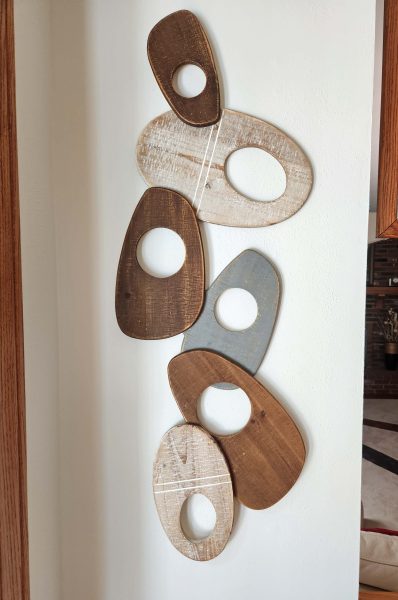
As I was looking around our kitchen one day, my eyes fell on the light parts of this wall sculpture we have, and a light bulb went off in my mind. I held the light pieces over our louvered doors and against the wall paint, then against one of the kitchen cabinets, and it looked good. Whitewash, I thought. That’s the finished look we needed! It would be more visually interesting than solid-color doors.
It wasn’t that easy. We took the sculpture with us to select paint samples that would look nice with a whitewash over them, but we didn’t like any of them. I contacted some painters for guidance–and perhaps a quote to do the job for us–but they didn’t seem to know what we were talking about. How tough is it to put on a decorative coat of paint? Did we really think we could do this?
Next, we went to an art studio for help, but they specialized in decorative glass and metal pieces, not walls or furniture. No one seemed to have any idea who else we could ask, and we didn’t want to order the doors until we knew how to finish them. Lacking in-person guidance, I went to YouTube to look for whitewashing videos, hoping for a clue. There were a lot of videos about whitewashing, but except for learning that the paints need to be diluted with water, I didn’t see any finishes that looked like what I had in mind.
While I was searching, however, I came across a video with “colorwashing” in the title, so I clicked on it. It was closer to what I was looking for, but the lady was painting walls, and that wasn’t the look we wanted. Still, that gave me a new word to search: colorwash. Whitewashing videos far outnumber colorwashing videos, but I came across two that were doing what I knew Ted and I wanted to do. I played them, took screen shots, and made notes. (Once a student, always a student.) Feeling confident we could handle this, Ted and I ordered bifold, unfinished shaker doors. We wanted to finish the doors at least two weeks before the carpenters arrived to start our laundry room update so that the paint would be completely dry and wouldn’t chip easily if it bumped against something during the installation process. We had to get going.
And then the stress began. The doors were pretty expensive, and neither Ted nor I come close to being described as “artistic.” I can draw stick people, line outlines of a small house, and trees like first-graders draw them–a brown stem with a green cloud-like top. Ted might not be even that good, so I started getting stressed about how the responsibility of artistically finishing the doors might fall on me and how I might ruin expensive doors. Then I remembered something my mom used to say: “The only things I don’t know how to do, I just haven’t learned yet.” That’s a good axiom. I decided take Mom’s advice and to give colorwashing a try.
The videos mentioned that practicing before doing the real thing is a good idea. I definitely agree, so we went to Home Depot and asked where we could find a flat, naked piece of wood smaller than a 4×8 sheet of plywood. The man walked us to the back corner of the store, pulled a sheet of wood about 18 inches by 4 feet out of a large trash can, and handed it to me. There were no tags to scan, so I asked him, “How much?” All the wood in the trash can was scrap lumber, so it was free. Great!
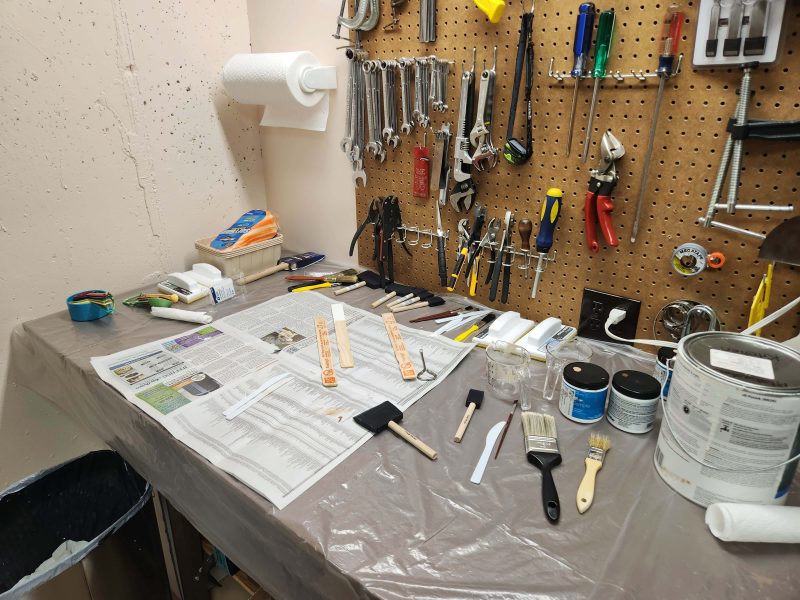
The first thing we had to do was select a color for the base paint and a color for the wash paint. We also bought the supplies the video told me we’d need: regular and feathering paint brushes, small containers to mix the paint and water, measuring cups/spoons to measure the proportion of water to paint so we could repeat it for the next batch, etc. We started with sample-size cans of paint in case we had chosen the wrong colors. (Remember, not artists.)
Spoiler alert: Step-by-step instructions of our mistakes and successes follow, just in case we forget how to do it another time in the future.
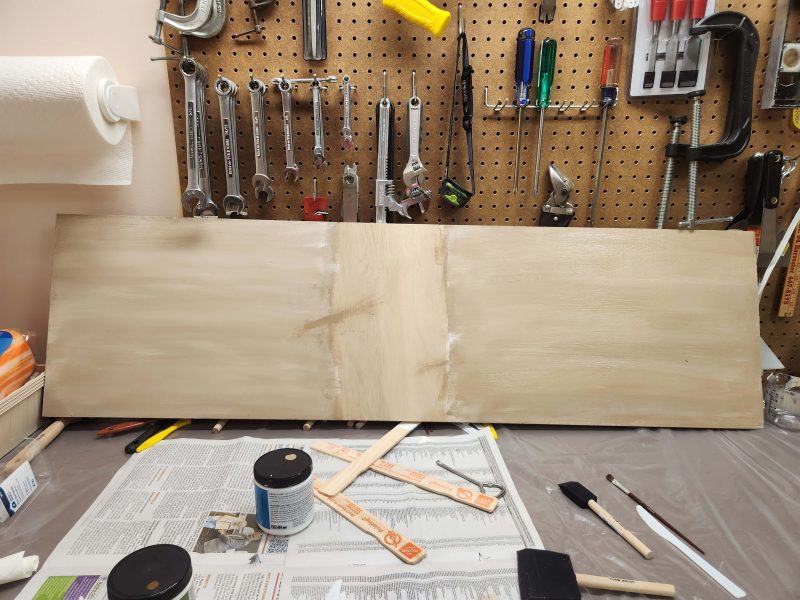
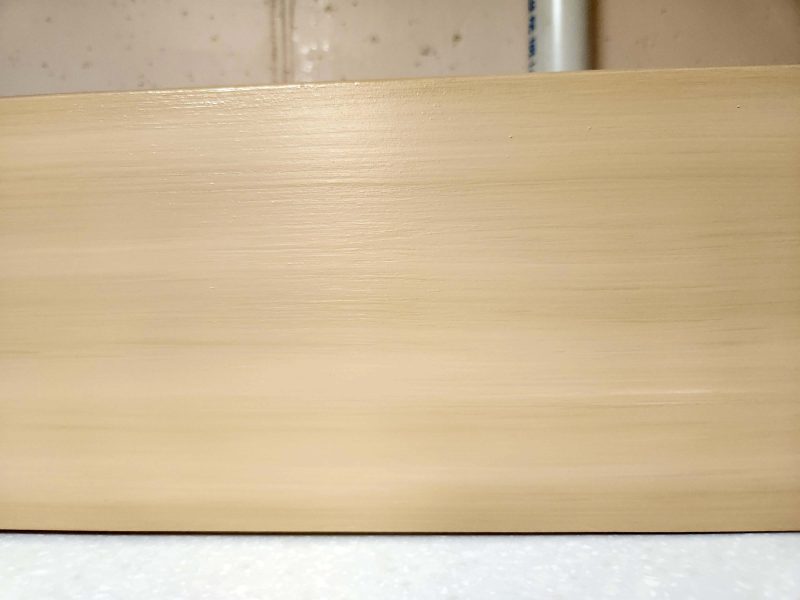
We started by putting two coats of the base color on our Home Depot practice board.
We tried different water-to-paint ratios and different brush strokes. Some on-line advice suggested a 3-to-1 ratio of paint to water, but that was too runny. After several tries, using a quarter-cup of base paint and gradually adding fractions of a teaspoon of water to the wash paint, we liked the look and the working viscosity of the paint with a wash ratio of 12 parts paint to 1 part water–a long way from 3-to-1!
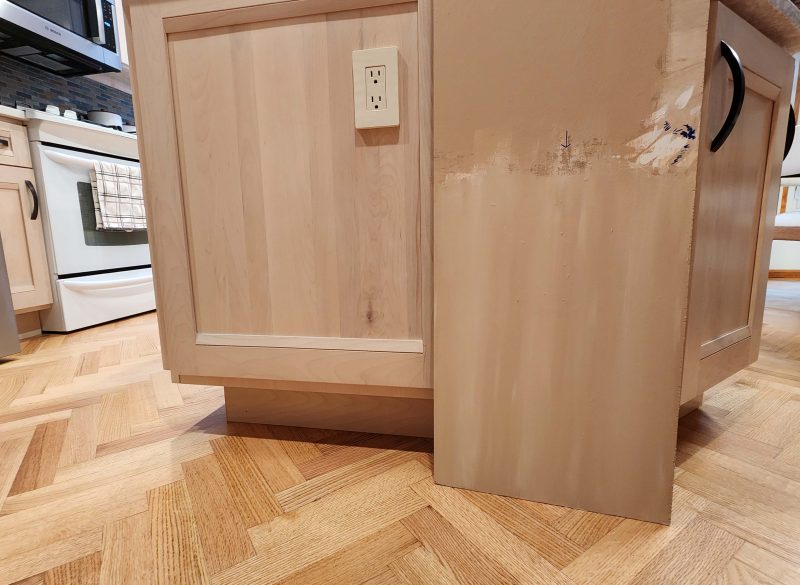
When we thought we were close, we took the sample board to the kitchen to check the color match. Not good. It was far too yellow.
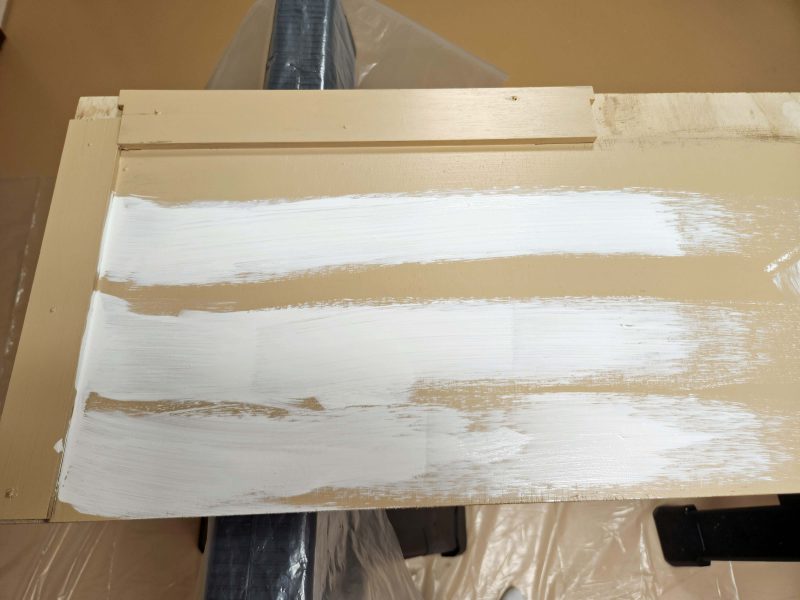
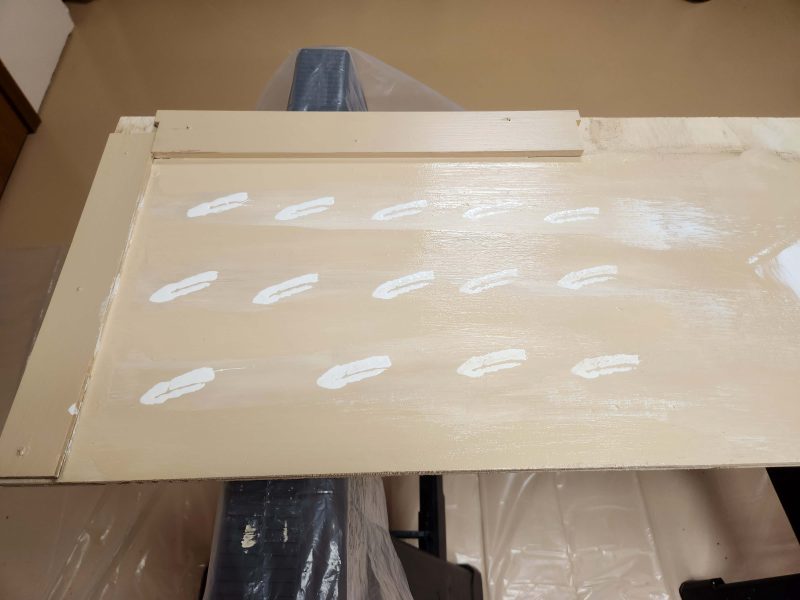
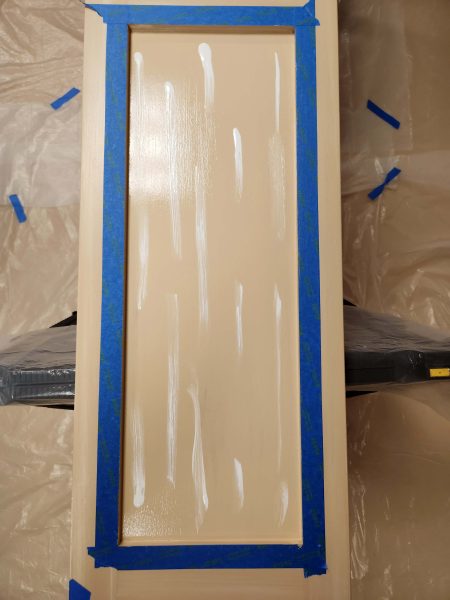
To get rid of the yellow cast, we decided to experiment with the extra-white ceiling paint left over from our 2022 house update. First, we brushed alternating columns of white over the dry base color.
That didn’t work because the wet paint couldn’t blend with the dry paint, so we got stripes instead of a faux wood-grain look.
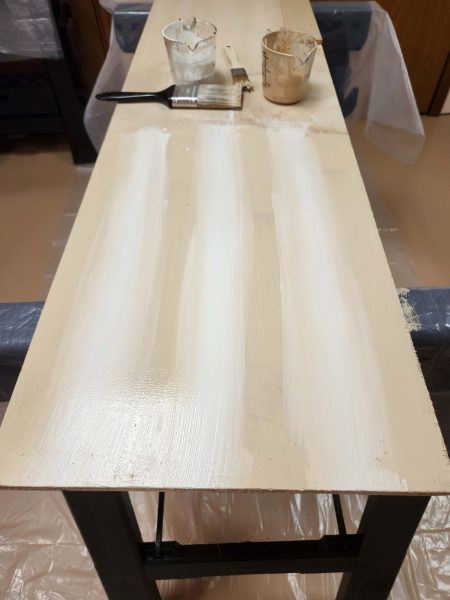
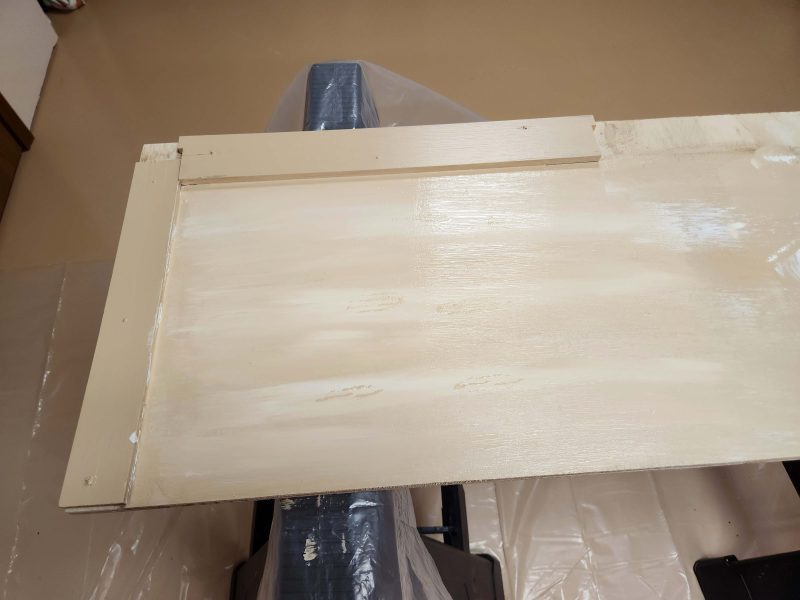
Then we tried it again with a fresh coat of wet base paint.
The wet-on-wet was better, but still turned out too stripe-y, so we tried dashes made by tapping the end of the paint brush on the wood.
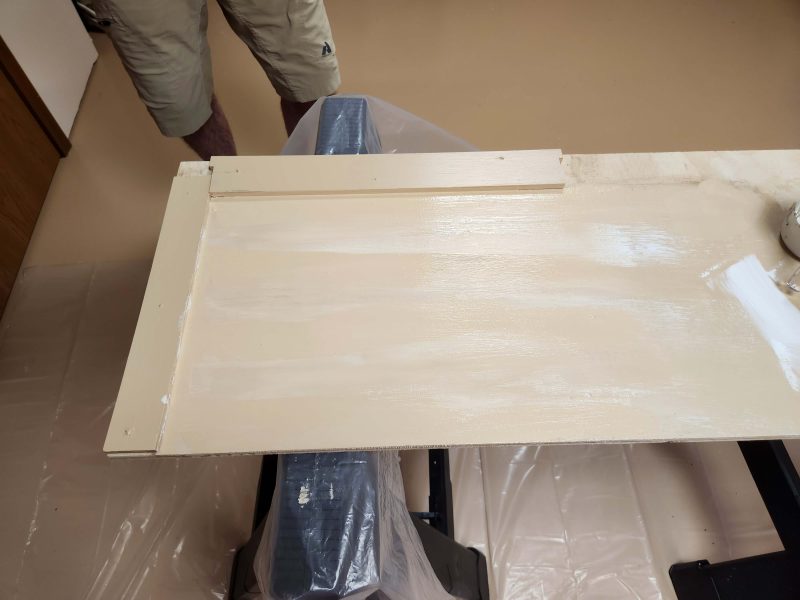
That also looked too much like white stripes and was too white instead of evenly blended with the base color. While that paint was still wet, we dotted the white stripes with some of the base color and blended that in.
Not bad. That helped. The color looks better, but the stripes are still too visible and the finished look is too white. We went back to the practice board, re-painted it with the base color, and tried some other techniques. We soon lost count of how many coats of trial paint we applied to both sides of the practice board.
We’d been wondering if it would add visual interest to the doors if we painted the inside of the door trim edges dark brown. We found a can of brown paint left over from another project and tried it.
After days of experimenting with methods of how much to thin the paint, how much of each color to use, how to apply the wash color, and how to satisfactorily blend the two colors, we decided we were close enough to give colorwashing a go, but to be safe, we’d begin by working on the back side of one door. The only way to see the color on the back of the doors after they’re installed is to remove them and turn them around. If the colorwashing didn’t work, we could just paint over it with the base color again–our original plan for the back sides.
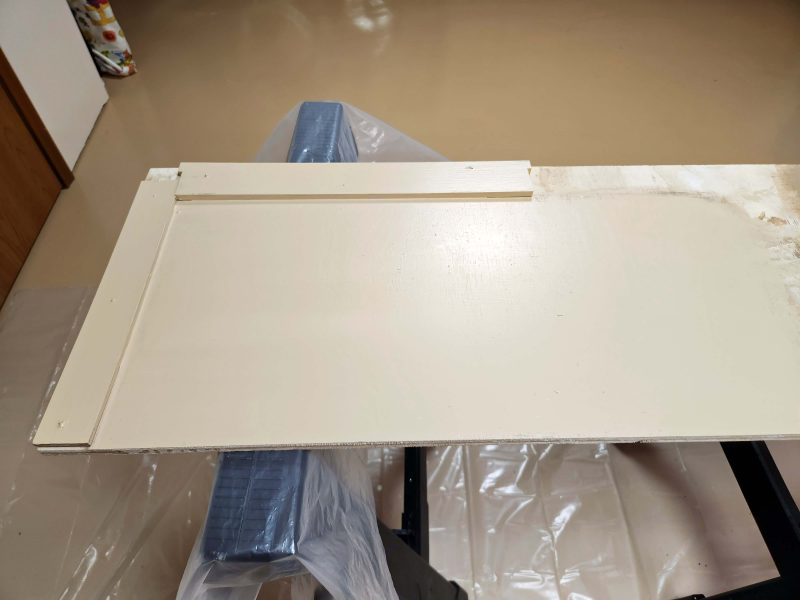
Good-bye, practice board. We went back to the basement and put two coats of the base color on both sides of the doors.
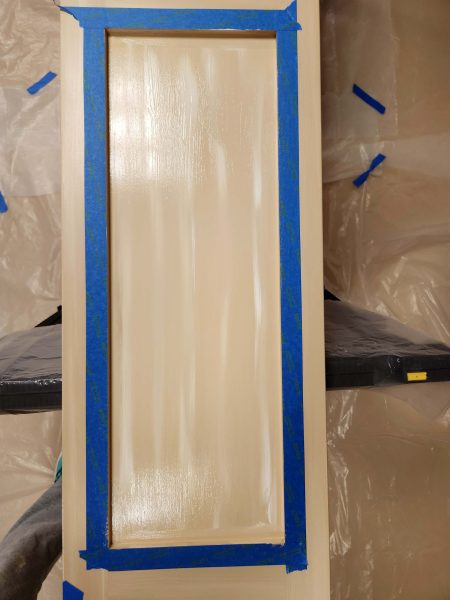
Working on the back side, we decided to try staggering, narrower streaks of white to avoid the striped look we’d been getting.
Staggered wet white on the wet base color is looking good. Keep blending.
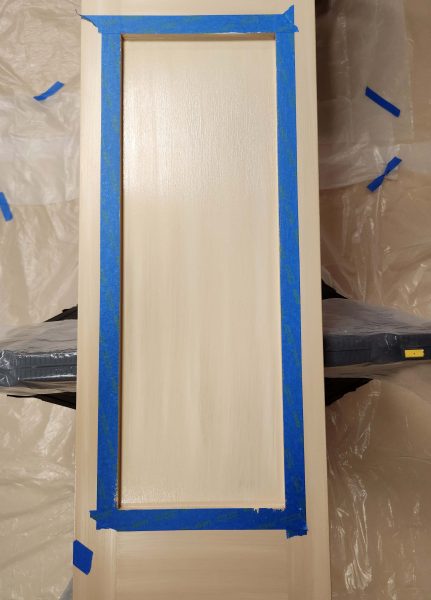
There we go! Success! Just a little more blending is needed.
Our practice board pattern and color looked good when we compared it to the kitchen cabinet doors, and the back of this door matches it, Great!
We wanted to try the brown trim in a more realistic form than the practice board.
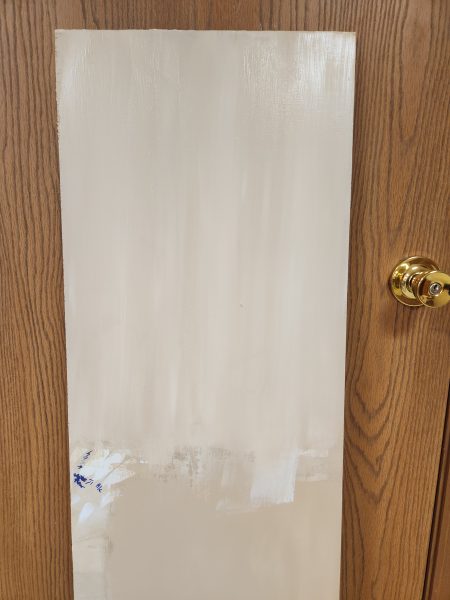
We only did the lower half of the door–again, because it was the back side and it was going to be re-painted in the base color anyway. We took it upstairs to see how the colorwash and the brown accent paint looked with the cabinets. The conclusion: the colorwash is satisfactory; the brown trim is a no-go.
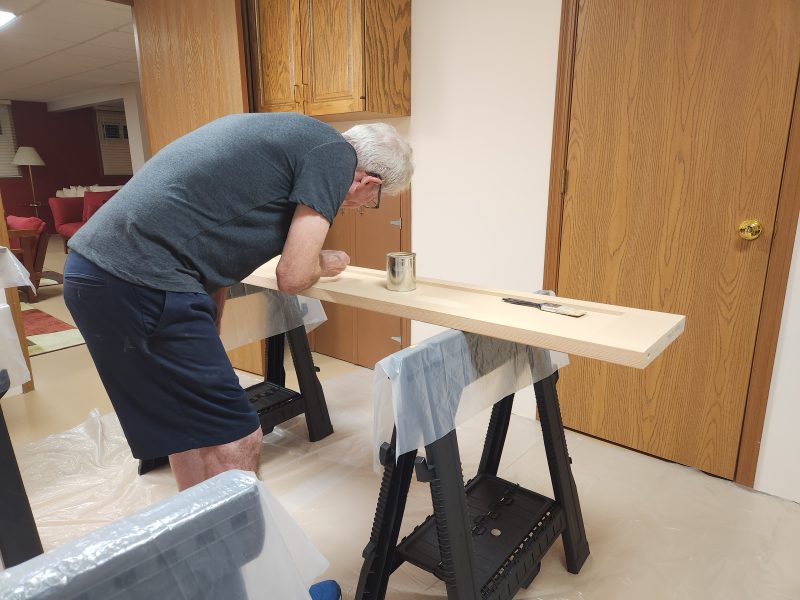
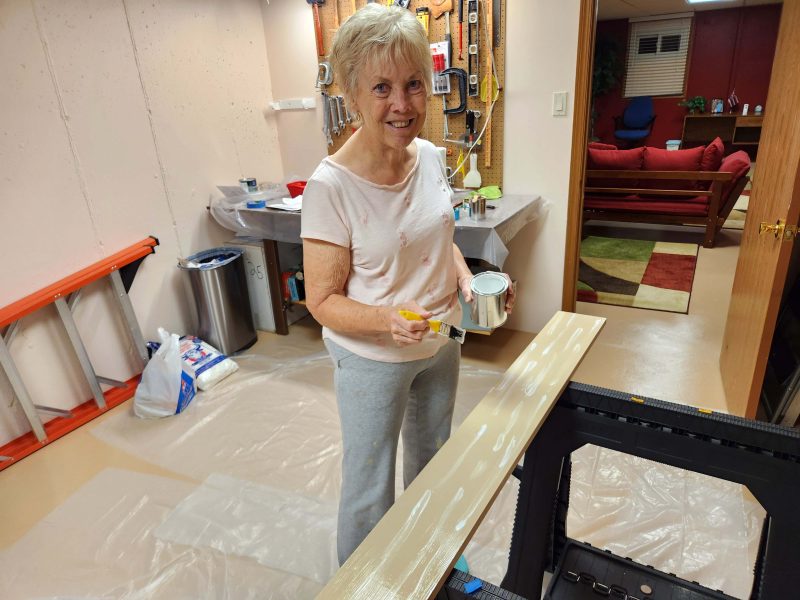
We went back to the basement to paint over that back side and to start colorwashing the front sides of all the doors. We decided to do the long, narrow outer trim strips first because we thought they’d be the easiest.
The blue tape left nice clean lines to colorwash in a horizontal direction next.
When we finished the front of one door, we pulled out one of the kitchen drawers to check our color match. Awesome!
With everything figured out and working well, we could really get moving. Here’s Ted painting the base color on the inner trim.
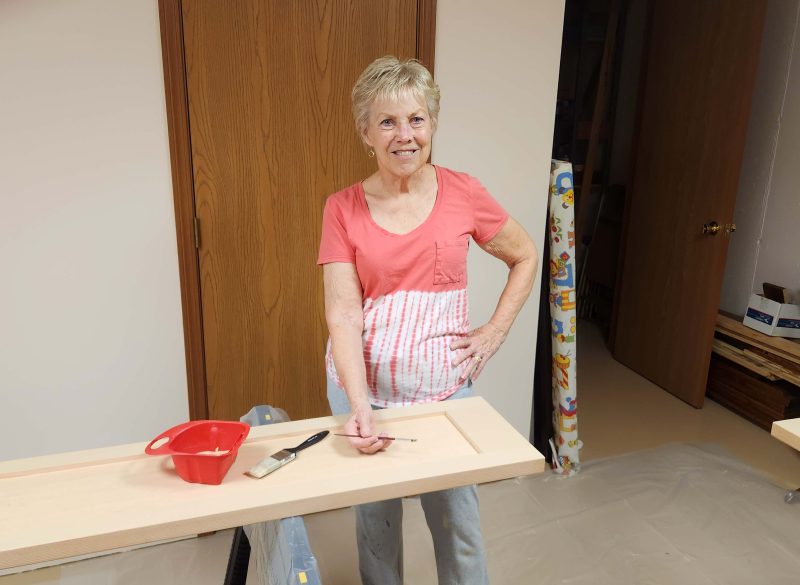
My job was to paint a skinny white line along that raised edge and then to blend it with Ted’s base color to colorwash the inside trim.
It took us about ten days to get from our first practice board trial to the last of the colorwash. Once we figured everything out, we averaged about an hour per door (front side only), including taping, painting, and colorwashing. We did the same thing on all four doors at once, then let the paint dry overnight so we could tape off the next section. It took three days to finish all four doors–vertical panels one day, horizontal panels the next, and inner flat surfaces last at just over an hour per day. After all the stress I suffered, what a breeze! Another thing my mom used to say was that anything you know how to do is easy. Right on, Mom!
The doors are finished. Here I am, colorwashing the header that conceals the track from which the doors are hung.
This is the finished header trim. The camera picks up every detail. It actually looks far less striped in person.
We did a (slightly) better job of colorwashing in some places than in others, so we arranged the doors in the order we wanted them hung and numbered them. That put the less-than-perfect areas in the shadow of the island and the best areas in the daylight. (Clever, huh?)
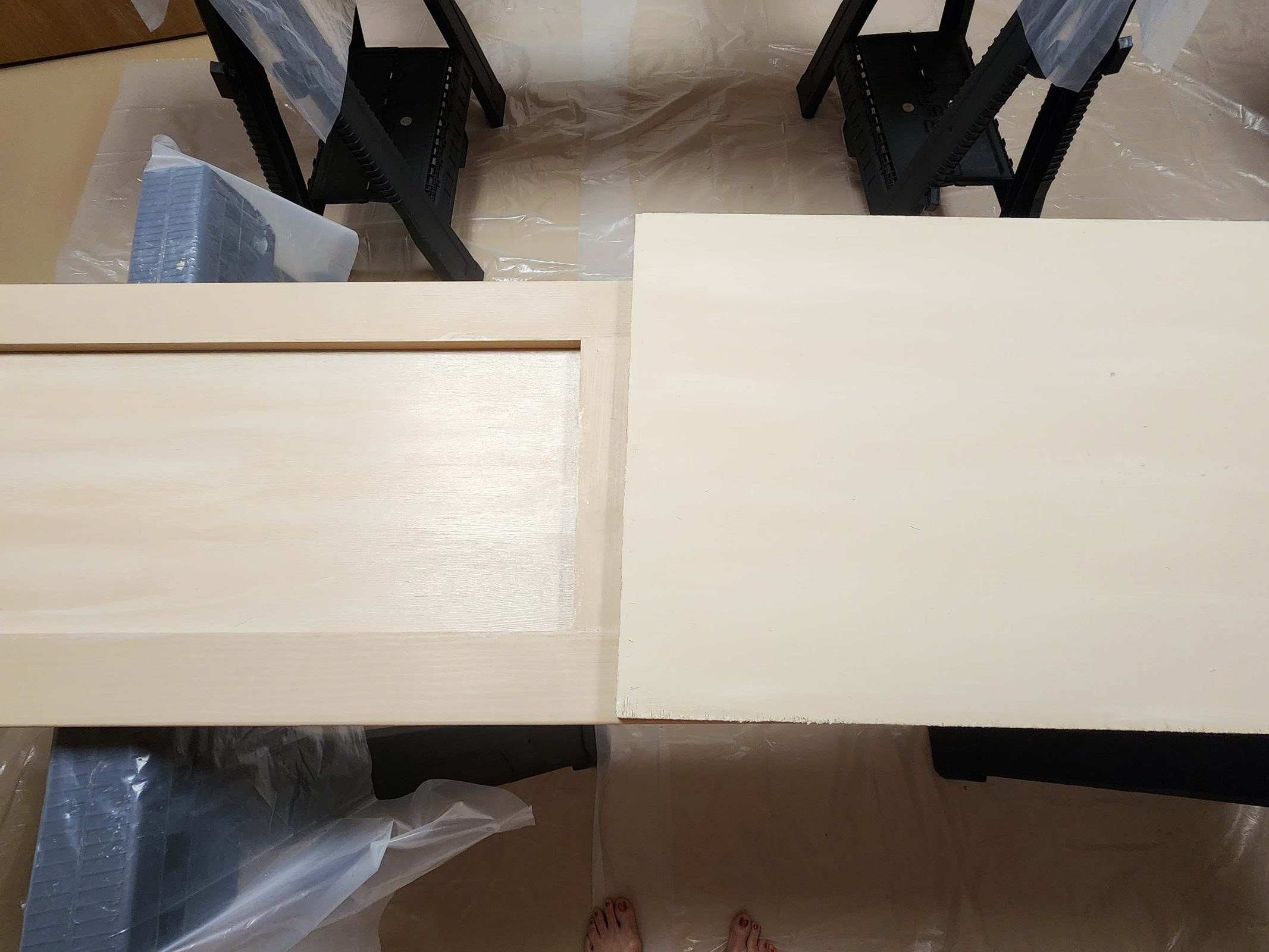
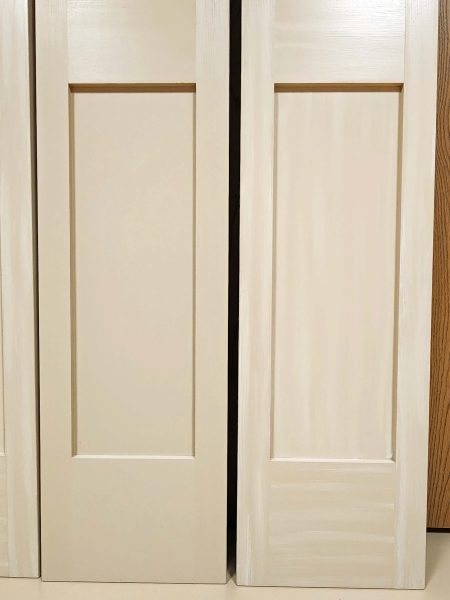
The door on the left is a back side with the base color. The door on the right is colorwashed.
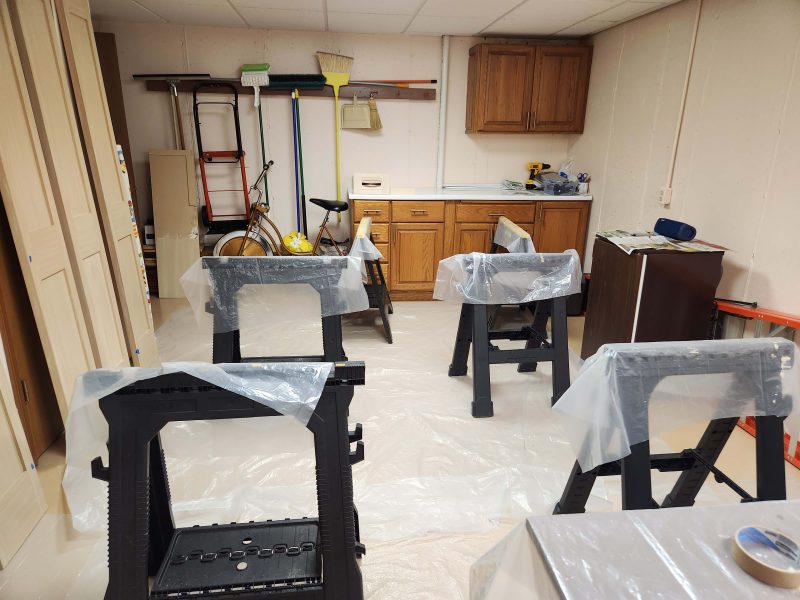
We’re finished! It’s time to put away the sawbucks and the painting tools.
When everything was cleaned up, we celebrated by taking a walk along the riverfront in St. Charles and stopping for hot fudge sundaes at Kilwin’s. Mm-mm good!
As Mom said, anything you know how to do is easy. Now Ted and I know how to apply a colorwash. Need help with your project? Give us a call. 🙂
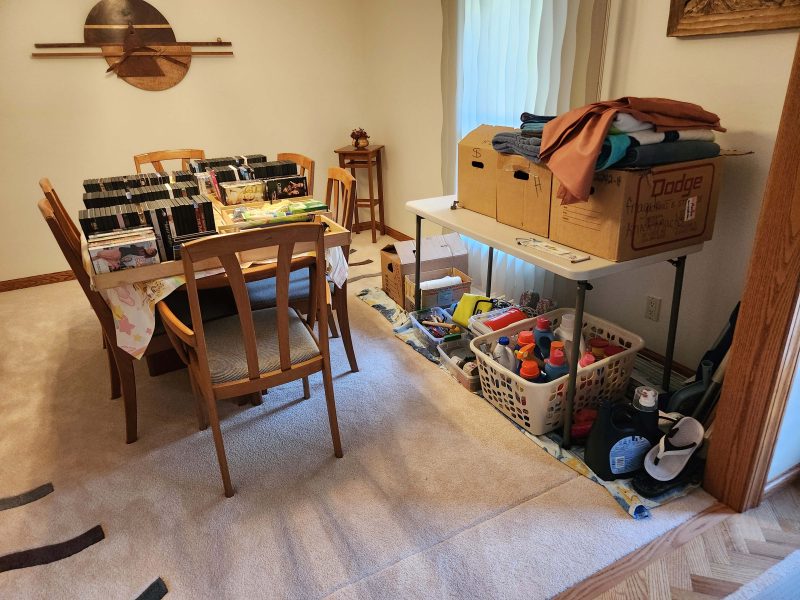
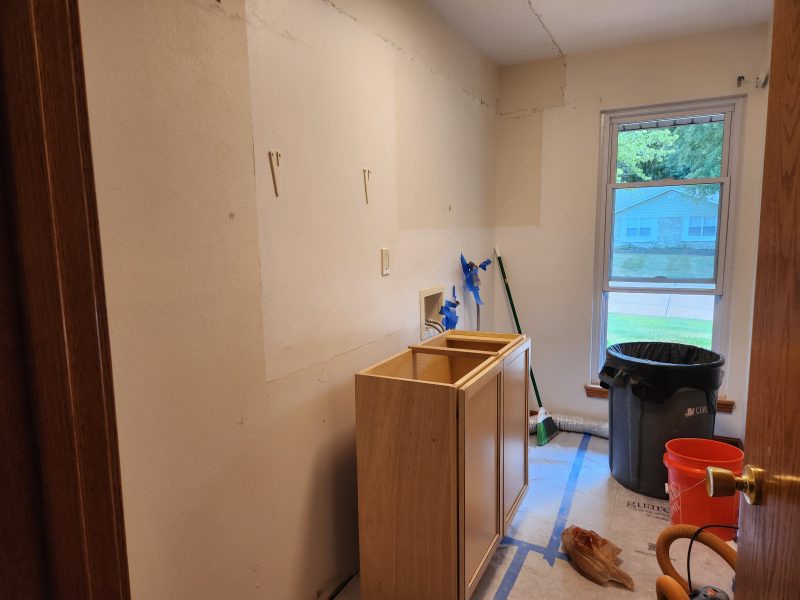
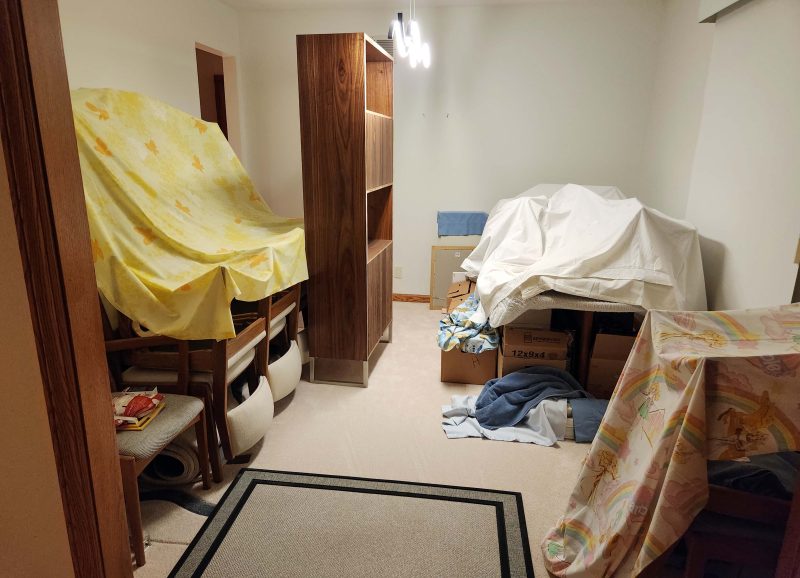
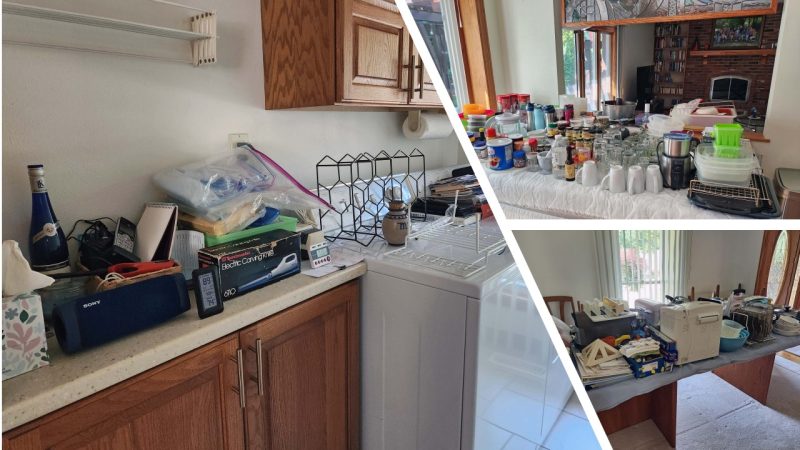
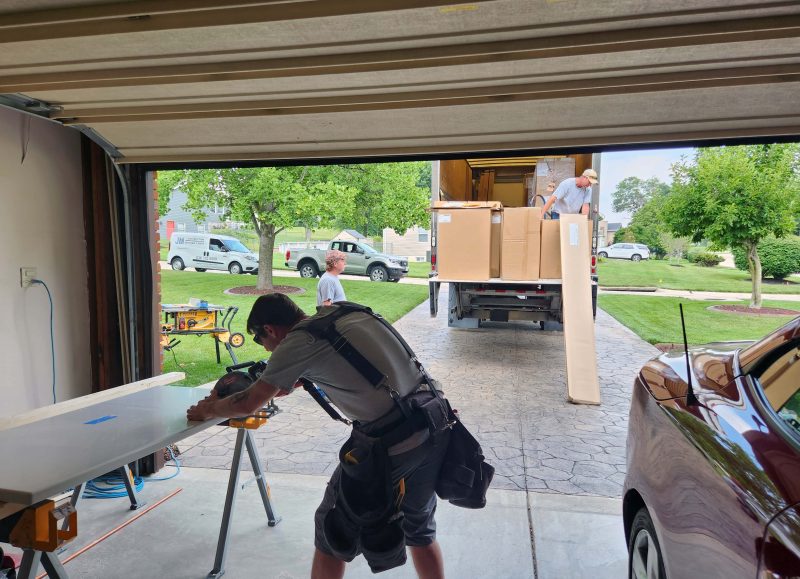
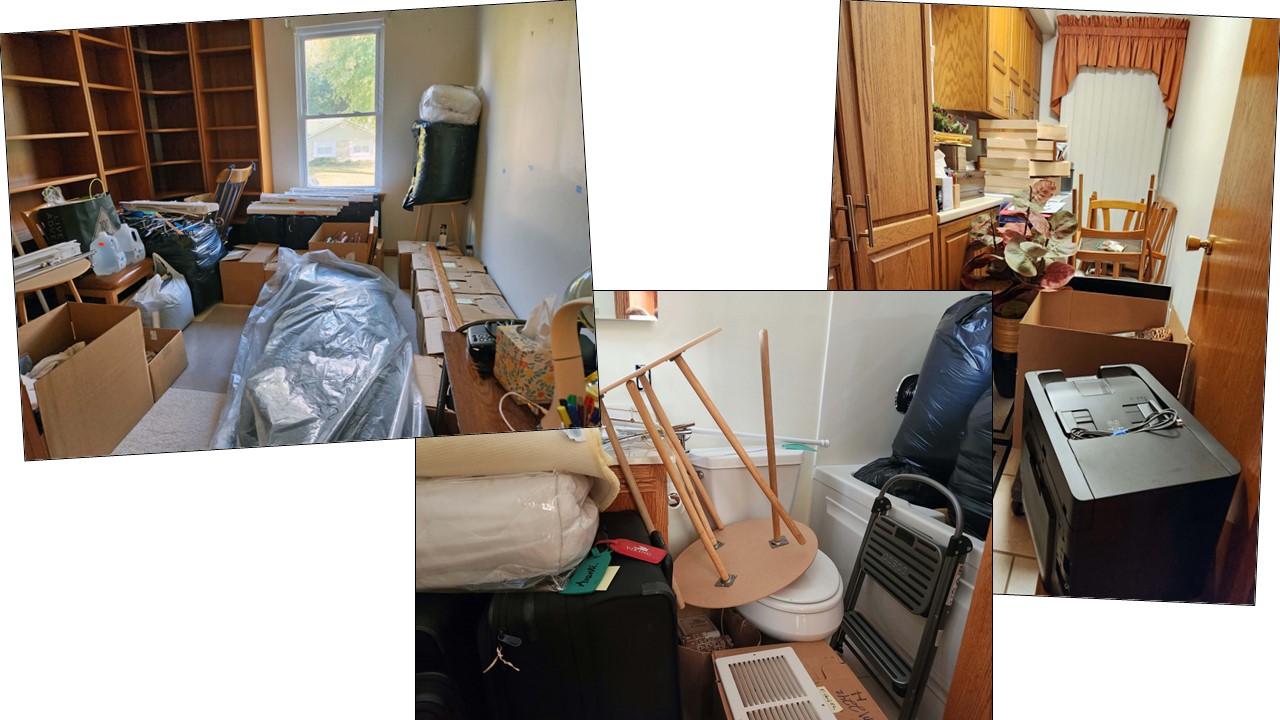
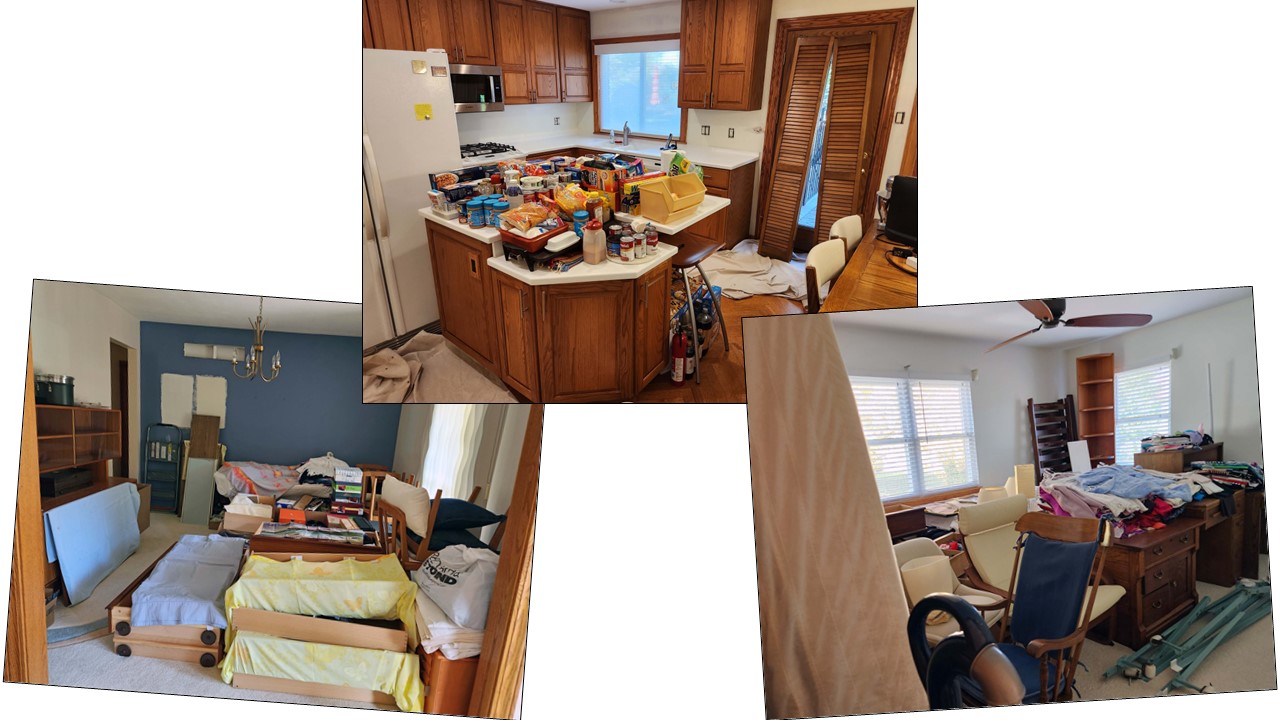
The laundry room was the last room to update in our house. We started in the usual way: empty the room and put everything in the dining room. When carpenters are working at our house, we always park our cars on the street so they can put their tool-filled trucks and their saws in the driveway. They store the supplies–and, this time, our washer and dryer–in the garage.
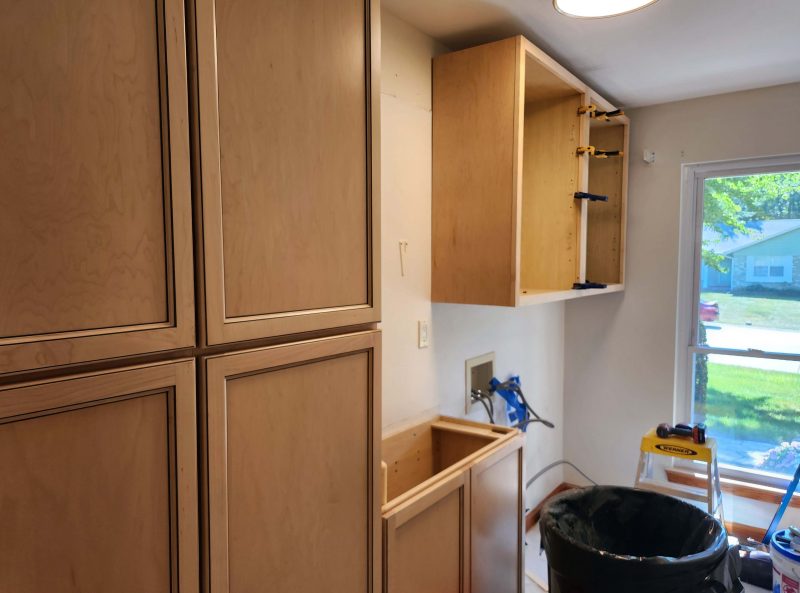
We wanted to extend our cabinets to the ceiling, so after removing the old cabinets, the first job was to remove the soffit. We were all surprised to see that the walls and the ceiling behind and above the soffit were already covered with drywall. That meant a discount on our cost. Yay! At the end of the first day, the carpenters, Christopher and Mike, brought one of the new cabinets indoors.
The next day, they brought in the remaining units and started installing them.
This is what our old utility cabinets looked like. One side provided storage for brooms, mops, etc.; the other side had eight drawers, most of which were filled with DVDs. We made it clear during the design process that we wanted the same design in the new cabinets, but . . .
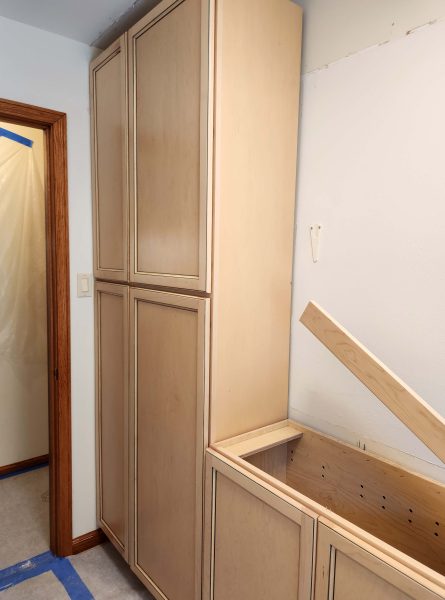
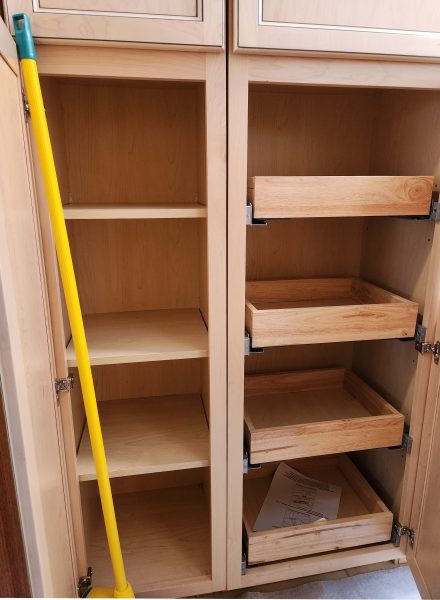
. . . this is what we discovered when we opened the new cabinet doors. We expected two tall cabinets topped by two short cabinets. Instead, we saw four identical cabinets stacked and fastened together with an installed shelf (the wide horizontal bar) between the two units. The installed shelf made it impossible to simply remove shelves to make mop and broom space or to add additional drawers. Even if we could have done that, the doors wouldn’t align with the taller spaces in the lower units.
The left cabinet was 6-8 inches too short for brooms. (The broom is standing on the floor, not inside the cabinet.) Then we were told that manufacturers are moving away from customized cabinets. Really? It wasn’t a problem ordering our 1999 kitchen and laundry cabinets to size, nor was it a problem to order our 2023 kitchen cabinets to size within a 3-inch range (30, 33, 36 inches, etc.). Could it be that this particular manufacturer did not build custom-sized cabinets?
What to do? Jimmy, the owner/contractor sells high-quality merchandise, and we’ve always been pleased with what we’ve had him install–until now. We told Christopher and Mike that these cabinets were not what we made clear we wanted and thought we had ordered. They were useless to us because the mops and brooms wouldn’t fit, and there weren’t enough drawers for our DVDs. Without that storage space, we didn’t need these cabinets.
Christopher and Mike didn’t want to start installing cabinets if they’d just have to take them out later, so they called Jimmy. He came to the house soon after that with his master carpenter (34 years of experience), Tommy, to see what could be done to customize the unsatisfactory cabinets. The two of them talked for about 20 minutes and decided they could make us happy. We didn’t understand all the technical jargon, but the idea seemed feasible, so we gave them the go-ahead and the other carpenters went to work.
The next problem appeared when I started thinking about how I’d arrange our stuff in the cabinets with the extra room at the soffit-free ceiling. I noticed then that the cabinets only had one set of holes for shelf adjustments in the lower cabinet and only three sets of holes in the taller cabinets. Each set consisted of three holes drilled three inches apart (six-inch total distance). That meant I couldn’t store my laundry basket in the lower cabinet, where it’s always been, because the shelf adjustment holes were only in the centers of the side panels.
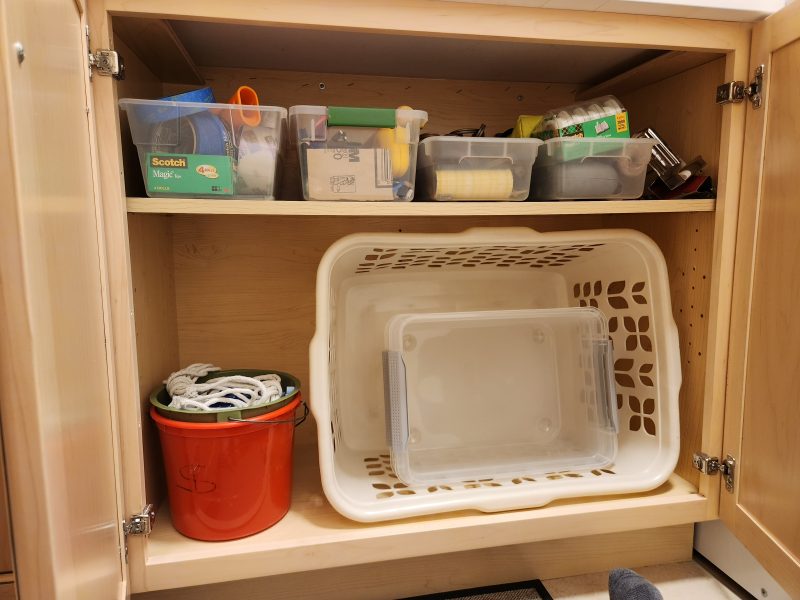
Ted and I don’t place our shelves evenly in our cabinets; we adjust the shelves according to what we store on each one. One or three sets of holes per cabinet was not good. Fortunately, the guys had a template they could use to drill holes any size and any distance apart, as desired, for shelf brackets. Go for it, guys! Now my laundry basket fits in the cabinet. Problem solved. If you zoom in, you can see the set of three holes inside at the right front of the cabinet and the strip of closer holes behind them. Note: the second plastic box from the left on the upper shelf is my “essential” toolbox.
The upper cabinets are installed. Note: This was the day of the ICE raid. Christopher, working on the upper cabinets, looked out the window and saw the law enforcement vehicles parking across the street.
Next step: install the trim at the tops of the cabinets.
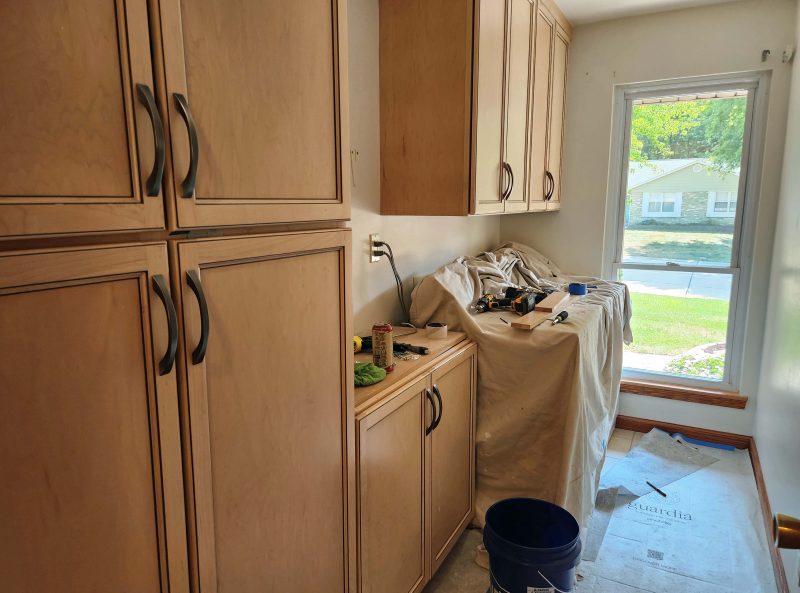
Door handles and trim: installed.
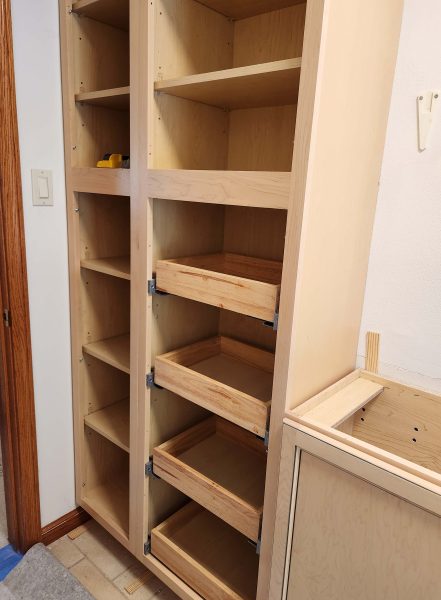
And now, the challenge. First, wait for the three additional drawers that needed to be ordered. When the drawers arrived, Tommy, the master carpenter worked to customize these so-called “utility” cabinets. The process sounds simple, but doing the job well to make it as attractive as possible took time.
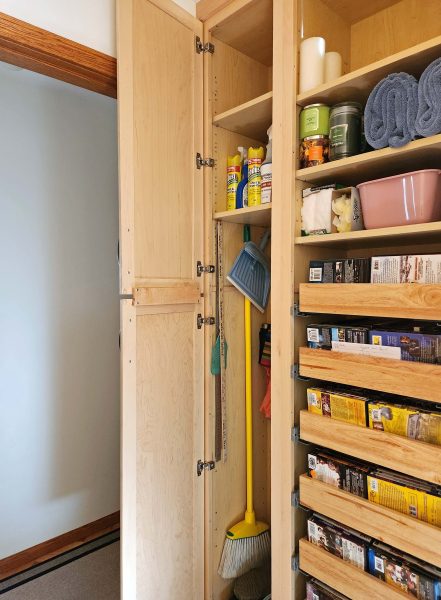
Tommy started by cutting out the horizontal shelving between the upper and lower cabinets. You can see the grooves in the side panels where the installed shelves used to be and the now-flush vertical scar in front of the left groove between the installed door hinges. That’s where he cut out the wide board that anchored the shelf in place and stabilized the joints between the upper and lower cabinets. Then he had to do some work to re-stabilize the cabinets. I wasn’t “snooper-vising” him, but I heard pounding.
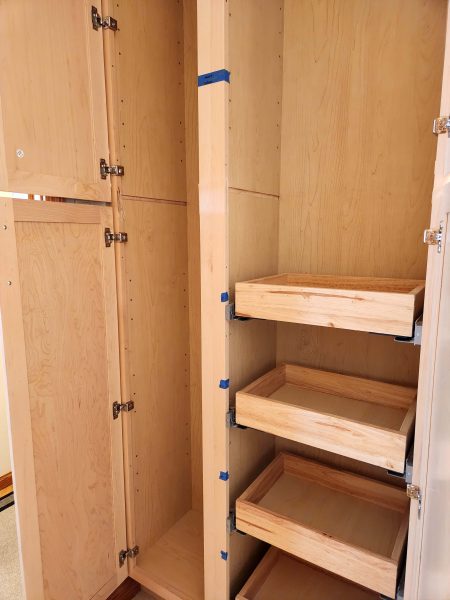
Next, he had to uninstall the top three drawers and remove the drawer slides. The bottom drawer was already as low as it could be to operate smoothly. Ted and I had previously figured out how far apart the drawers had to be placed so that our DVDs would fit in them without wasting space between drawers (see the blue tapes). To accommodate our measurements, Tommy re-installed those three drawer slides lower and then the three additional slides above them.
When that was finished, he used matching wood–from a shelf that was removed from the lower left cabinet that we knew we’d never use–to fasten the upper and lower doors together and to cover the empty space between them. The down side of this solution is that the upper and lower doors now open and close as a single unit.
Result: We have utility cabinets with room for brooms and mops, and drawers for DVD storage. The door arrangement is unusual, but it works.
Jimmy is a good guy. We’ve never had problems with his products or service before, so we had a private talk with him about how disappointed we felt. He apologized and told us it’s hard to find skilled carpenters, so he made the decision to hire younger carpenters and pair them with his more experienced carpenters, hoping the younger ones will continue working for him. He didn’t charge us for any of the extra customizing labor.
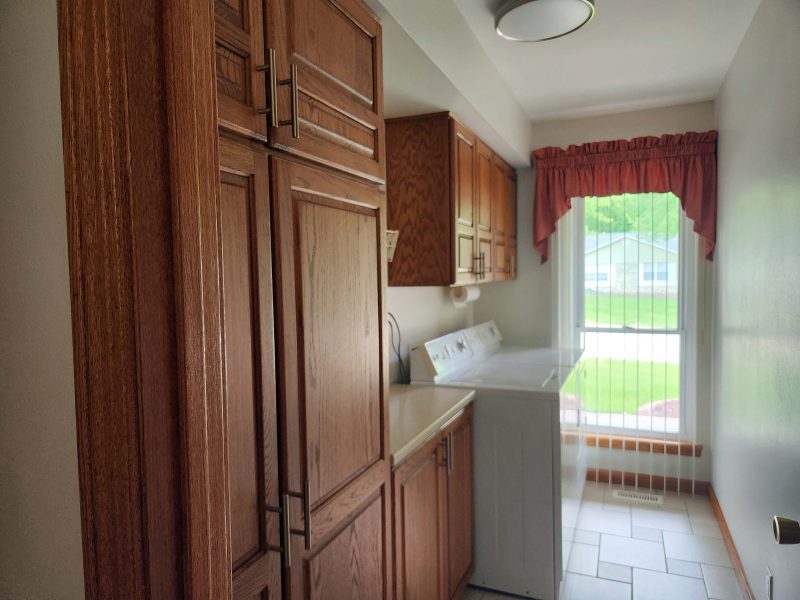
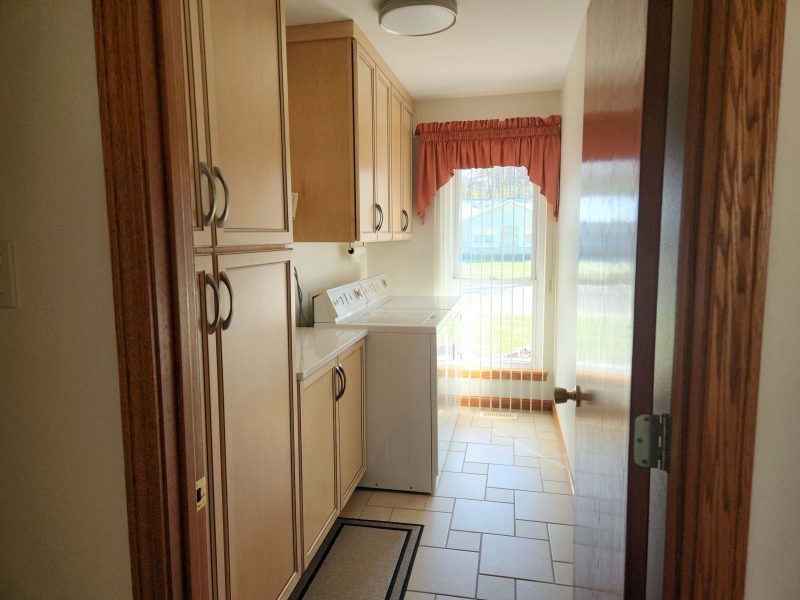
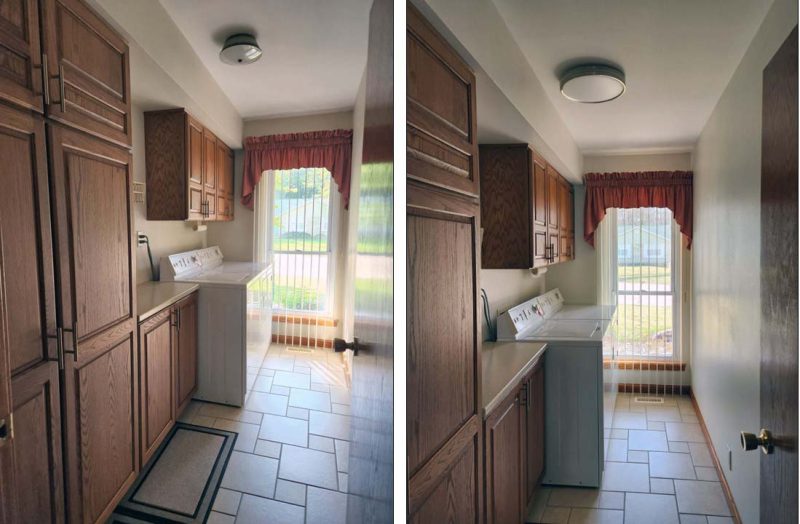
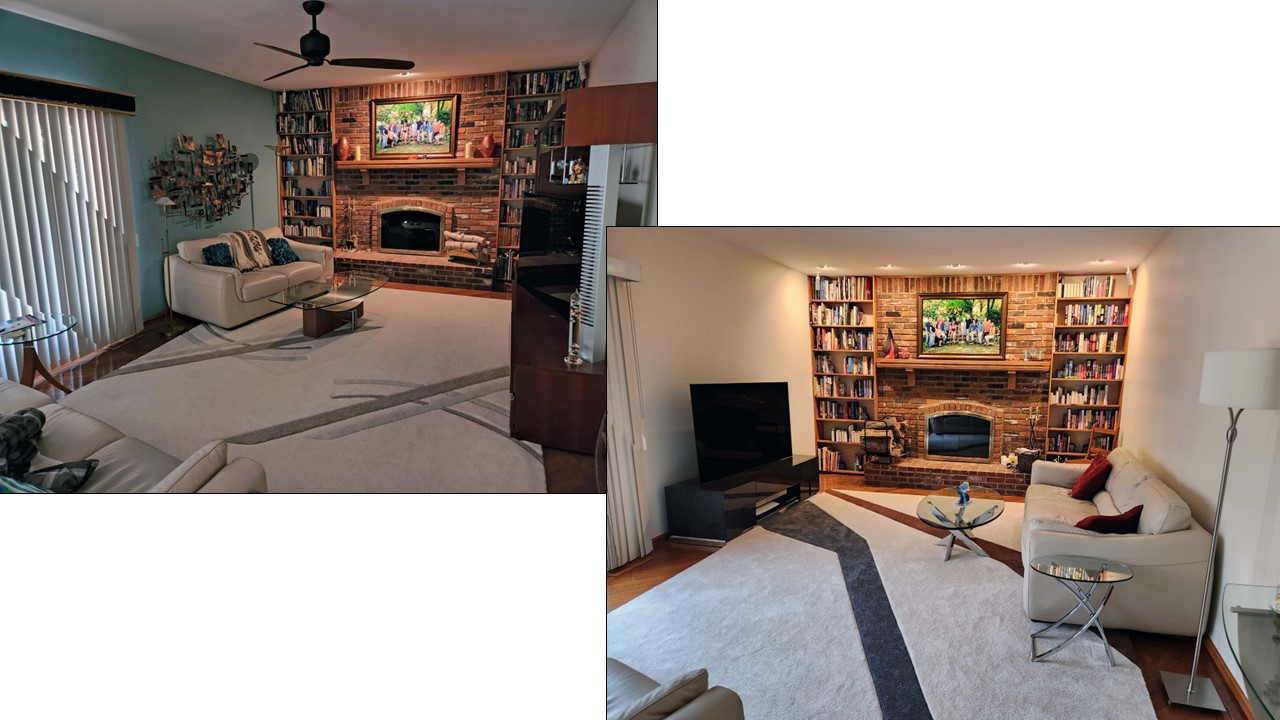
Here are photos of the c. 2000 laundry room and the 2025 laundry room. We definitely like the lighter, brighter new look.
The cabinets are new, but we still have our 30-yer-old Maytag washer and dryer. They just won’t quit working!
The laundry room and pantry door stories should come first, but the carpenters–who were doing all three jobs–finished the basement first, so that’s where I’m starting.
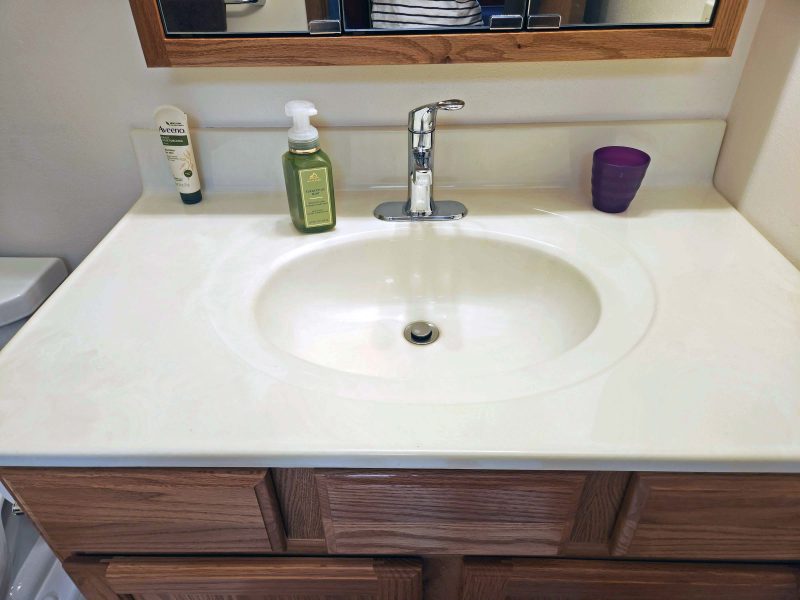
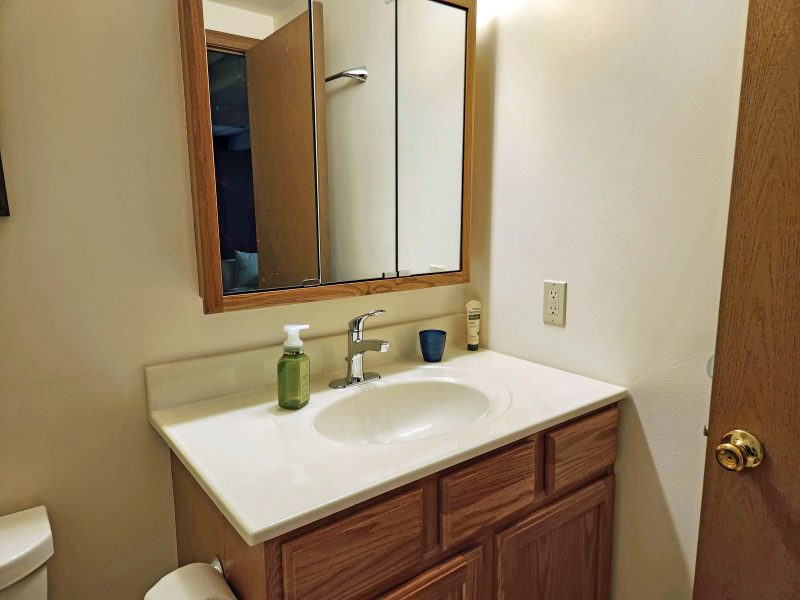
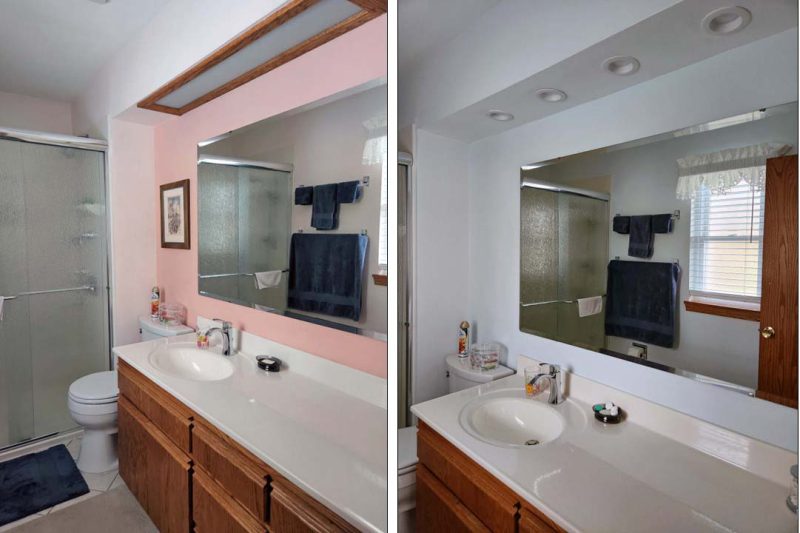
First, the basement bathroom. The sink in the next two pictures doesn’t look too bad but, in person, it had yellowed greatly and looked awful with the white tile floor, the white toilet, and the white shower. It was time for a new vanity top.
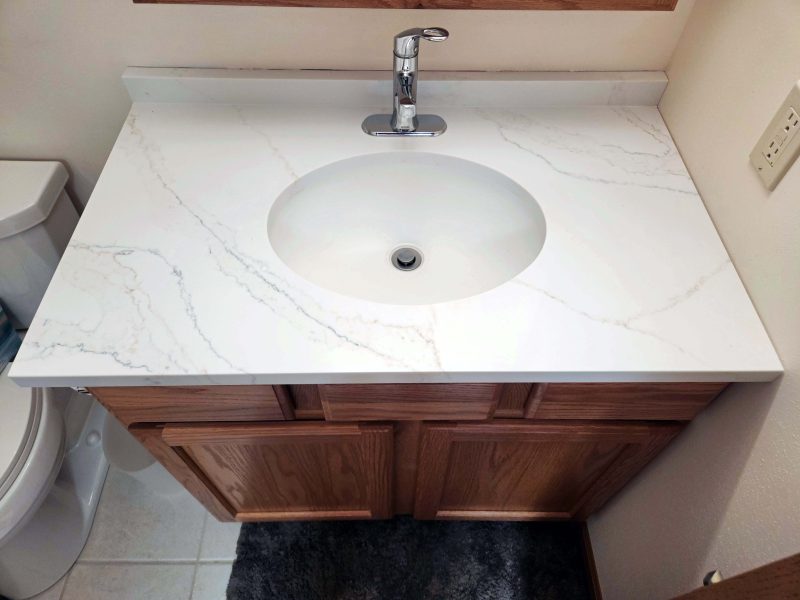
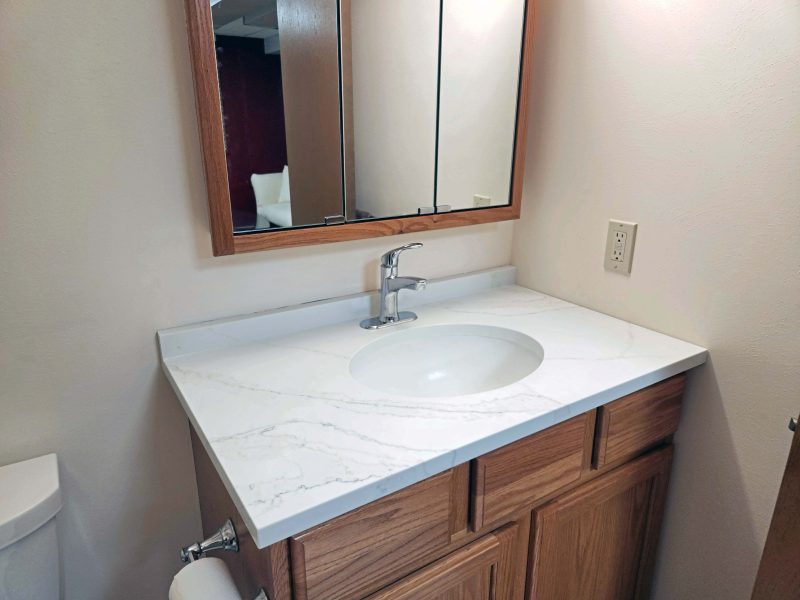
Our old sink was Corian; this time we chose quartz. While I was talking with the sales lady about the quartz top, she mentioned that the quartz used for countertops is not actually made of rock because quartz is not a rock. I tactfully did not correct her that quartz is, indeed, a real rock and that “quartz” countertops are fabricated to look like actual quartz rock. Here’s the not-real-quartz pattern we chose. It gives the bathroom a nice, fresh look.
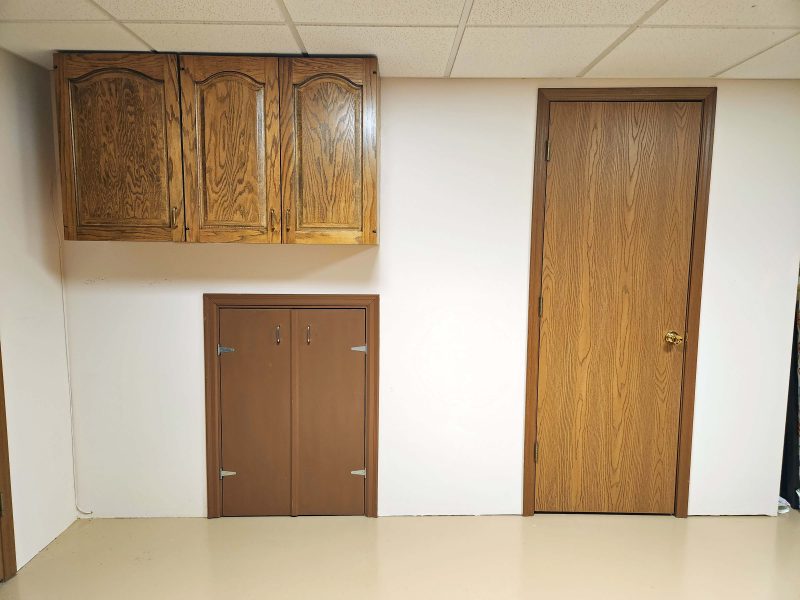
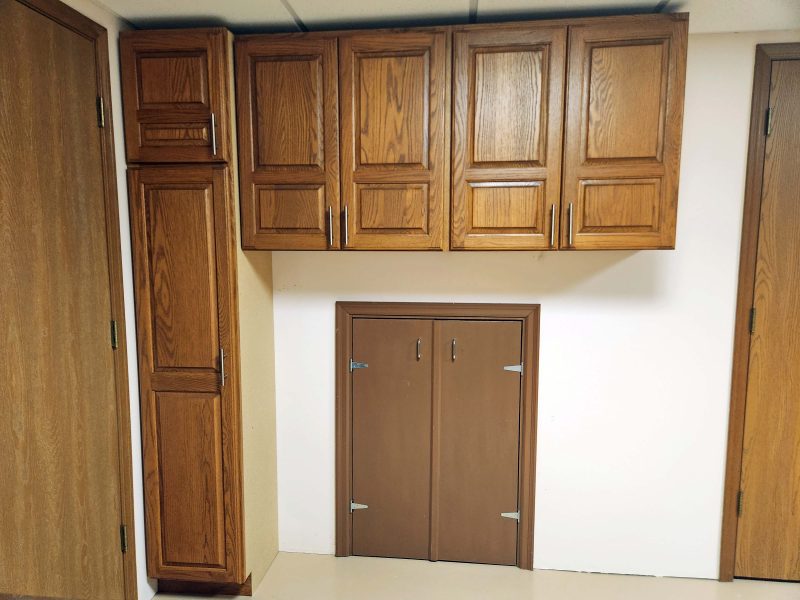
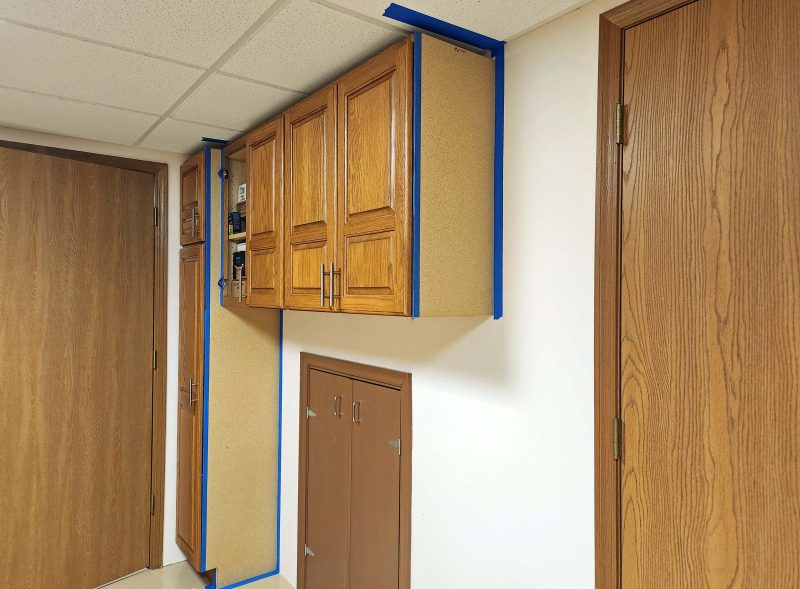
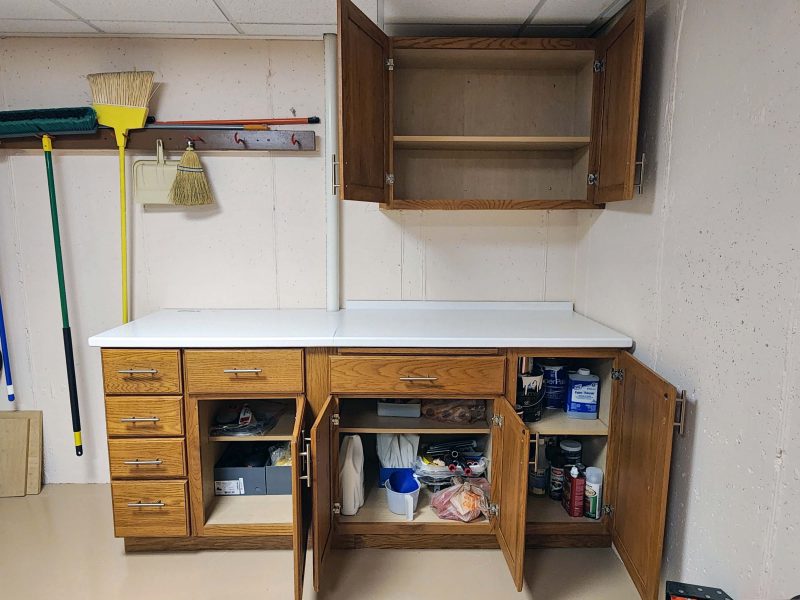
Back in 2023, when we updated our kitchen, we had some of the old kitchen cabinets installed in our basement workshop. There weren’t enough kitchen cabinets in the sizes we wanted to finish the job, so we planned to add old cabinets from the laundry when we updated that room. These are the last of the original cabinets that came with our new house 46 years ago.
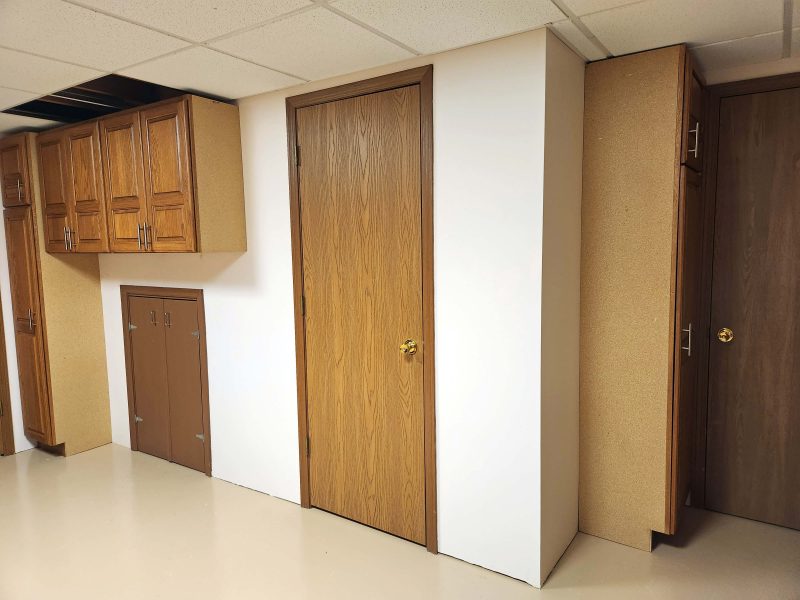
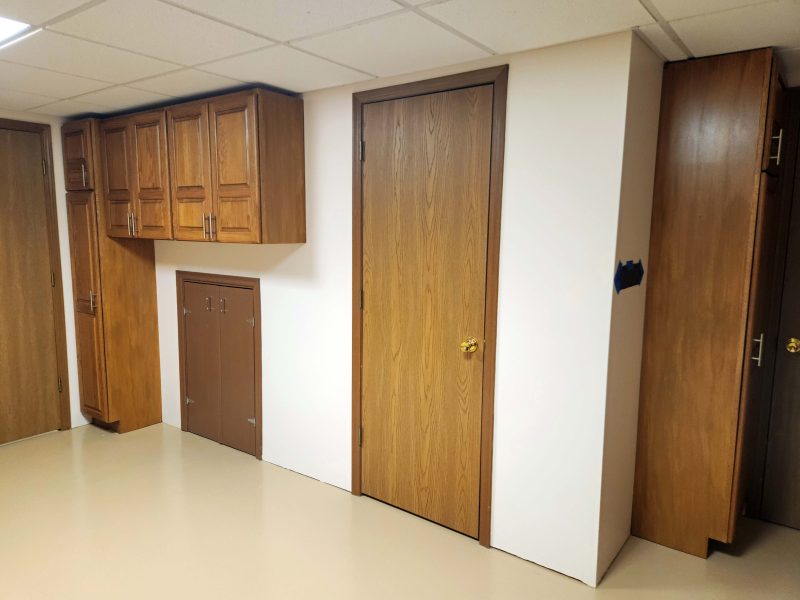
Now, those three (antique?) cabinets have been replaced with four (relatively) “new” 27-year-old overhead cabinets and a utility cabinet, plus another utility cabinet around the corner of this wall. The laundry room cabinets live on!
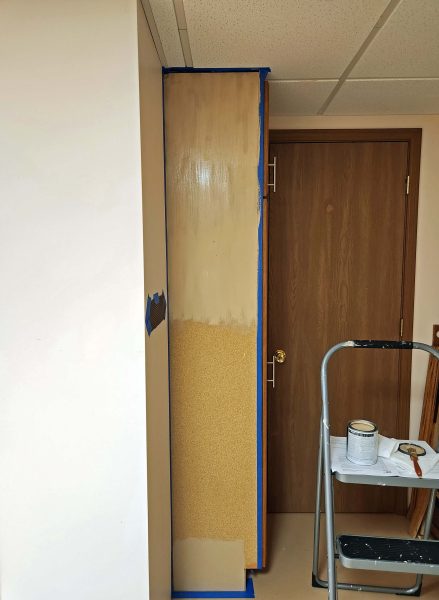
I didn’t like the seeing the three unfinished sides of the cabinets (they were originally against other cabinets or walls), so having learned how to colorwash (story coming up), I decided to colorwash the unfinished sides. Note: The crew replaced the missing ceiling tiles a few days later.
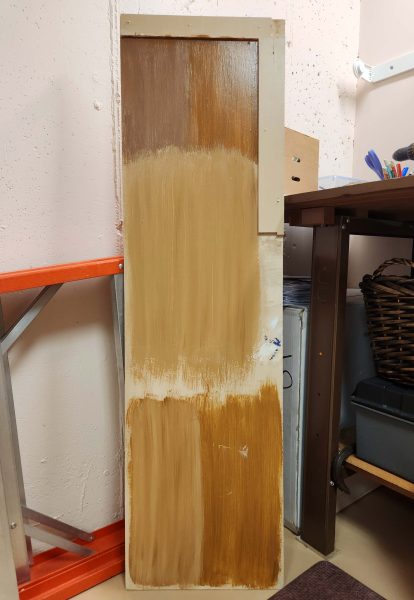
I got out my practice painting board, Ted and I selected paint colors that seemed to match the colors in the wood of the cabinets, and I went to work, trying a variety of styles and colors to choose which looked best. They were mostly awful!
A closer look at the top right sample on my practice board showed a possibility. The base color paint showed through the colorwash paint, creating a wood grain appearance. The idea seemed so simple after what we went through with the pantry doors (yes, coming up). Just put on two coats of the base color and paint over them with a single coat of the wash color? How easy is that?!
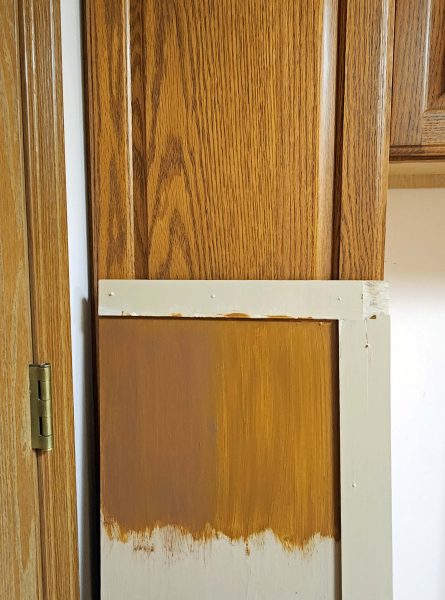
I had to remove a cabinet door to paint the upper strip on the utility cabinet. Then I taped all the edges and started painting.
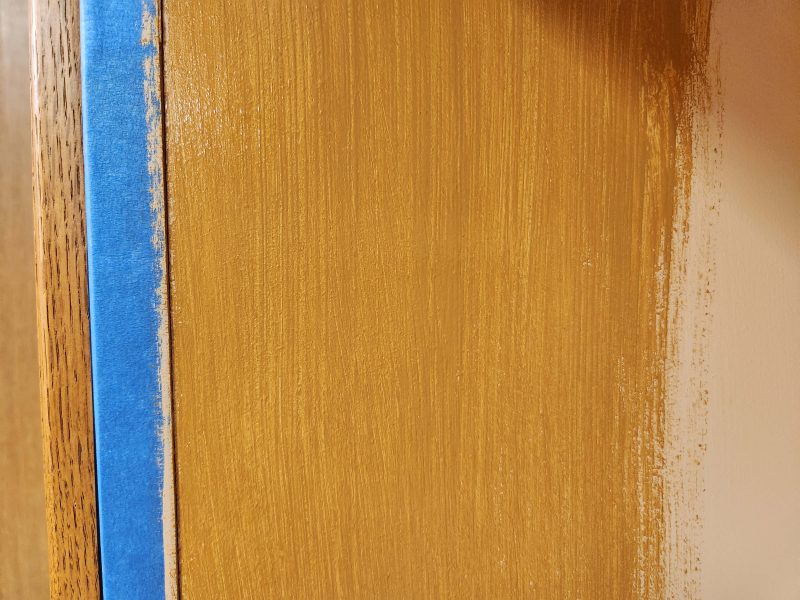
Here you can see the start of the first coat of the base color. The second coat looked far more uniform, as second coats usually do.
Here’s the faux wood grain look of the wash color. I used a feathering brush to smooth out the streaks a bit.
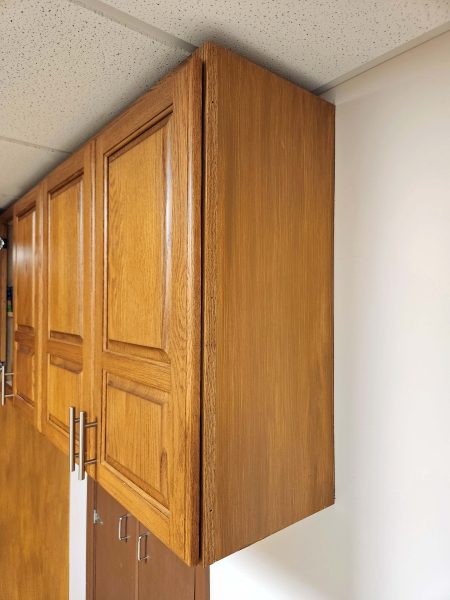
And here’s the result.
The strip between the two cabinet doors in the photo below is colorwashed. I think I achieved a pretty good color match.
We like the finished look much better than those unfinished panels.
Now that the hardwood floor in the kitchen looks so nice, I decided we needed new coverings for the blind headers on the windows. Ted and I went shopping for fabric and found a piece with a design and colors that were perfect for our kitchen. There was just one problem: it was upholstery fabric, not drapery fabric. That means it was thicker, had an applied backing, and frayed more easily than drapery fabric. I’m an excellent seamstress, so I took on the challenge. I didn’t know it would turn out to be a bigger challenge than I’d expected.
Even though I only wanted to wrap the fabric around the blind headers, there were problems to solve. With drapery fabric, I’d cut a long rectangle, fold it in half lengthwise, sew that long seam together, turn over each end to sew hems, and slide the tube I’d made over the header. Upholstery fabric is a different story. One problem is that upholstery fabric is thicker so it can take the wear and tear of furniture use, where draperies and curtains simply hang against the wall–or window–and get dusty. My “wrap” (as I call it) also had to turn two corners from the front of the header onto the returns that attach the front piece to the window frame. The thicker fabric bunched up heavily at the corners and, if it fit the header, it was too tight to slide over the returns. My solution was to make the wrap slightly wider from the corners to the window frames to make it fit around the corners and the return pieces.
The wrap at the bay window was longer than the width of the fabric, so I had to match the fabric pattern at a seam. That seam was bulky where it folded over the top and bottom of the header. My solution? I notched it at the folds to allow it to bend more easily with less bulk.
Folding over a hem at each end was tricky too. I usually double-fold the ends, but that was far too thick with upholstery fabric, so I zigzagged the edges to prevent future fraying and settled for a single fold-over. The double layer of fabric at the hemlines made the wrap even tighter over the returns. That’s where my solution to make the wrap a little wider in that area really helped. My finished pieces weren’t simple rectangles; they were long rectangles with flared ends.
It didn’t surprise me that I triumphed over the challenges. I’d have given up if Ted and I hadn’t liked the fabric color and the pattern so much, and if we hadn’t agreed that a runner-up piece of drapery fabric would always be second-best. Still, making everything work was more frustrating than fun, so in the future, I’ve decided to avoid buying upholstery fabric for window hangings! That is, unless it’s this perfect for the look we want.
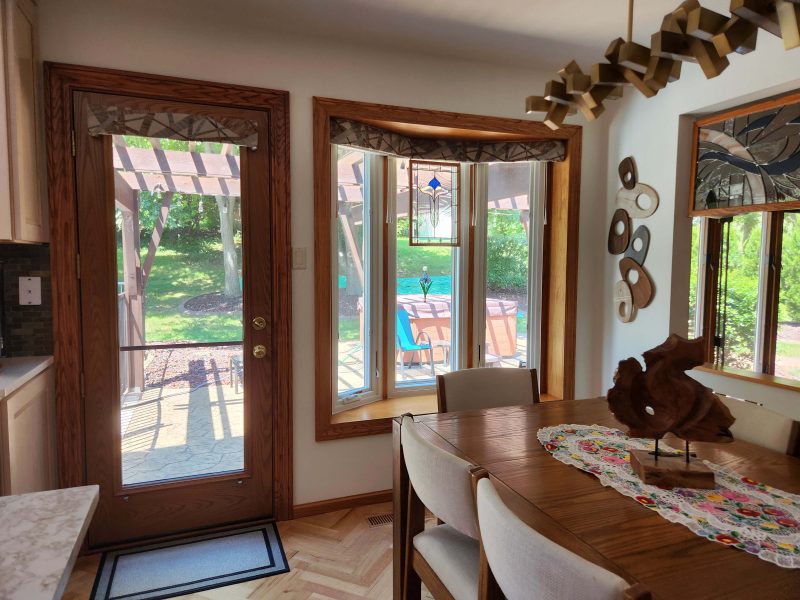
Here are before and after photos of the new wraps–old, then new.
We like the colors of the new wraps with the new cabinets. They look warmer and less “washed out.”
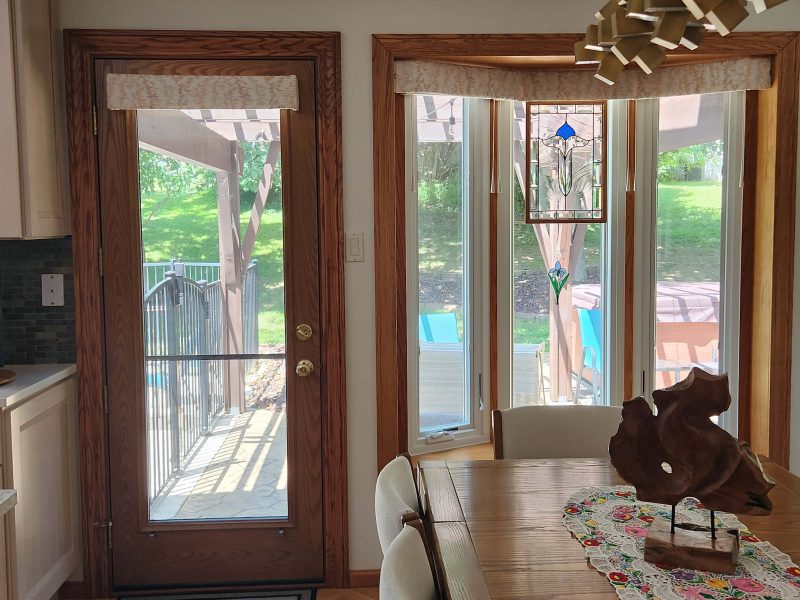
See how well that pattern matches our new light (part of the 2022 update) and the colors in the wall sculpture? I couldn’t say “no” and I’m glad it worked out.
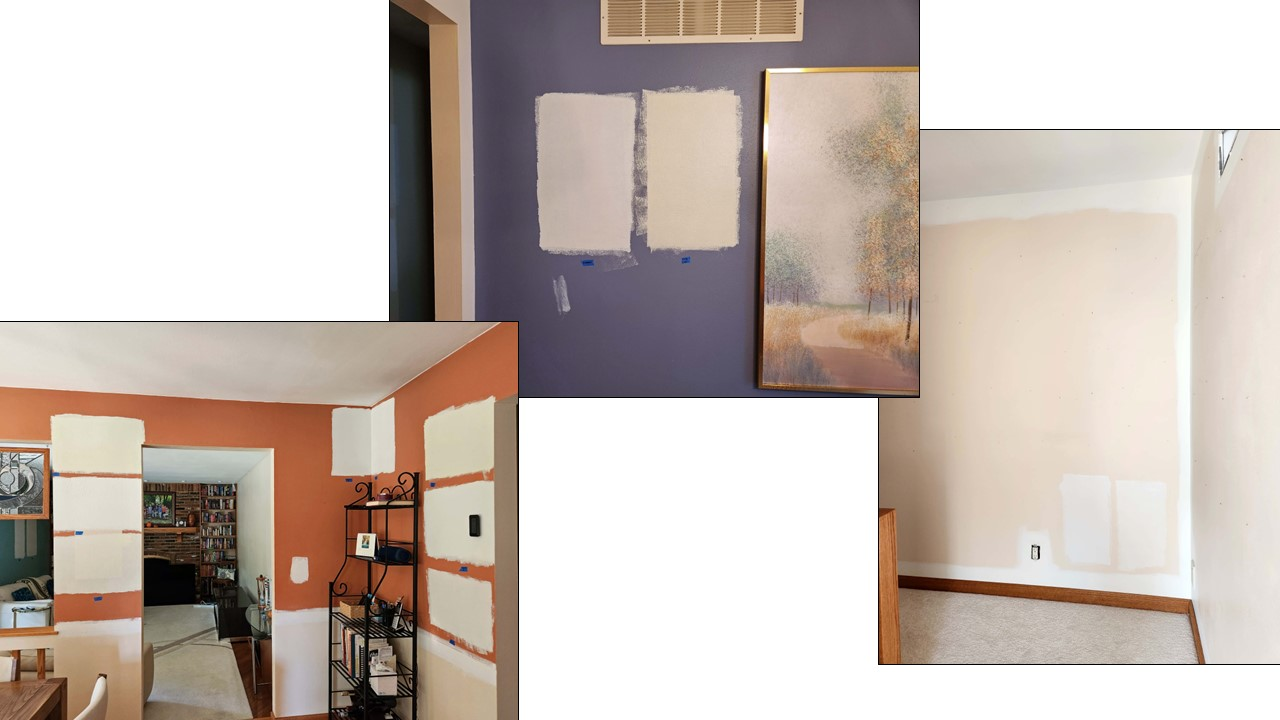
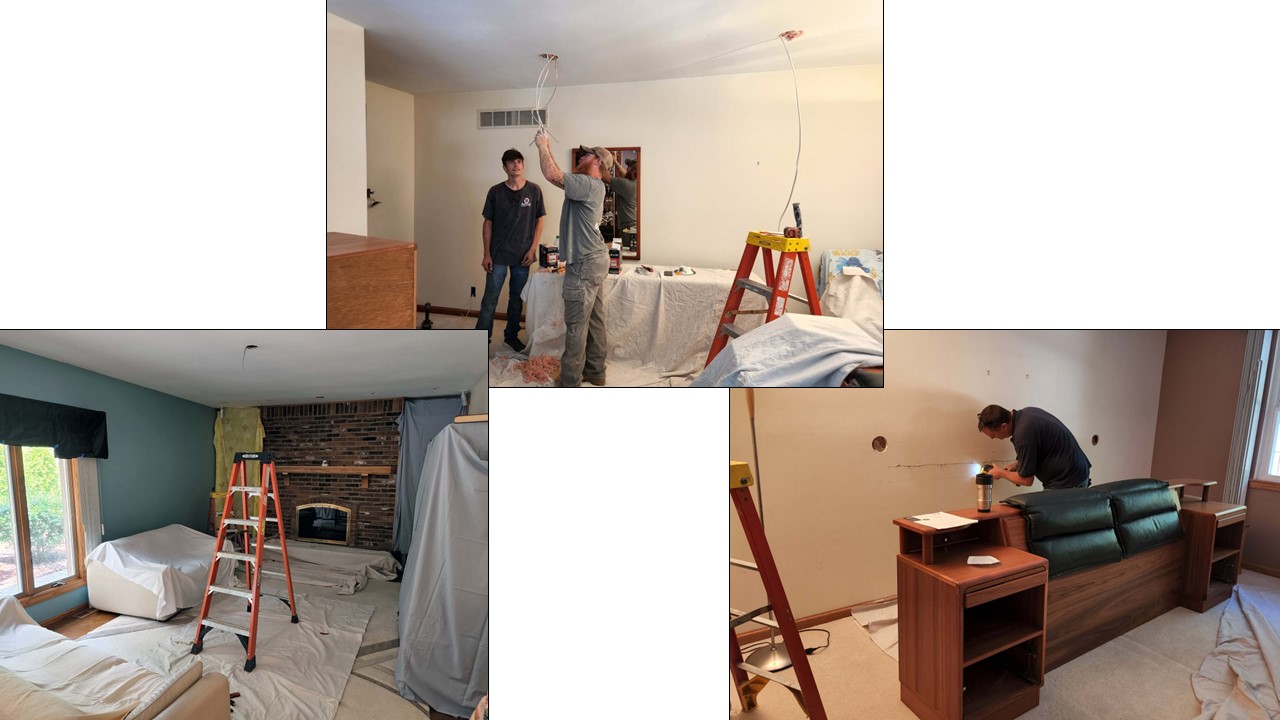
Ted and I started updating the interior of our house in 2022. We made electrical changes (halo lights in the ceilings, a light wall in the family room, etc.), we had all the walls painted, and we replaced all the carpeting. In 2023, we updated the kitchen. After that, the only remaining jobs were to refinish the hardwood floor, update the laundry room, and get some new pantry doors. Our current pantry doors were in the house when we bought it new 46 years ago. They held up well, but their age was showing.
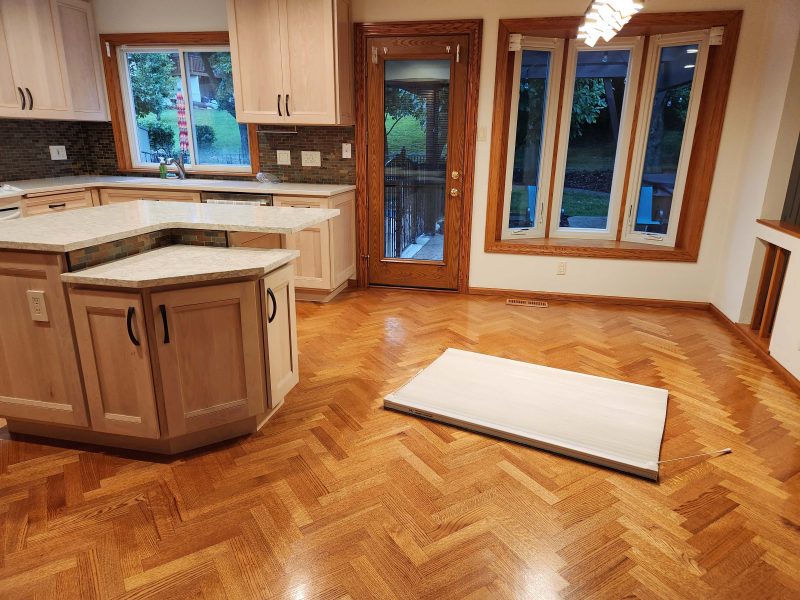
We started by going to our favorite contractor to start planning the laundry room update. Of course, working with his designer, making choices from samples, selecting the cabinet style we wanted, etc. all takes time. Then the stuff has to be ordered and the contractor has to find a place in his schedule to do the job for us. Meanwhile, we decided to get started on refinishing the hardwood floors, which would take less time. In fact, they did the job a week after I called and finished it in four days. Wow!
We started by emptying the pantry and the closets so the team could work on those floors.
We knew everything would get dusty from sanding the floor so, as long as we were taking down the blinds, we decided to wash them. There was lots of floor space to do it.
Everything got piled in the dining room, where it would be out of our way during the project.
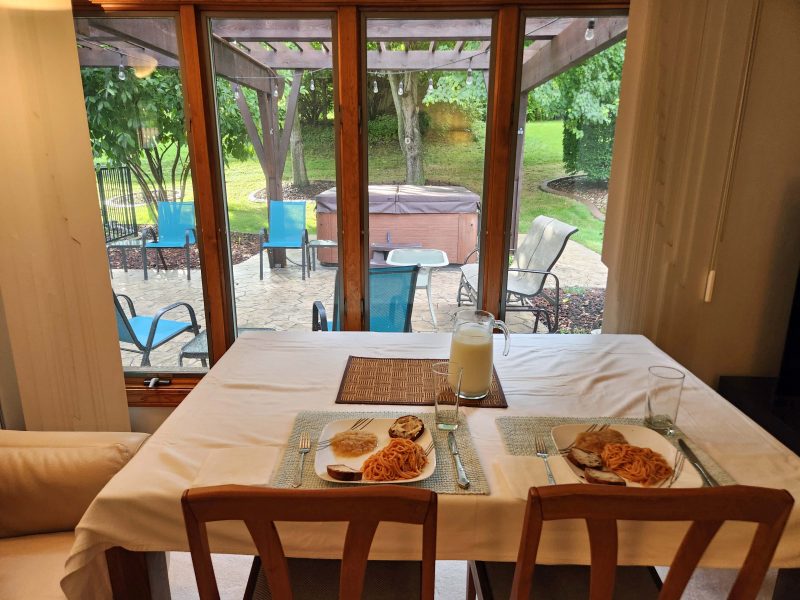
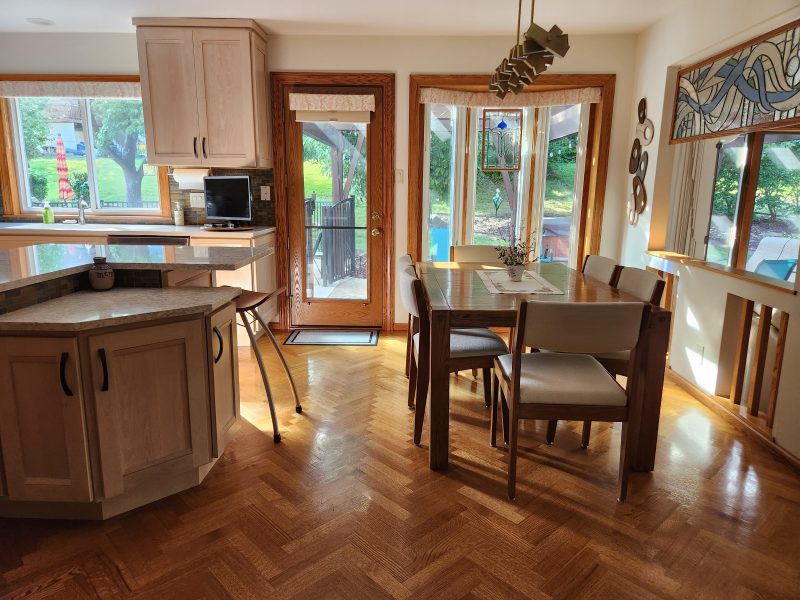
We moved the kitchen table to the family room and took out the leaves to make it smaller. That gave us a window view while we ate meals during the work time.
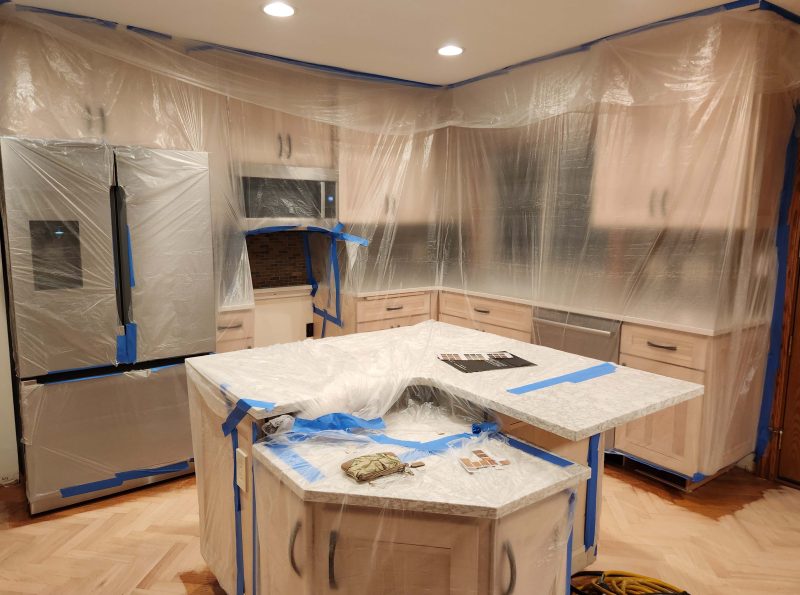
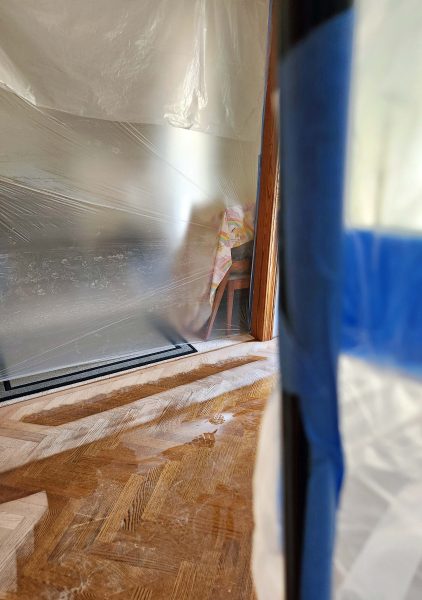
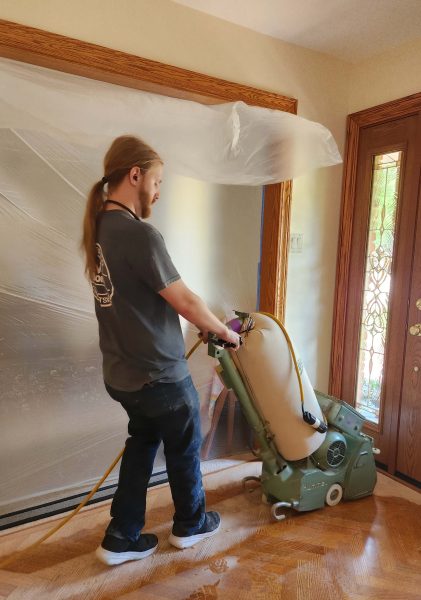
Then the team of two arrived to start working. They spent a block of time protecting as much as possible from the dust they were going to create. They wrapped the refrigerator doors separately to allow us access to the refrigerator. We could also use the microwave.
The stove was moved to the family room.
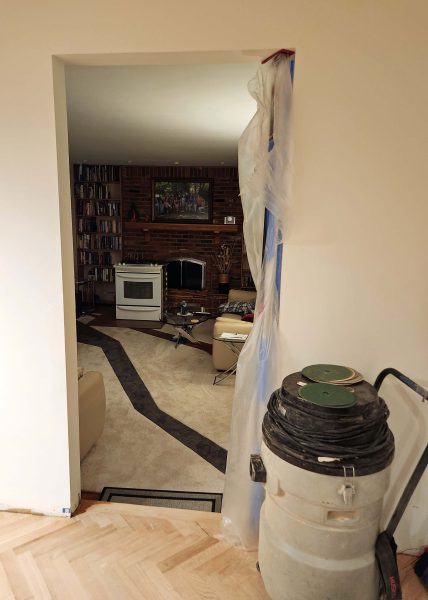
They covered the doorways with plastic and wrapped one vertical edge of the plastic at each doorway around a spring tension rod. That allowed us to use other rooms–we just had to move the rod aside far enough to squeeze through, then put it back against the door frame.
Then the mess began. “Dusty” isn’t a strong enough word, although the plastic coverings helped a lot. After the entire job was finished, Ted and I cleaned the entire house, including wiping down the walls.
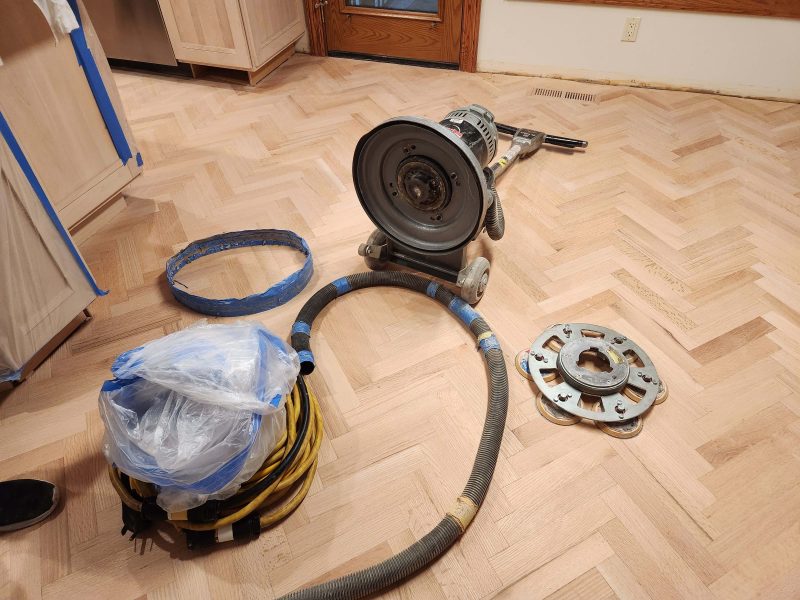
This is a view of the bottom of the sander. The large disk on the floor spins and each of the six smaller disks on it also spins. All that action prevents sanding strokes from showing on our herringbone floor pattern.
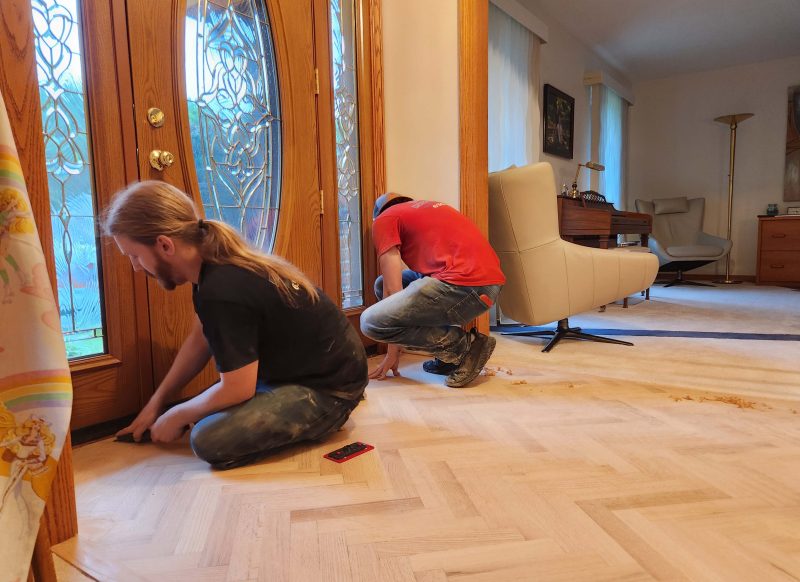
The edges and corners needed to have the old stain and varnish scraped off and sanded by hand. You can see some of the scrapings on the floor in the center right of the photo below.
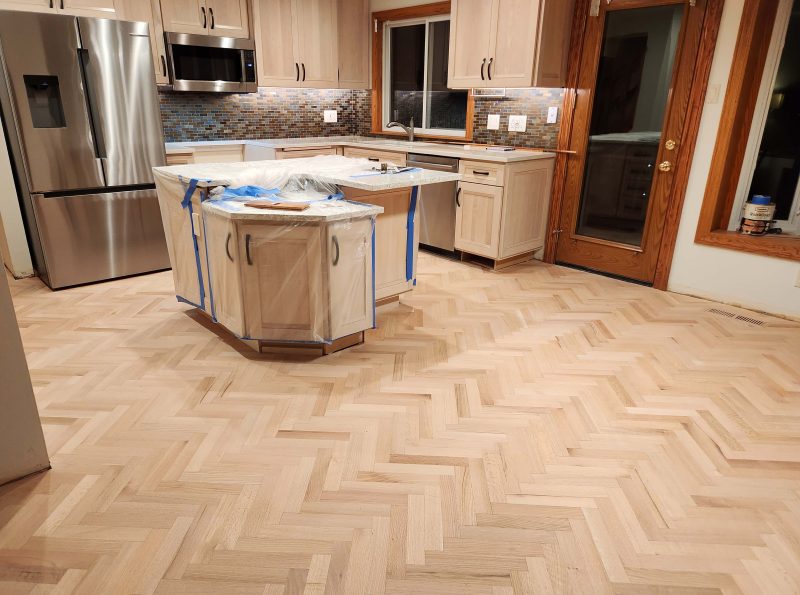
When everything was sanded, it looked so light and clean that we hated to put a colored stain on it. It felt really smooth too, compared to our 27-year-old pre-refinished floor.
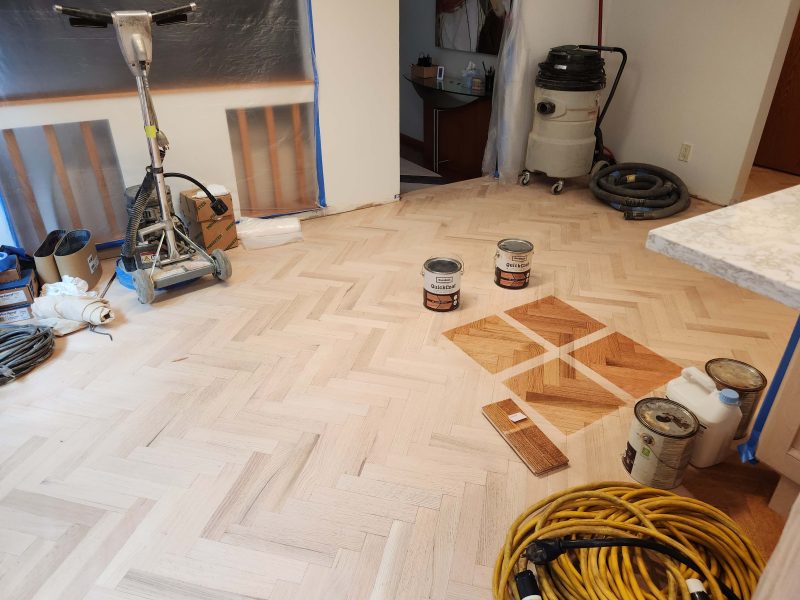
From an array of stain colors, we were allowed to choose four to be applied to the floor to help us select the one we wanted. From our four choices, we went for “natural,” the lightest one.
For the finish coat, we chose a low-sheen finish, rather than a gloss.
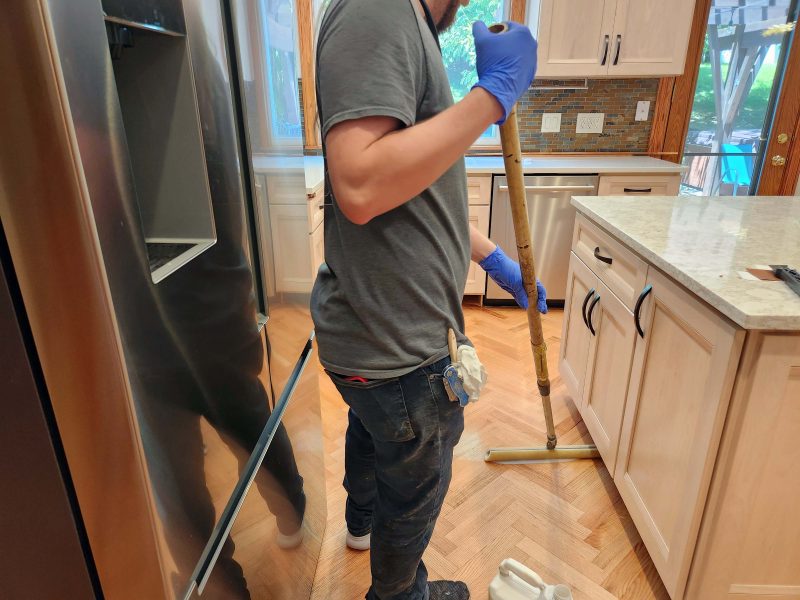
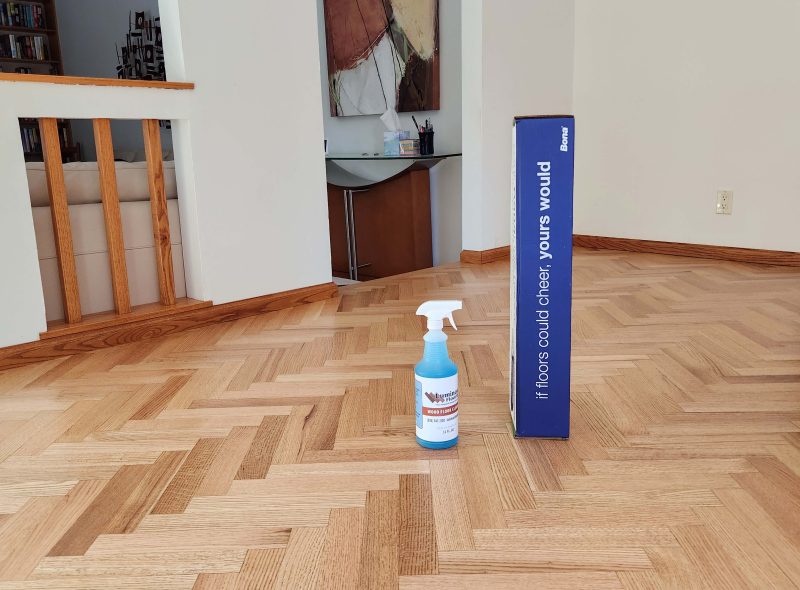
When the guys finished the job, they left a little gift for us–wood floor cleaner and a Bono mop.
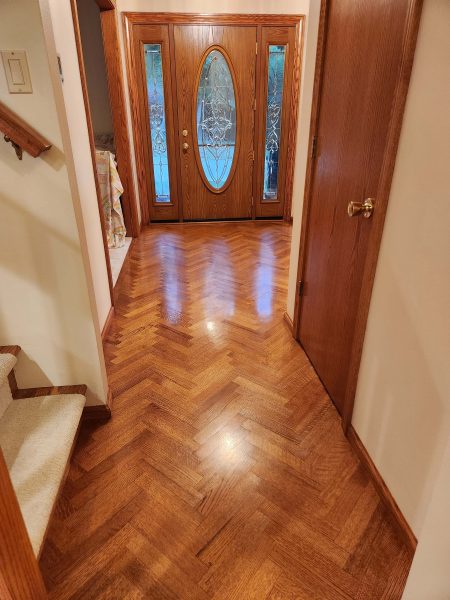
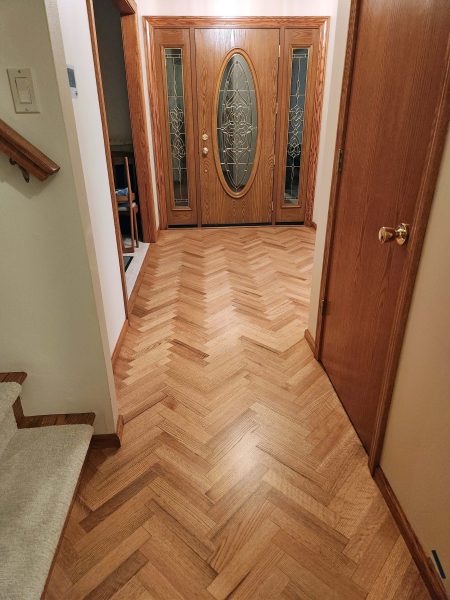
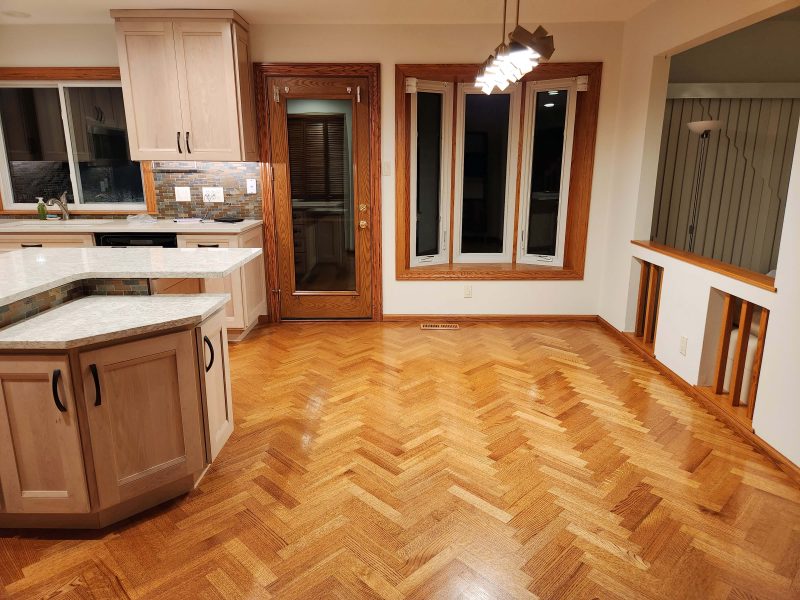
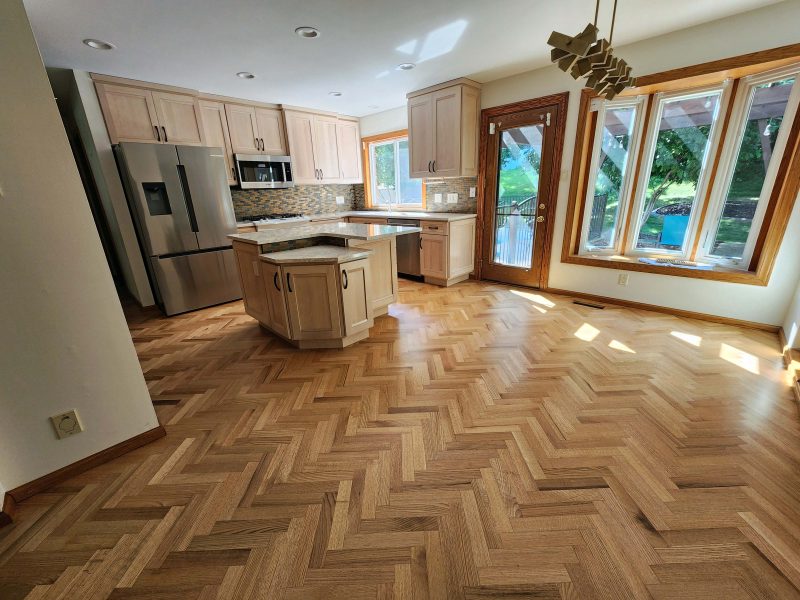
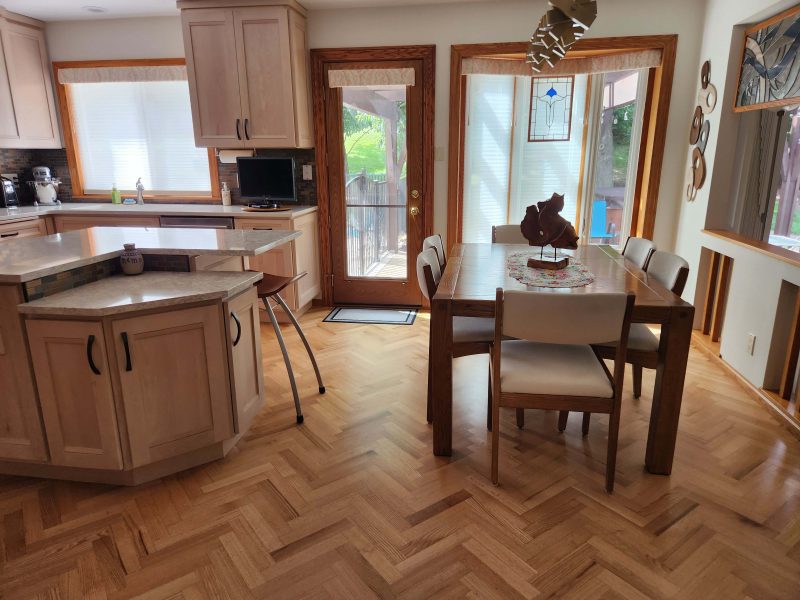
The following are before and after pictures of the floor. We can’t believe how much depth and color are revealed with the lighter stain! It’s even better than the clean, sanded look.
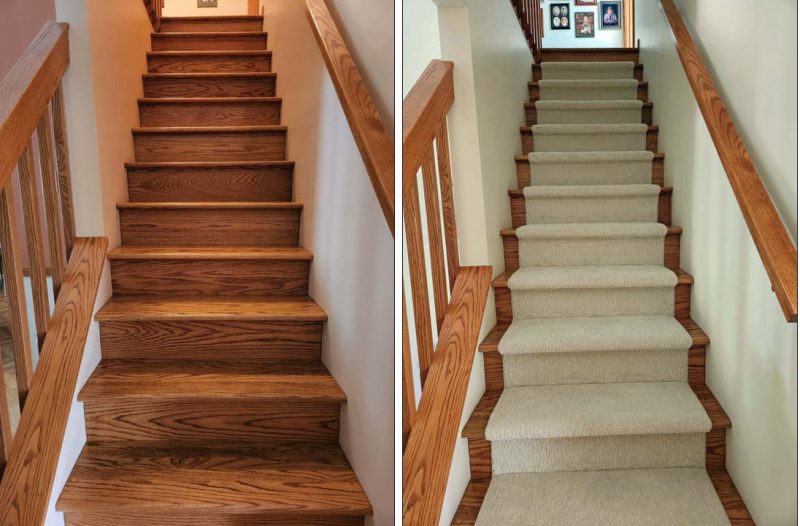
This floor extends to every exterior door and to every first floor room, as well as to the stairways for access to the basement and to the second floor. On the day the finish coat was applied, we needed to leave the house for a few hours to let the finish dry enough to walk on it with socks, so we went out to dinner.
On our way home, we saw a rainbow–a good sign for a successful, beautiful project.
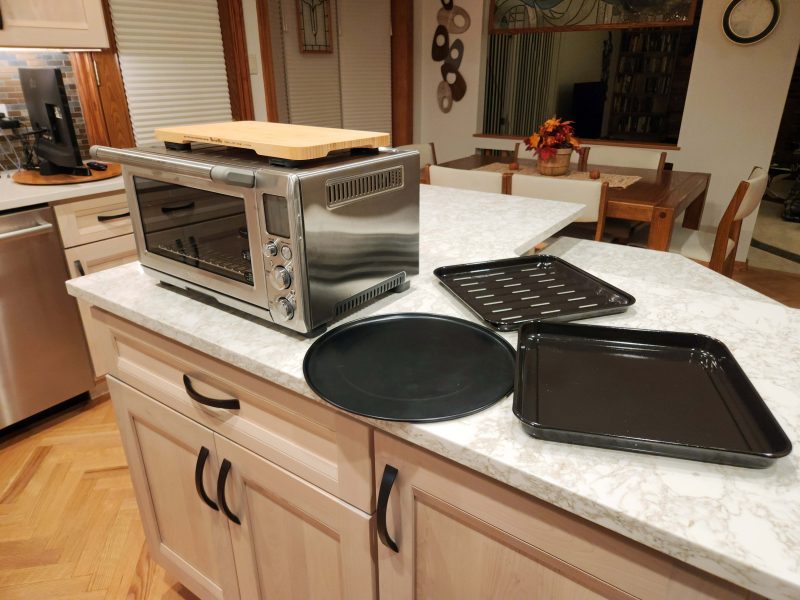
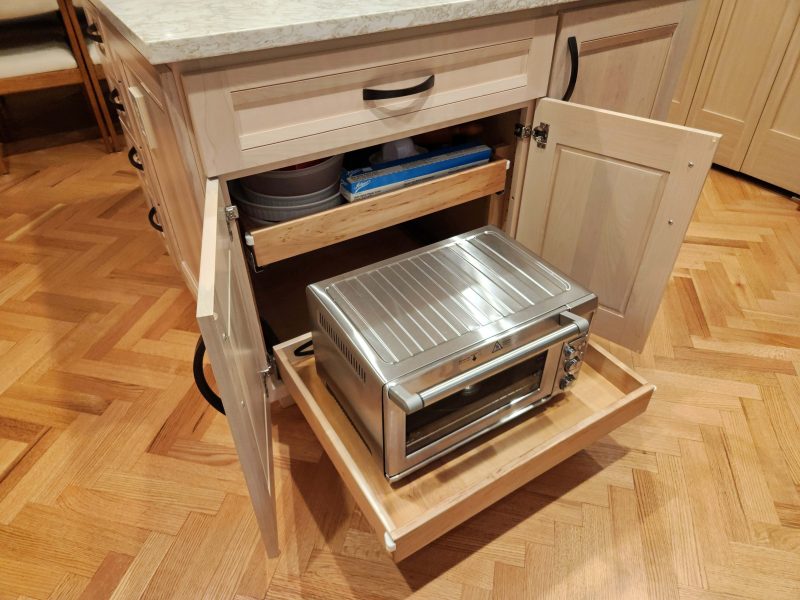
For years, our friends and family members have been telling us how much they love their toaster ovens, so Ted and I finally decided that we ought to buy one. It wasn’t hard to find one we like (Breville), and it didn’t cost a fortune, so we drove to Target, picked it up, and joined the toaster-oven crowd–just like that!
Our excuse for not buying a toaster oven sooner was that we don’t have enough empty counter space for it. That problem was solved by rearranging a few things in one of our island cabinets. Now we can simply pull out the drawer, lift the (not heavy) toaster oven up, plug it in on the side of the island, and do any of the 10 functions we choose. It’s definitely faster than heating the oven, and it doesn’t warm the kitchen as much.
It’s been very convenient to bake just a few cookies at a time and to eat them fresh and warm. Although we’ve already used our toaster oven for a lot of things, this is the first thing we made.
It was delicious! All those people were right: a toaster oven is a good thing to have. What took us so long to get one?!
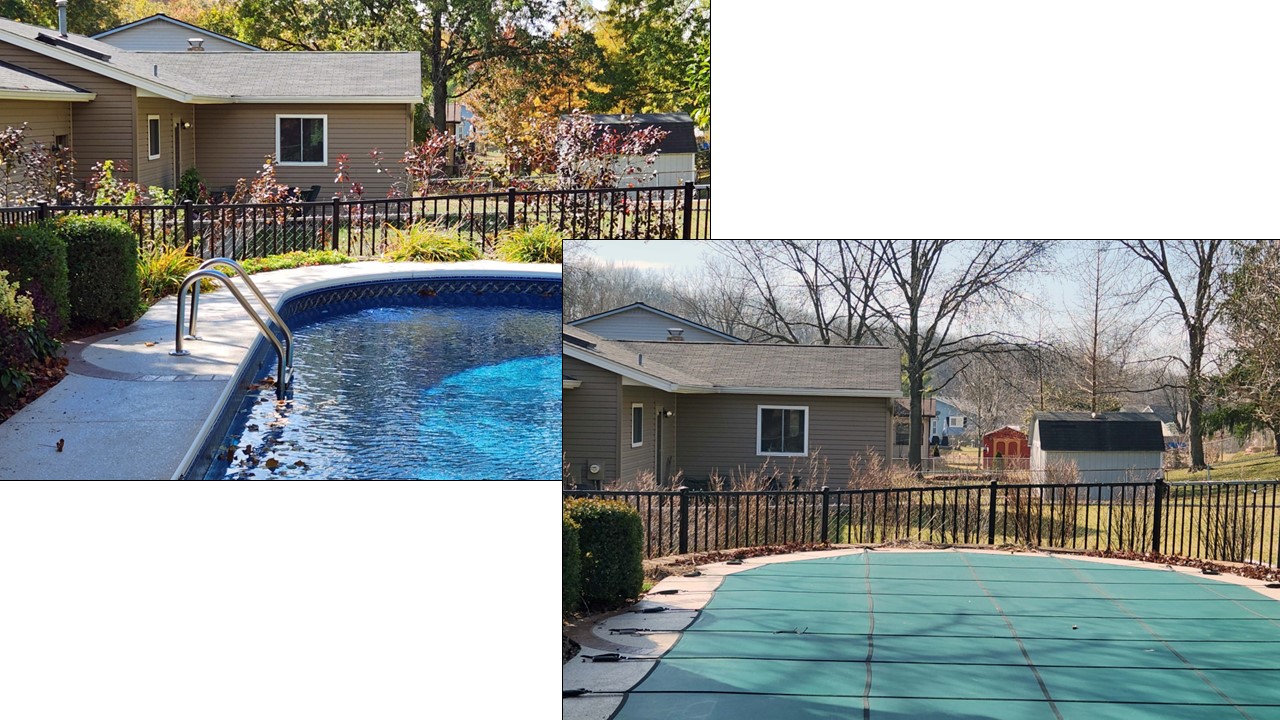
Ted and I have been working on updating our house and yard for two years, and we’re almost finished. In late July, we finished the outdoor updates with some tree trimming and thinning.
Tulip tree
This tulip tree is special. When our children were in elementary school, every fourth-grader was given a tree sapling on Arbor Day. At the time, the saying was that the best survival rate for these saplings was at the homes of the kids’ grandparents. Our kids’ grandparents did not live nearby, so we planted them in our yard.
Jeff and Kathy each received an evergreen. Both of those died within a few months. Thom was given an oak tree. He named it Fred, and it lived for a few years until bunnies chewed off all the bark at the bottom of the trunk. Kari’s sapling was a tulip tree. She named it Paul, in honor of her Grandpa Paul. Roughly 40 years later, that tree still lives. Unfortunately, a disease struck it a year ago and our arborist has been working with us to save it. It looks much better now than it did before the treatments.
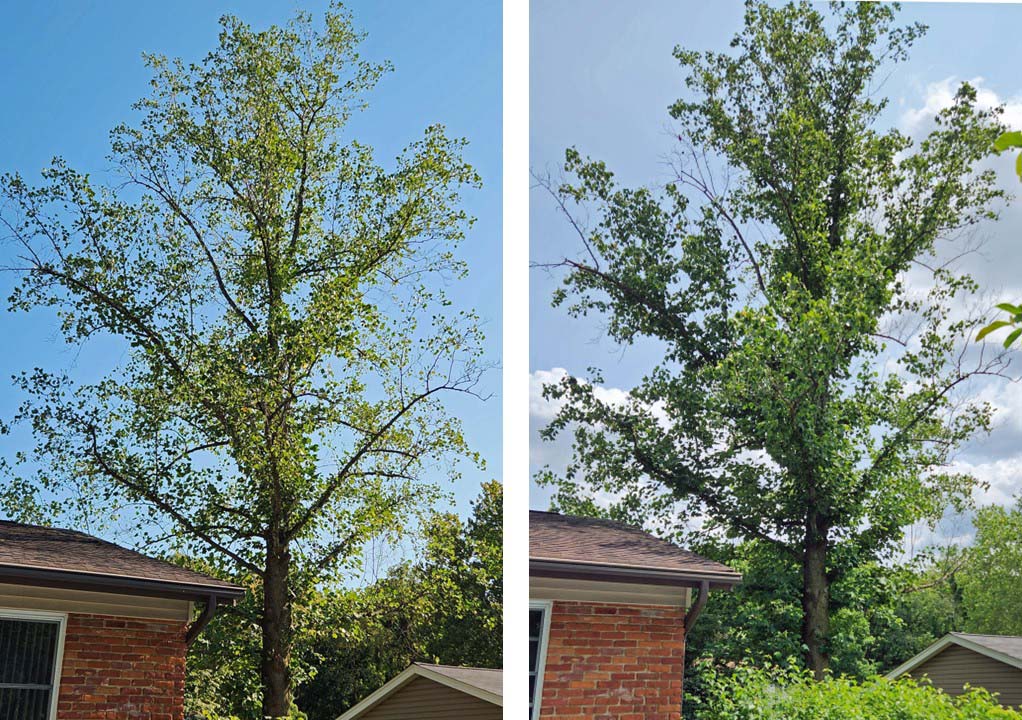
Now that the tulip tree is healthier, we decided that it’s time to prune the formerly-diseased, now-dead branches. The workers needed a cherry-picker to reach the high branches.
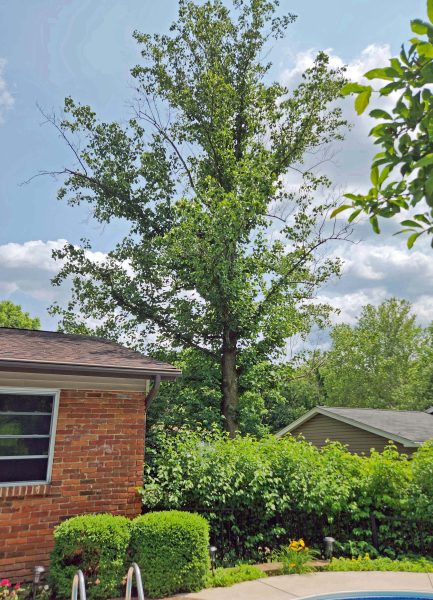
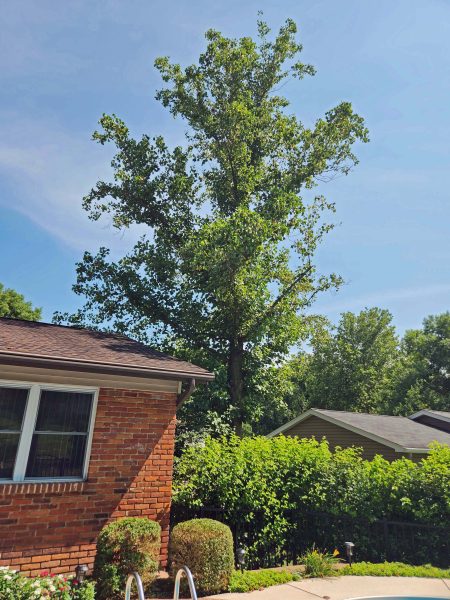
Here are the before and after pruning pictures. The “after” tree doesn’t look as full in this photo as it does in the above “healthier” photo because I took this picture earlier in the year, before it was fully leafed out. The tree looks better without the deadwood.
Magnolia trees
Long ago, in 2010, Ted and I hired a landscape designer to beautify our yard. He must have been amused at our naiveté. We don’t have strong gardening skills, so we took his word for everything and paid him a small fortune (in our terms) to install what he’d planned. Some of the things his team planted were very nice; most of them were overdone and/or overplanted; and about one-half of them died within 2-4 years (after the one-year survival warranty, of course).
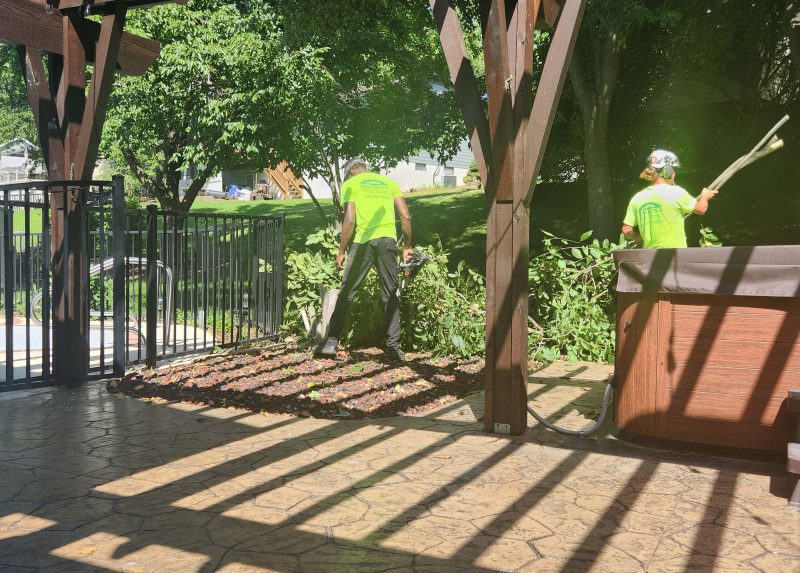
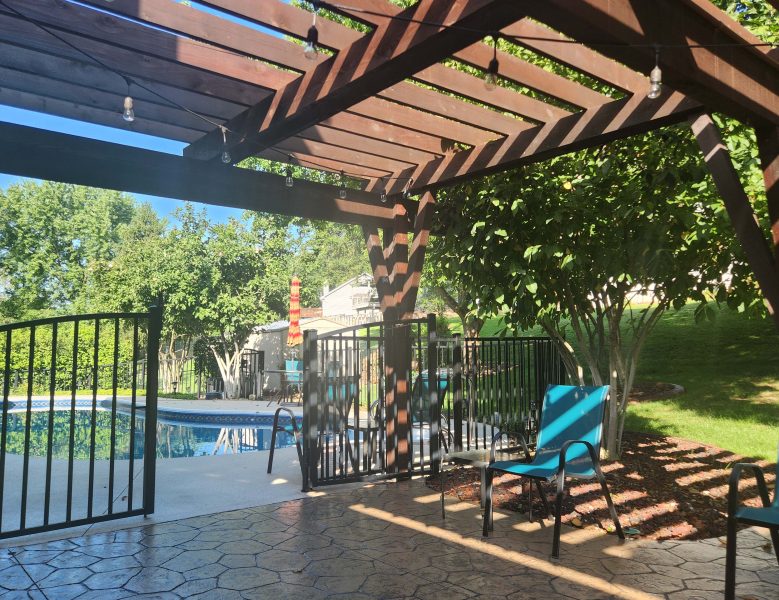
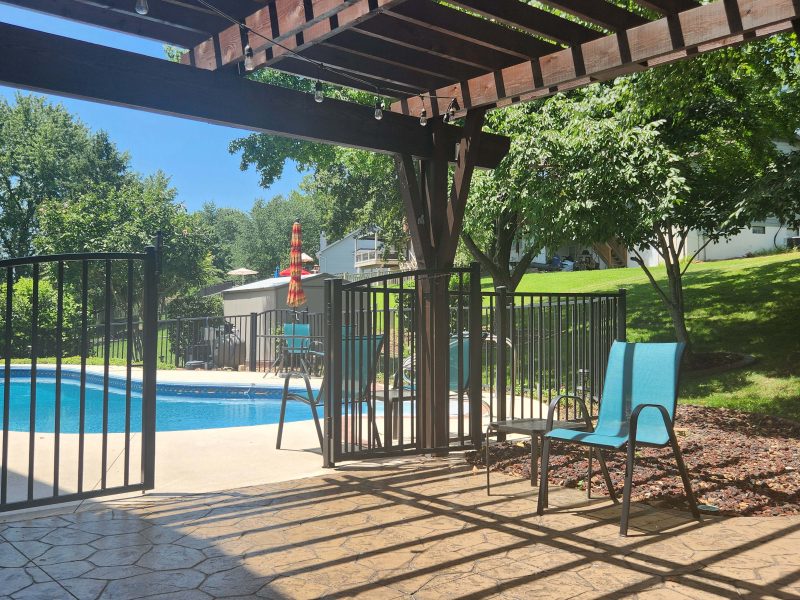
The designer placed three trees in stupid (my opinion) places: two beneath the pergola and one beside the pool deck. After (I think) 9 years, one of the trees beneath the pergola died. For the 15 years since they were planted, we have tried to keep the other two trees trimmed to fit under the pergola and beside the pool. Although we enjoy the magnolia blooms every spring, we decided that those plants just want to be trees, not shrubs. They’re growing almost faster than we can keep them trimmed back. We were starting to feel a little claustrophobic with a tree closing off half of our view on one side of the pergola and of skimming leaves from the other one out of the pool. It was time for them to become “giving trees” and to give mulch to gardeners, so we had them removed.
Here goes magnolia tree #1. Surprisingly (to us), it took less than 30 minutes to make these trees disappear. That’s a tiny fraction of the time we’ve been spending to keep them pruned away from the pergola and the pool!
Because of the (idiotic) places these trees were planted, the tree company could not get a stump grinder in place, so we have low-cut stumps now. We’ll have to think of a way to enhance them. Any ideas?
And here goes magnolia tree #2.
Our patio view no longer feels claustrophobic. Here’s the before picture, followed by the after picture.
As you can see, we still have plenty of trees without those two magnolias.
Burning bush hedge
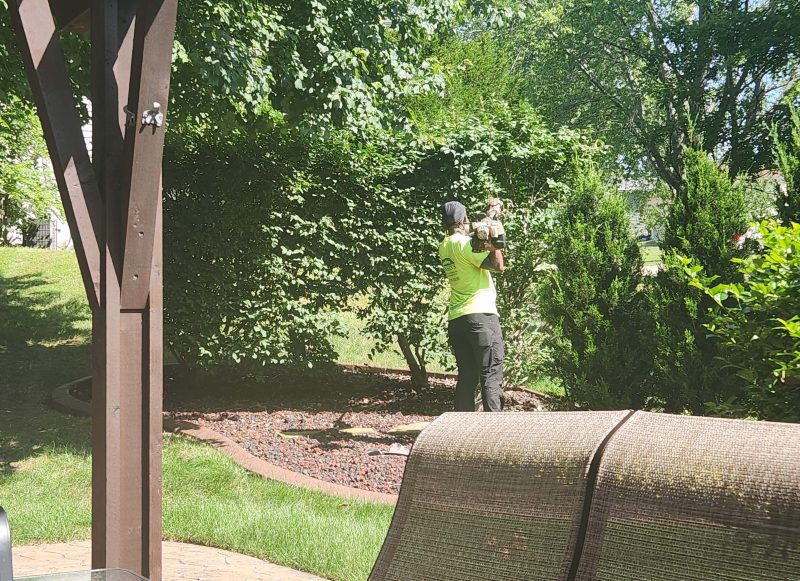
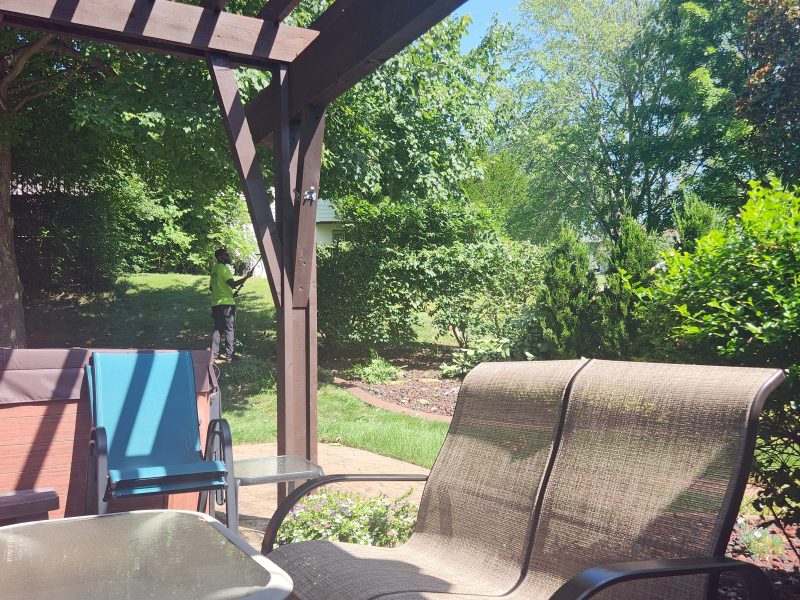
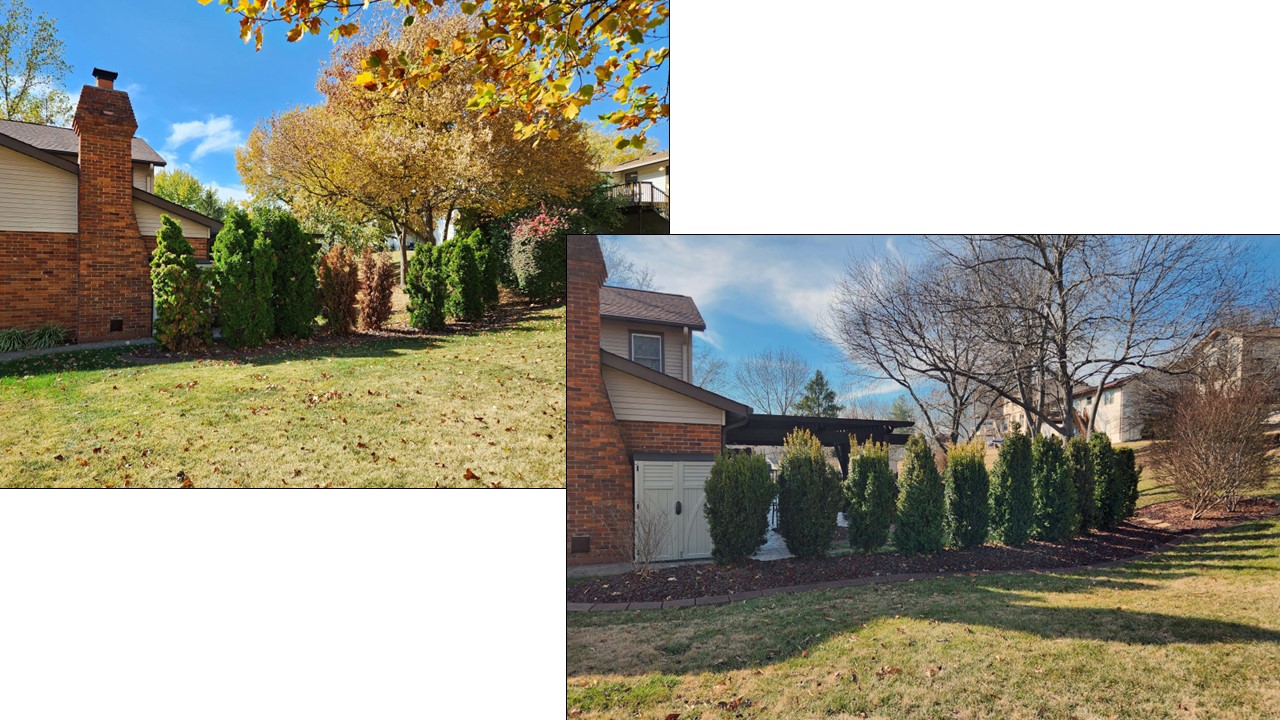
I’ve mentioned in previous posts that, when fall arrives and the burning bushes turn bright red, it looks like nearly everyone in the area has at least two burning bushes in their yard. We have six–four in a privacy hedge, one beside the storage shed, and one at one end of our house. The burning bush hedge reached a point where Ted and I could not trim it without a tall stepladder, so we decided to take it down and keep it shorter. Here’s one of the tree guys beginning to do that for us.
The worker has part of the hedge trimmed, but hasn’t yet done some of the back side. You can see how much he’s taking off.
Here’s the hedge at a manageable height. With air and light, the bushes will fill out by next spring. A four-man professional team with professional knowledge and tools, completed all this tree/bush work in under 3 hours. I’m looking forward to the time we’ll save next spring when we’ll only have the now height-accessible burning bush hedge to trim.
Japanese maple
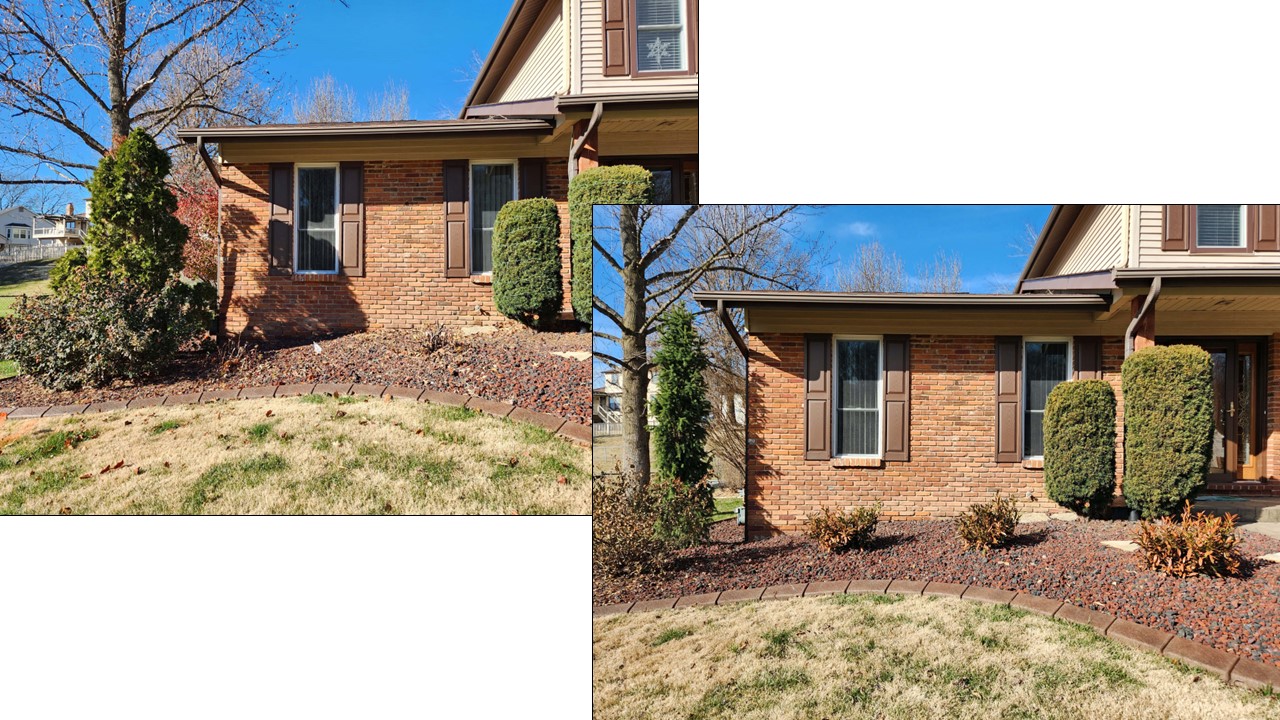
The landscape designer put a Japanese maple in a dumb place too. It’s one of his plantings that has survived and we’ve continued to trim it in the shape it had when it was planted. Over time, however, it’s getting to be a challenge to keep it trimmed away from the sidewalk so that we can walk past it without ducking. It’s also reached a point at which we can’t reach any higher with our electric trimmer to keep it trimmed back. Like the magnolias, we decided this little tree also wants to be a real tree, so we trimmed it from the bottom up. The carpet roses along the front porch (again, planted by the landscaper) have also survived, but they never look very good and can barely be seen from the road. In addition, Ted is tired of deadheading them all the time. We took them out this year.
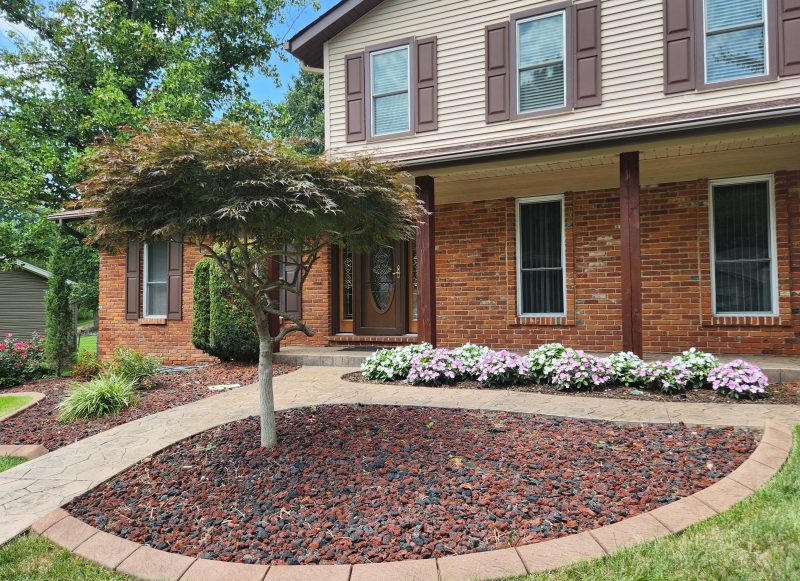
Now the Japanese maple can grow to be a tree and the annuals we planted along the porch have brought us numerous compliments from neighbors and passing pedestrians.
That completes our outdoor updates–at least for a few years. We still have a little bit to do inside our house. Watch for the coming changes. They’re in progress as I write this post.
We bought a new side-by-side refrigerator in 1997. A number of years ago, the icemaker stopped making ice in a controlled manner, but we don’t use much ice, so it was easy to turn the icemaker on when we needed a bucket of ice, then turn it off until we used up that supply, then turn it back on. No big deal, and everything else worked fine. Everyone–friends, salesmen, and any type of serviceman who came to our house to fix anything over the years–told us to keep our old appliances as long as we could, because the new ones are expensive, and they don’t last very long. The servicemen often told us tales of things they fixed in the first two or three years of a new appliance’s life, and of appliances that needed to be replaced after only five years.
Time went on, and the icemaker began to cause problems. It dispensed undersized ice cubes, dropped non-stop ice cubes into a glass, and randomly allowed ice cubes to slip out of the chute and fall to the hardwood floor, where they melted if we didn’t hear them drop and pick them up immediately. It was becoming a major nuisance. Sure, we could have manually made ice cubes in trays, but the refrigerator was 28 years old, so we decided to put it to rest.
We liked our side-by-side refrigerator, and we like the water/ice dispenser on the outside of the unit, making it unnecessary to open either the freezer to scoop ice out of a tray, or the refrigerator to fill a glass with chilled water. Well, that style is fading away and is available in only a few models. Nearly all of the new models have French doors on top and a freezer drawer at the bottom with a large box for the icemaker to drop cubes into–thus using up freezer space and requiring the user to open the freezer to scoop ice into a glass. We settled on a Bosch refrigerator because (1) it’s a very good brand, and (2) they had two models with an icemaker/water dispenser on the outside of the door.
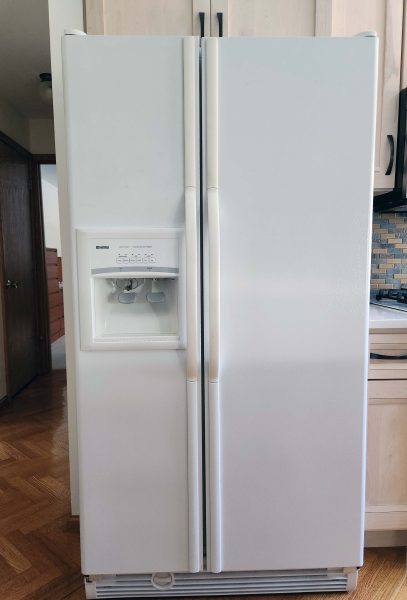
Here’s what we’ve enjoyed for 28 years.
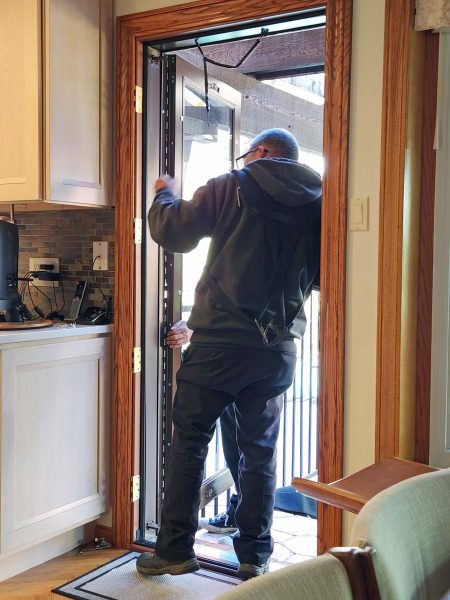
The installation guys surveyed our house for the best route in and out with a refrigerator and measured all the doorways and both refrigerators before deciding what Ted and I already knew–the exterior door in the kitchen is the best one to use for this. Unfortunately, the new refrigerator was wider than the doors would allow, so the guys had to remove the interior door and the storm door to bring in the new refrigerator.
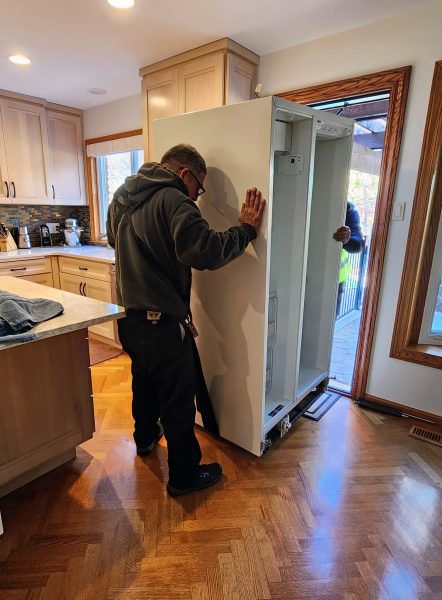
They took the doors off the old refrigerator, and there was no dolly in sight, so I thought they were going to slide it across the room to the doorway. I didn’t want the hardwood floor scratched, so I asked if they planned to put something under the old unit. “Oh, no,” the senior guy said, “we’ll just carry it to the truck.” “Yikes!” I thought. “They must be really strong!”
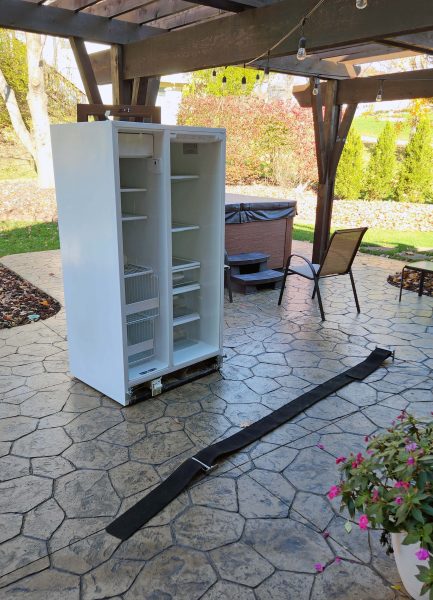
Well, each man had a harness that circled his waist with an over-the-shoulder strap that circled from one hip up and over the opposite shoulder, then back to the hip. In the photo below, you can see the long strap they slipped under the refrigerator and a little bit of the harness shoulder strap on the man’s left side. Each man hooked one end of the long strap to the harness at his waist. When they picked up the refrigerator, I could see how the belt was holding the weight and distributing it over their entire bodies, rather than taxing only their arms and shoulders. All they had to do was balance the refrigerator to keep it from tipping over.
They carefully maneuvered the refrigerator through the doorway and parked it on the patio, leaving the belt to pick it up again later to carry the refrigerator to the truck. I think Ted and I could have carried a refrigerator with a belt and harness like that. It was a great system!
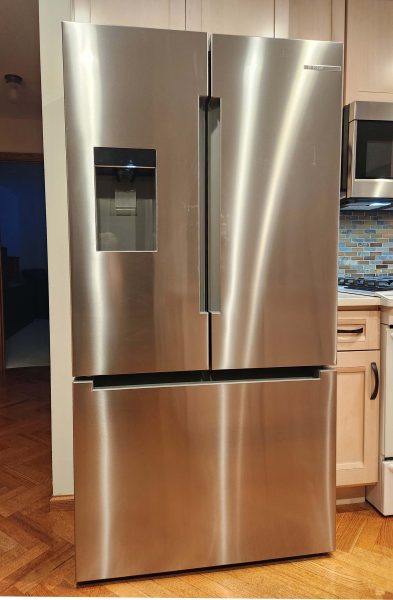
Here’s our new refrigerator. Neither of us was thrilled about the French doors and the freezer drawer, but as time goes on, we’re getting used to both and we like it. Best of all, we can get a drink of cold water and/or dispense ice without opening any doors and letting the cold air out.
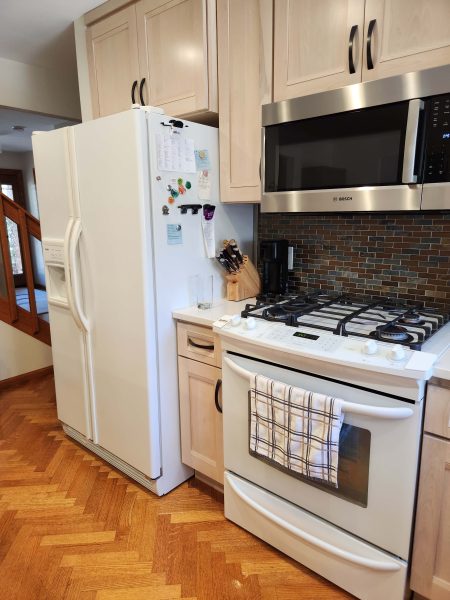
We’ve heeded the advice to keep our old appliances until they wear out. When we updated our kitchen in 2023, we kept our old refrigerator and stove, planning to replace them when they wore out. Well, the refrigerator is gone now, but the stove still lives. We bought it in or around 1993, making it over 30 years old. It still works perfectly and has never been repaired. When it dies, we’ll get a new one and then all of our kitchen appliances will be stainless steel instead of white. This will probably happen just in time for stainless steel appliances to go out of style. I’ve already seen brightly colored appliances in stores and I’m half-expecting poppy red, harvest gold, and avocado green appliances from the 1970s to return, because retro is “in.”
P.S. Our first washer and dryer lasted 22 years. Our current one is 30 years old and still working, with only minor repairs over the years (two thermostats for the dryer and a solenoid for the washer). They don’t make ’em like they used to!
Before the weather got too cold, I thought I should scratch some little jobs off my list.
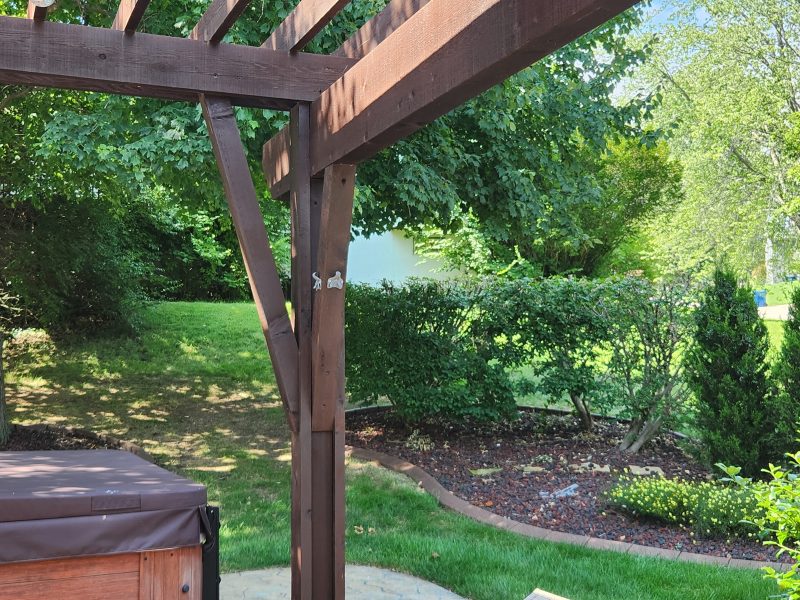
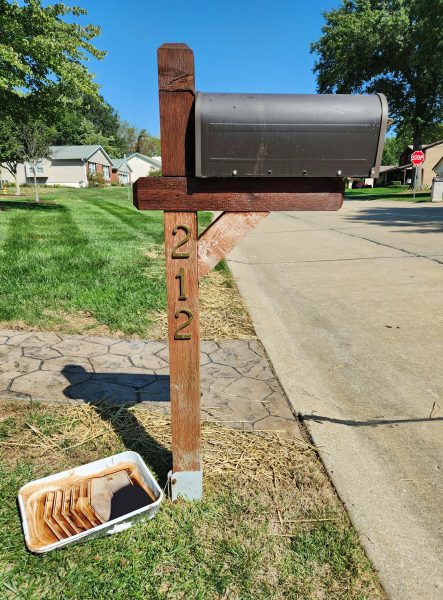
The stain on our mailbox post and on the front porch support posts has faded badly. Ted and I finally drove to the home decorating store to buy stain, and then I went to work. If you look at the bottom of the mailbox post in the photo below, you can see how faded the color was before I freshened it with new stain.
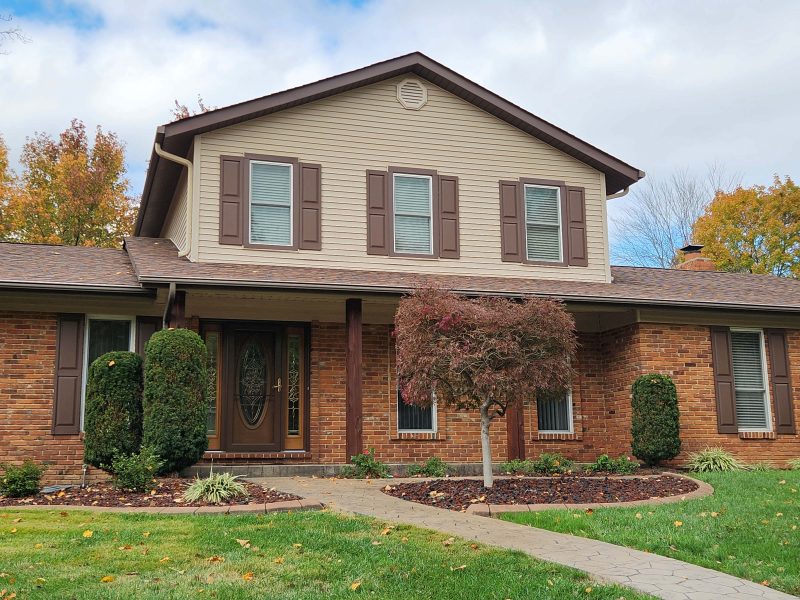
The same was true of the porch posts, but they look better now. I was wearing a boot for an ankle injury, so Ted helped me by climbing the ladder to stain the high parts and I stuck to what I could reach.
Okay, the little outdoor jobs were finished, but I still had one little indoor job to do. We have a jet tub in the upstairs bathroom. Because of the extra depth of the tub and the placement of the jets, shower curtains are too long–unless you want the jets to massage the shower curtain rather than your body. That’s not a problem for me–I just cut the curtain shorter and hemmed it.
We had the bathroom re-painted as part of the 2023 interior update of our house, so we bought a new shower curtain for the bathroom to celebrate. The piece I cut from the bottom of the curtain was long enough to make a matching valance for the bathroom window. That piece of fabric has been waiting for me to do something with it for over a year, and I finally did.
Obviously, the cure for procrastination is to just do it. Now I can’t help wondering, “What took me so long?”
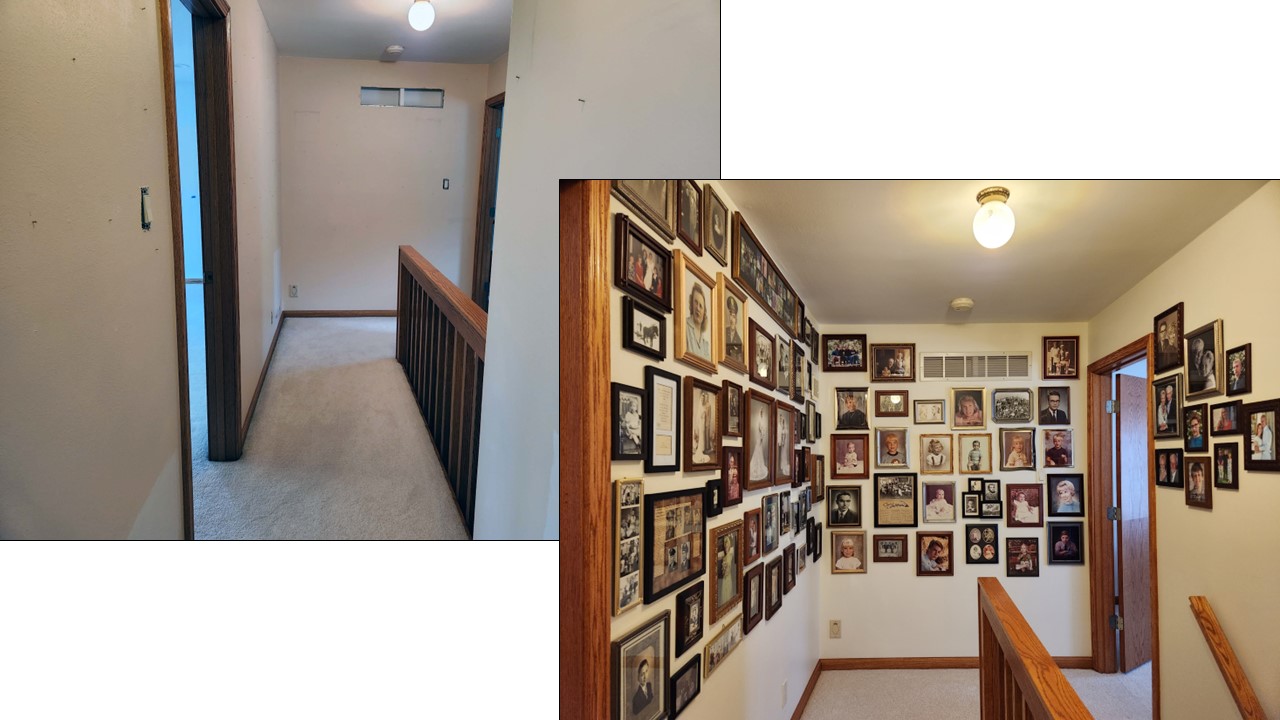
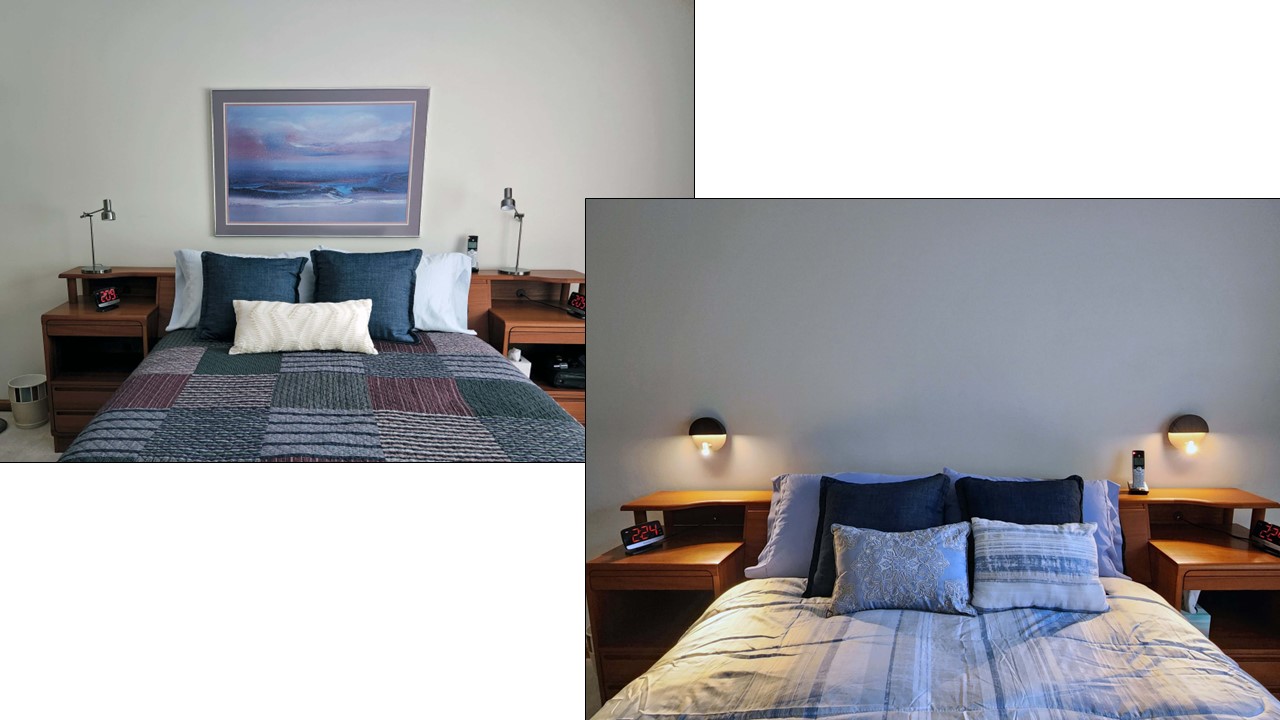
When Ted and I updated the interior of our house in 2022-23, we deliberately chose not to re-hang artwork or to set out decorative objects that we were getting tired of looking at. We also decided to simply leave the affected walls and surfaces bare in order to provide incentive for us to shop for new things.
It takes patience to find something that tells you, “This is the one.” We’ve been browsing in a variety of places every now and then–not too often, because you have to give the stores time to put out new stuff if you don’t like what you see. When I see furniture ads on TV, I don’t look at the furniture–I look at the artwork on the walls and at the accessories on the tables. If it looks appealing, we check out that store.
Last weekend, we went to Main Street in St. Charles to browse at the annual Mosaics Fine Art Festival. We weren’t sure we wanted a mosaic piece, but we’ve seen beautiful mosaic work on our travels, so it was worth a look. Not only that, but the weather was beautiful for a stroll through a festival. Surprise! We saw just about every variety of art–except mosaics!
After walking the half mile up Main Street where the displays were placed, and then the half mile down Main Street to get back to where we started, we liked only one thing. Wouldn’t you know it? We saw it at the third booth we visited! The walk gave us time to think it over, though, and to come back after some time had passed to see if we still liked it. This piece said, “Take me home,” so we did.
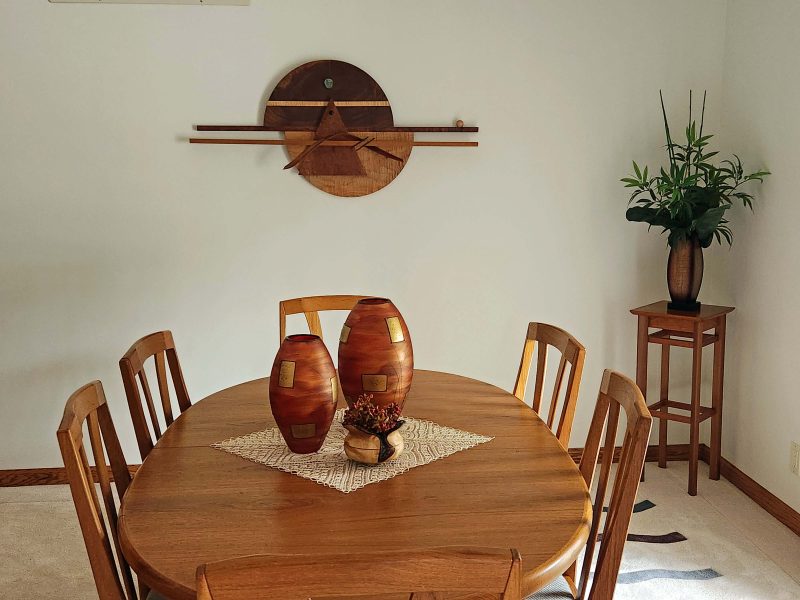
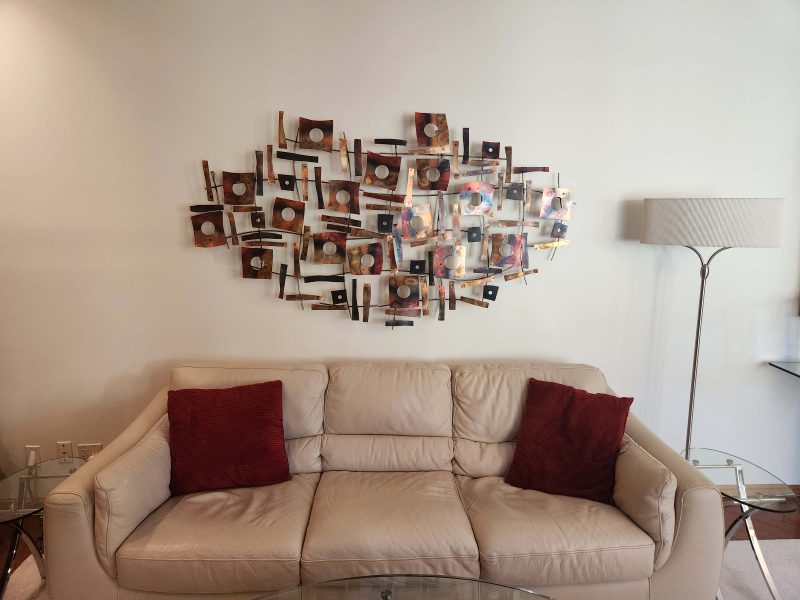
We hung it the next day, and it looks just as good as we hoped it would. It was made by an artist from Iowa. He titled the piece “Out of Balance.” We had to make a decision about which horizontal line to level when we hung it, because none of the horizontal lines is parallel to any of the others–therefore, they’re “Out of Balance”! It goes well with the vases Kathy bought from the Chicago Art Museum and gave to us for Christmas one year. We like it!
P.S. The small bowl in front of the vases is also from Kathy. She’s so artistic!
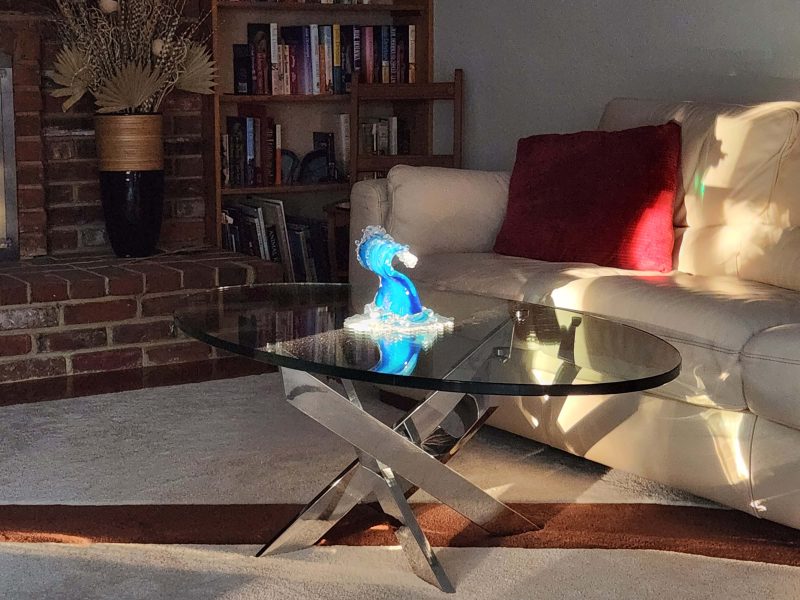
One day I walked into our family room during the few minutes the setting sun shone through the window and directly on our “Wave” sculpture from Hawai’i. It really made the blue color of the sculpture stand out in the room.
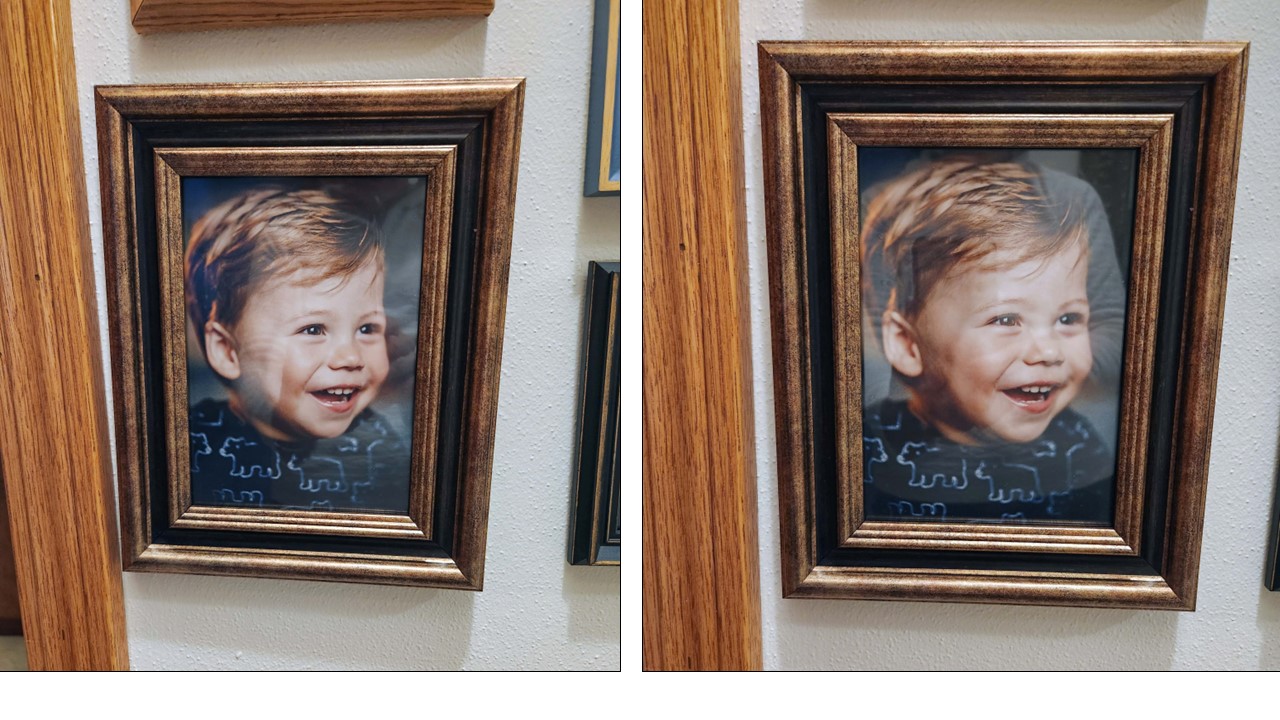
One of our gallery pictures of our grandson has always hung crooked, no matter what I did to straighten it. One day, I decided to weight the picture with pennies. Unfortunately, between Ted and me, we had only one penny, and that turned out to be insufficient. The picture still hung crooked.
I mentioned this little problem at a family gathering and said I thought I needed another two cents. The conversation moved on, but after a few minutes, Dylan re-entered the room and handed me two cents. Thank you, Dylan!
I added Dylan’s pennies to the back of the picture and it still didn’t hang straight, so I tried a nickel. That didn’t help, so I moved up to a quarter. That helped a little. When I added a second quarter, the picture hung straight.
I don’t think I’ve ever added more than two cents to a picture, but this one was a 53-cent job. The bottom corner of the picture butted up against the door frame. I wonder how far it would have tilted if the door frame didn’t stop it. Well, at least it’s finally straight and this little guy’s picture is no longer cockeyed.
Ted and I had to clear our walls for the painters in Fall 2022. We were both tired of looking at the same old things on the walls, so we decided that we would only re-hang the things we missed looking at. One of the things we missed looking at was a two-piece sculpture. It’s not an easy thing to hang. The two pieces need to be properly aligned; they are heavy and awkward to handle; and the design pieces have sharp corners. An added challenge is that it needs to be hung on eight irregularly arranged hangers.
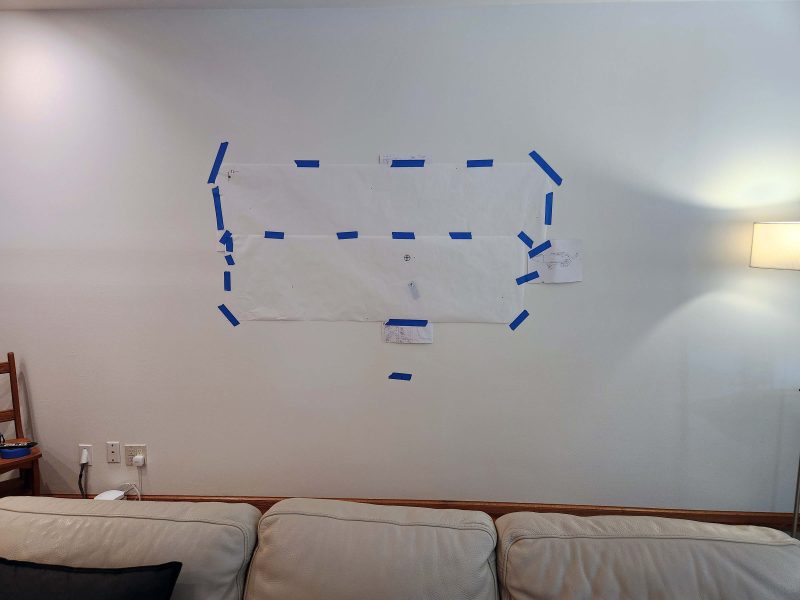
I decided that a template would probably avoid repeated trial-and-error efforts, so we spread some large, taped-together sheets of paper on the basement floor and properly aligned the sculpture pieces on them. Then we marked where the irregular hangers were so we’d know where to put the nails into the wall. The hangers are welded to the sculpture frame, but the frame does not extend to the edges of the sculpture. That provided another challenge: deciding where to place the template on the wall so that the sculpture would hang where we wanted it to be. We worked with the outside measurements of the sculpture and the template to determine the center, transferred those measurements to the wall, and then taped the template to the wall.
Instead of pounding the nails all the way in on the template markings, I tapped them just hard enough to make a visible dent in the drywall. Then we removed the template and put in four of the eight nails we needed–just enough to hold the sculpture temporarily–before hanging the sculpture to check its placement. It looked good, so we took it down and hammered in the other four nails. Now the sculpture is securely hung and the placement looks good. Nice work, if I do say so myself.
Thanks to the kitchen update, the basement workshop got an update too. The last time we updated our kitchen, we selected some of the old, to-be-removed cabinets from the kitchen and had them moved to the workshop for neater storage down there.
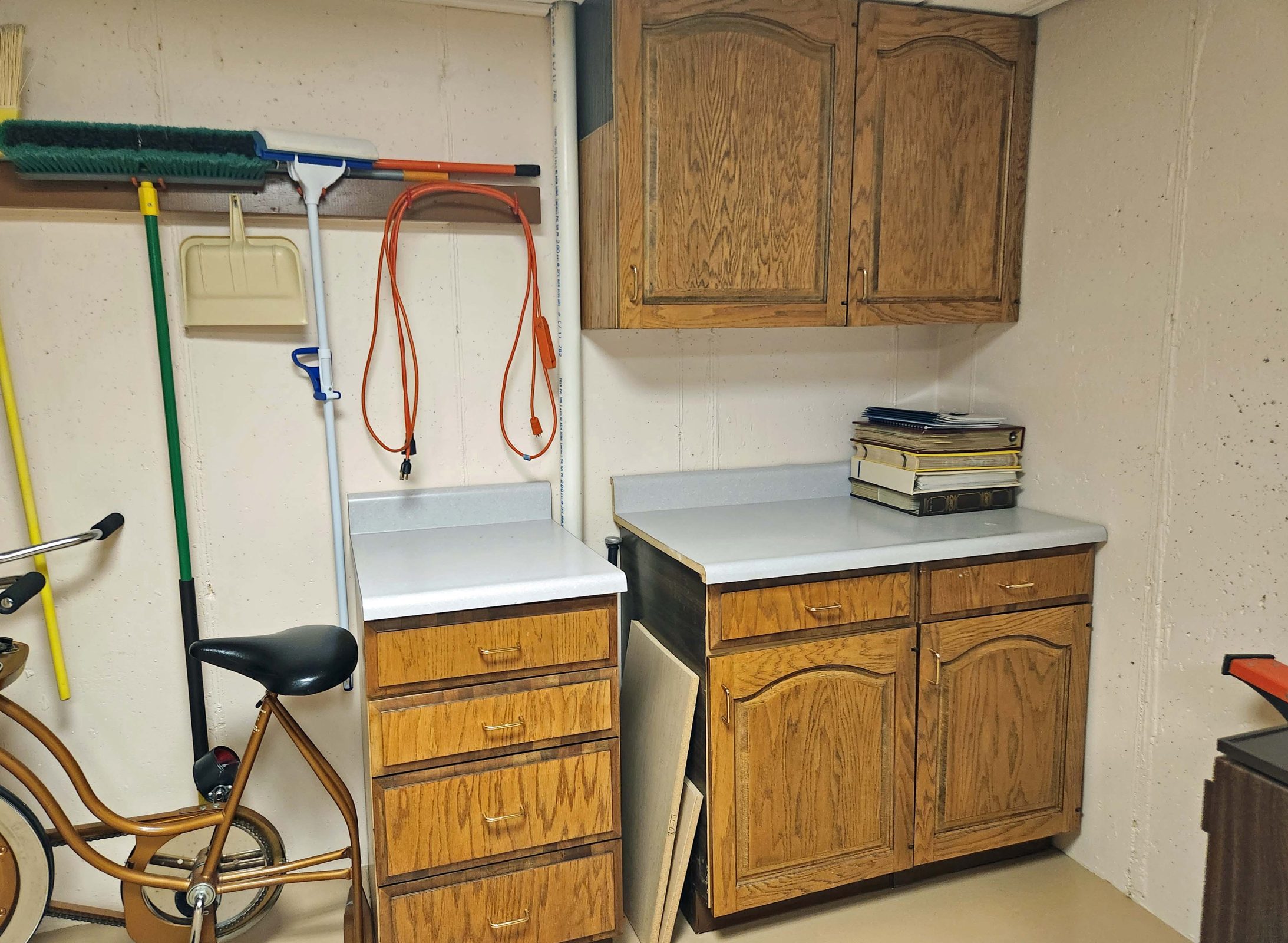
The cabinets pictured below were original to the house, and are now 44 years old. They show their age and the drawers no longer work very well. Naturally, the upper cabinet is installed (i.e., fastened to the wall). The lower three pieces, however, are just set in place against the wall with the countertop pieces simply resting on the cabinet tops, making those pieces easy to move. Not surprisingly, we never moved them. The PVC pipe drains the washing machine above, so the cabinets were placed separately on each side of it. The dark portions of the cabinet sides are the original color of the cabinets. I hated that dark color when we bought the house, so I stripped the cabinets and stained them lighter. The dark areas were against adjacent cabinets, so those portions didn’t get stripped. You can see the raw edge of the Formica countertop in the center. That countertop wasn’t originally on that cabinet; the workers at the time cut it to fit.
This was the workshop in the basement, so we didn’t need or expect beautiful cabinetry. We were satisfied for many years, but with new cabinets coming to the kitchen, it was the perfect time to replace these worn-out cabinets with something only half their age.
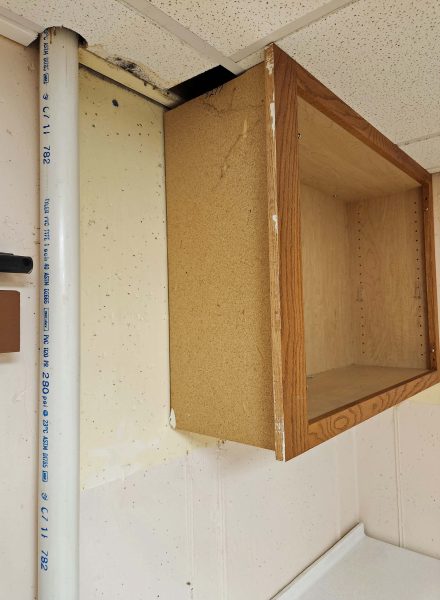
When our kitchen crew, Christian and Craig, removed the upper cabinets in the workshop, they noticed mold and some ceiling tile damage. That must have developed years ago when the washer hose broke and sent a full load of water to the basement floor–gallons of wash water and more gallons of rinse water. I left the washer running while I was away from home, so I wasn’t there to immediately turn off the water. Oops! What a mess that was to clean up! Since the cabinets were installed before the washer hose ruptured, we couldn’t dry the water or remove the ceiling tiles above them, and we couldn’t see the resulting damage. As a result, the water absorbed by the ceiling tiles in that area dried slowly enough to develop mold. It’s a good thing Christian and Craig could repair it now.
I expected the same kind of installation from Christian and Craig as we had last time: attach the upper cabinet to the wall, put the lower ones in place, and cut the countertop(s) to fit. Wow! Was I surprised!
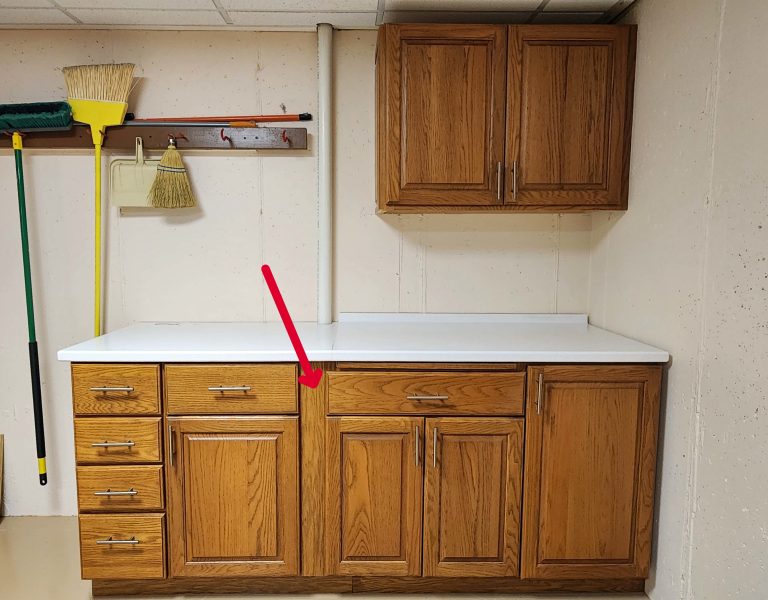
These guys didn’t put the cabinets in the basement; they installed them. They leveled everything and fastened every cabinet to its adjacent wall and to its adjacent cabinet. To hide the drainpipe space needed between the cabinets, the guys cut a spacer from a flat wood panel taken from a to-be-trashed cabinet from the kitchen, and inserted the spacer between the cabinet sections (arrow). None of the removed countertop pieces was long enough for the entire lower surface, so the right portion has a backsplash and the left portion doesn’t. To make a continuous countertop around the drainpipe, Christian cut a half-circle into the back edge of the countertop and joined the two pieces with a nearly invisible seam sealed with clear caulk. The back edge is also caulked along the wall. All of those details make the four lower cabinet pieces look like a single unit. Compare the photo below with the top photo above. Attention to detail makes a big difference!
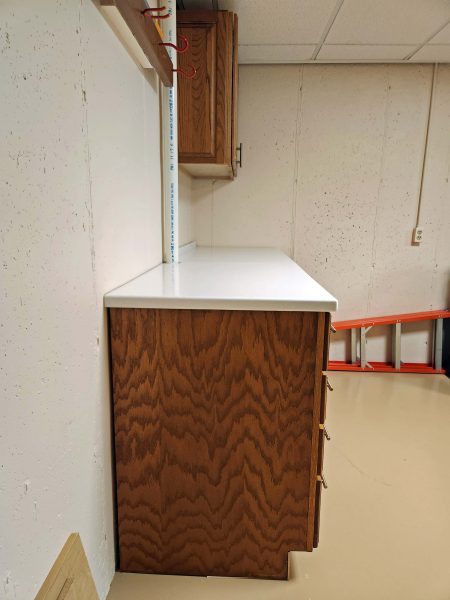
Speaking of details, . . . The over-the-top thing the guys did in the basement was to cover the exposed end of the upper cabinet with a trim piece (below). It’s not a perfect fit, but, like the spacer and the continuous countertop, I didn’t expect that level of detail in the workshop. Craig cut the piece from one of the old, matching cabinet doors and attached it to make the upper cabinet look nice from the side. Uh, that would be the side that faces the storage room. Doesn’t everyone want to see a beautifully finished workshop cabinet edge from the storage room?! Christian and Craig certainly do!
I expected these repurposed cabinets to look a lot like the previous ones, but in better condition. Instead, I feel like we ought to do something special in this room to justify such nice cabinetry. When I repeatedly complimented Christian and Craig on how beautiful the cabinets looked, they kind of shrugged as if to say, “How else would we have done it?” and Craig said, “Well, I like my workshop nice.” Obviously, it could have been done as simply as the previous crew did with the previous cabinets, but that’s not how these guys roll.
When we emptied all of our living area rooms for painting and carpeting in Fall 2022, we got rid of so many things, that we removed shelving and still have extra shelf space. The same was true when we refilled the “new” basement cabinets–we have extra space in our updated workshop. I wonder how long it will take us to fill all the empty shelf space we now have throughout the house. There’s a saying that the more countertop you have, the more things you set on it. I’ll bet the same is true for closets and shelves.
Our kitchen update project included some changes to bring our kitchen from its circa 2000 look to the 2020s era of design. Most of the changes were optional. One was not.
One evening last spring, while Ted and I were eating dinner, the chandelier we installed when we updated our kitchen 20+ years ago abruptly turned itself off. Everything looked good when we checked the breakers and the light switch connection. We tested the five light bulbs in another lamp and they all worked fine. In August 2022, we had the electrical box for this light moved to center it over the kitchen table. We wondered if there might be a problem with the installation, and felt nervous about using a light that might have wiring problems. I called our electrician, and he assured me that, as long as the switch was turned off, we were not in danger of an electrical fire. We planned to replace the chandelier with a new one during our kitchen update, but now we had a sense of urgency to shop.
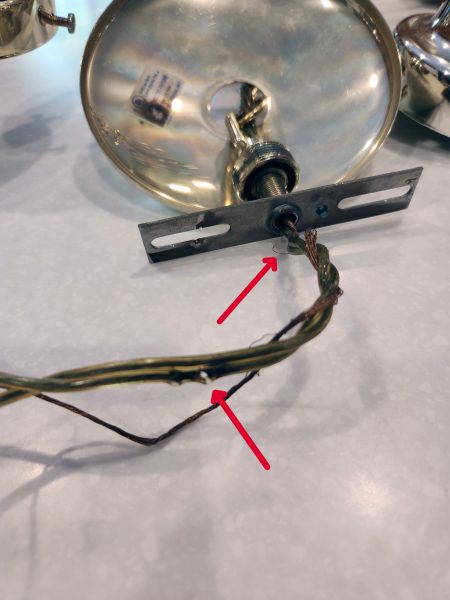
We bought a new chandelier and called the electrician to install it. When he removed the damaged light from the ceiling connection, he found the problem. The installer who moved the kitchen table light in 2022 (same company) pinched some wires with a screw when he attached the chandelier to the electrical box, and that eventually broke the wire. You can see the damage indicated by the arrows in the photo below. After installing the new light, the electrician prepared to leave and informed us there was no charge for the service. The company, he said, stands behind its work and we lost a chandelier due to their error. He even offered $100 toward our new light.
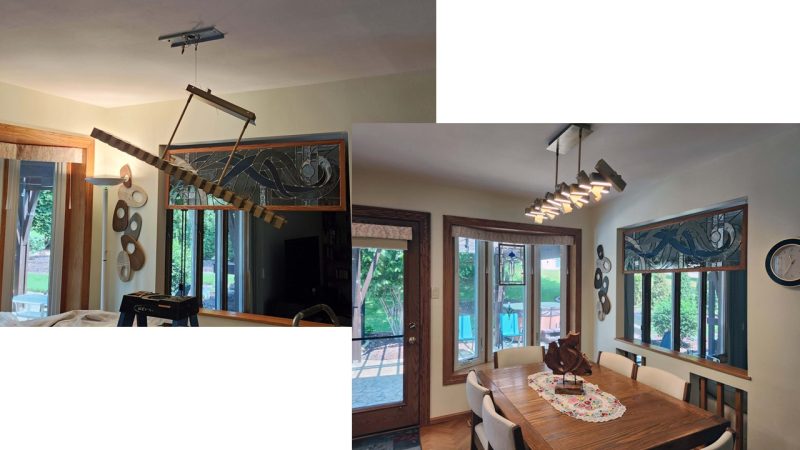
While he left his work area to get some other tools, the electrician let the (relatively heavy) new chandelier hang by a wire designed to hold the fixture during the installation process (left). I’d have been nervous about doing that, but it worked just fine. We used a 1980s vintage pole lamp from the basement (in the corner, left photo) for table lighting while we shopped and waited for the new chandelier installation. The right photo shows the new chandelier, properly attached to the ceiling.
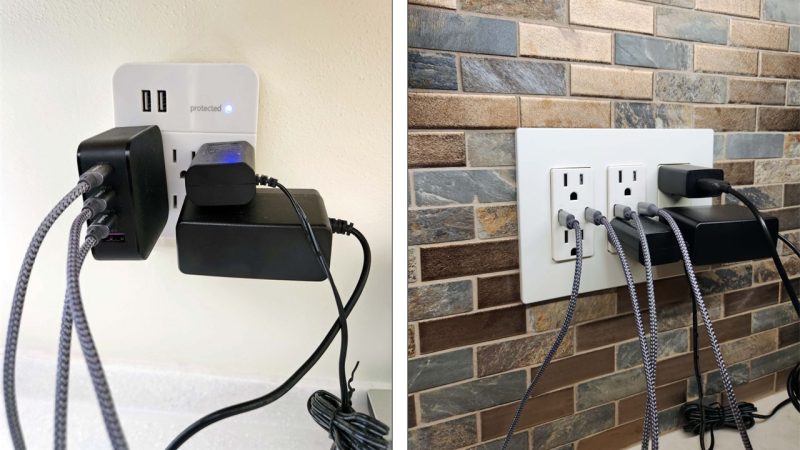
In addition to the new chandelier, we made a number of other changes to our kitchen design. There weren’t a lot of home devices to charge in the late 1990s when we last updated our kitchen, so one of our kitchen outlets used to look like the left photo. All of those plugs are inserted into a six-gang tree with 2 USB chargers which, in turn, is plugged into a two-gang outlet. Twenty-some years later, we had a six-gang outlet with built-in chargers installed to accommodate our current needs at that location. Much neater.
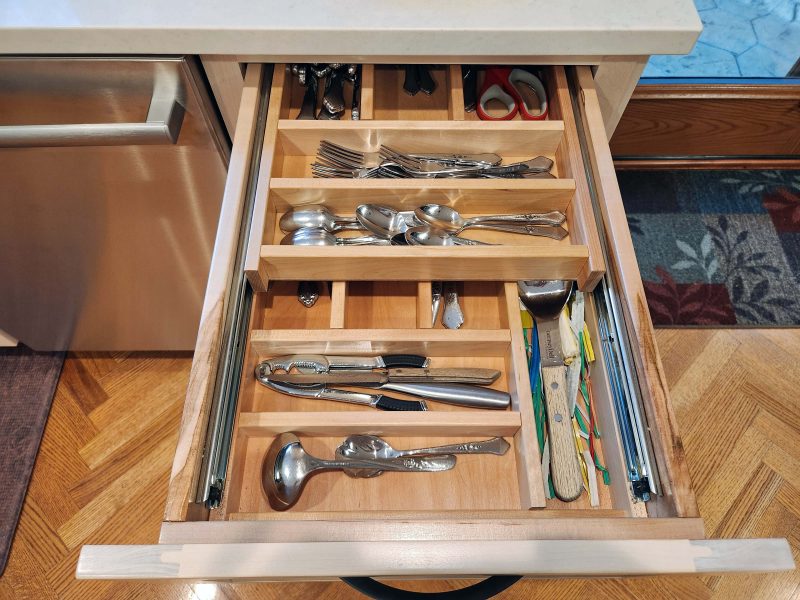
Instead of our Bed, Bath & Beyond silverware tray, we now have a two-tiered built-in silverware tray in this drawer.
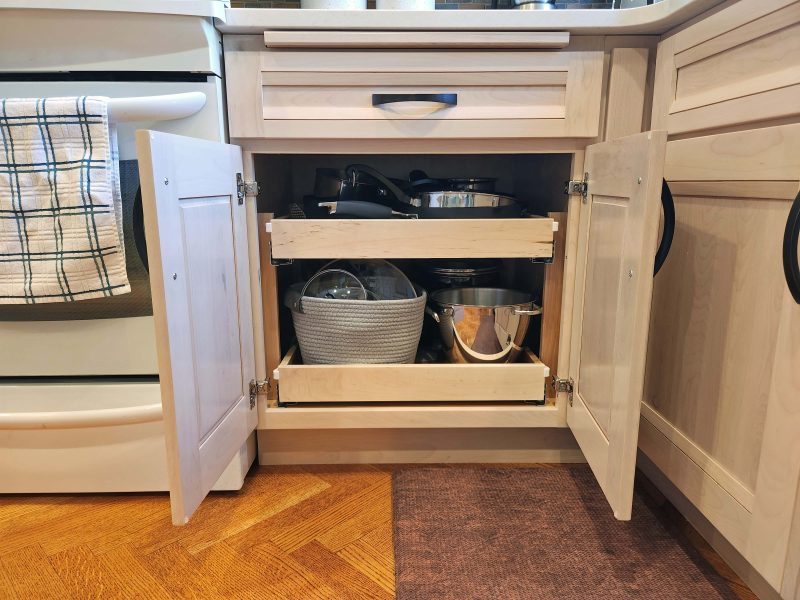
All of the lower cabinets have drawers instead of shelves. Now it’s much easier to put things away and to get them out because we don’t have to remove the items in the front to extract an item from the back.
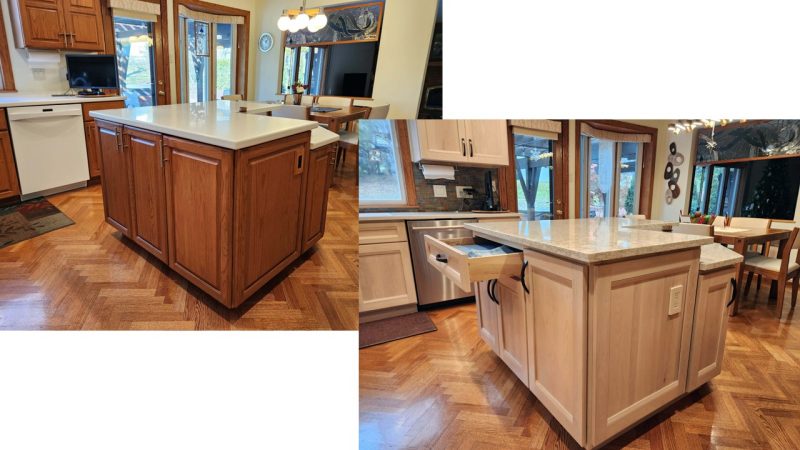
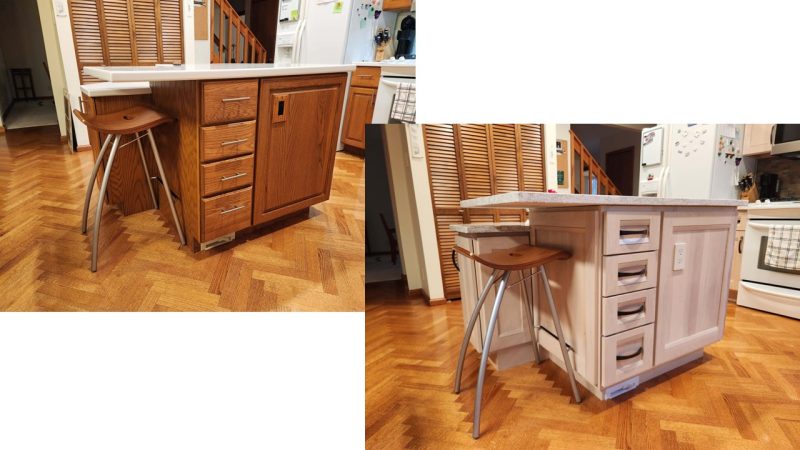
We added a drawer to the island so that we can store placemats and napkins conveniently near the table.
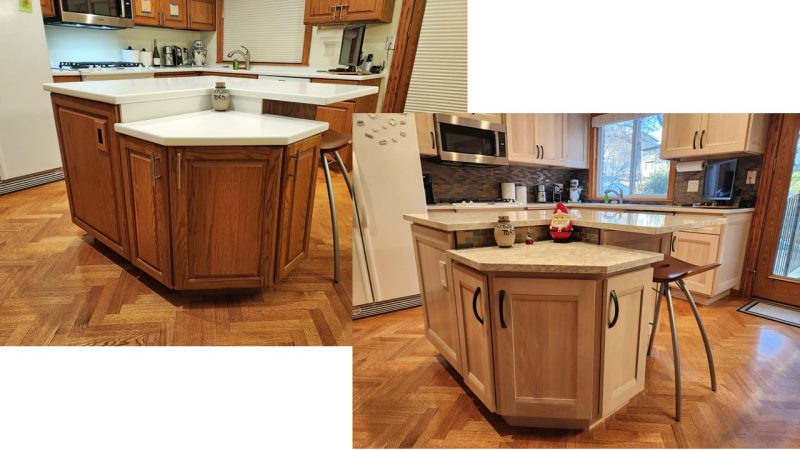
In our last kitchen update, the island backsplash matched the countertop. This time, we matched it to the backsplash over the cabinets.
Some of our previous cabinets had a matching flat panel on the exposed sides. This time, we added a trim panel to all the exposed sides, even in the corner where we keep the stool.
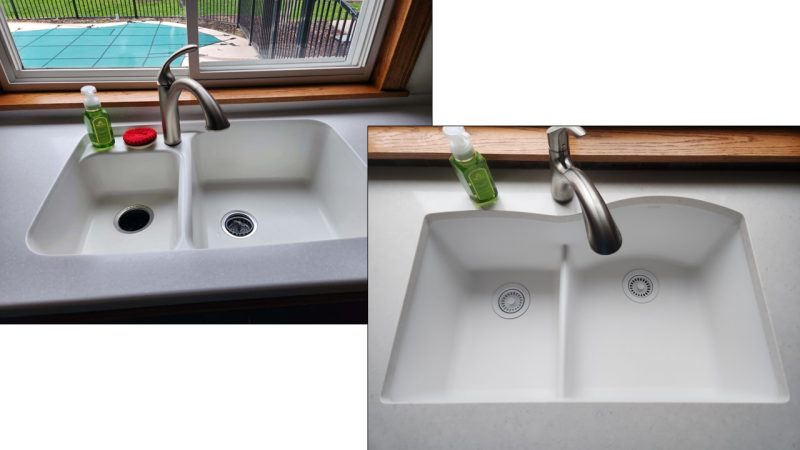
We replaced our Corian sink with a composite one. The Corian sink was still in great shape, but could not be removed from the surrounding Corian countertops, since they were poured together. Now we have a composite sink attached separately to the countertops.
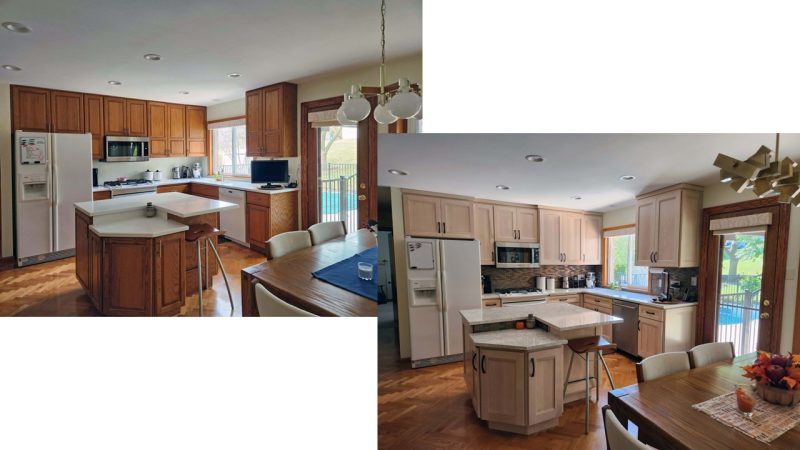
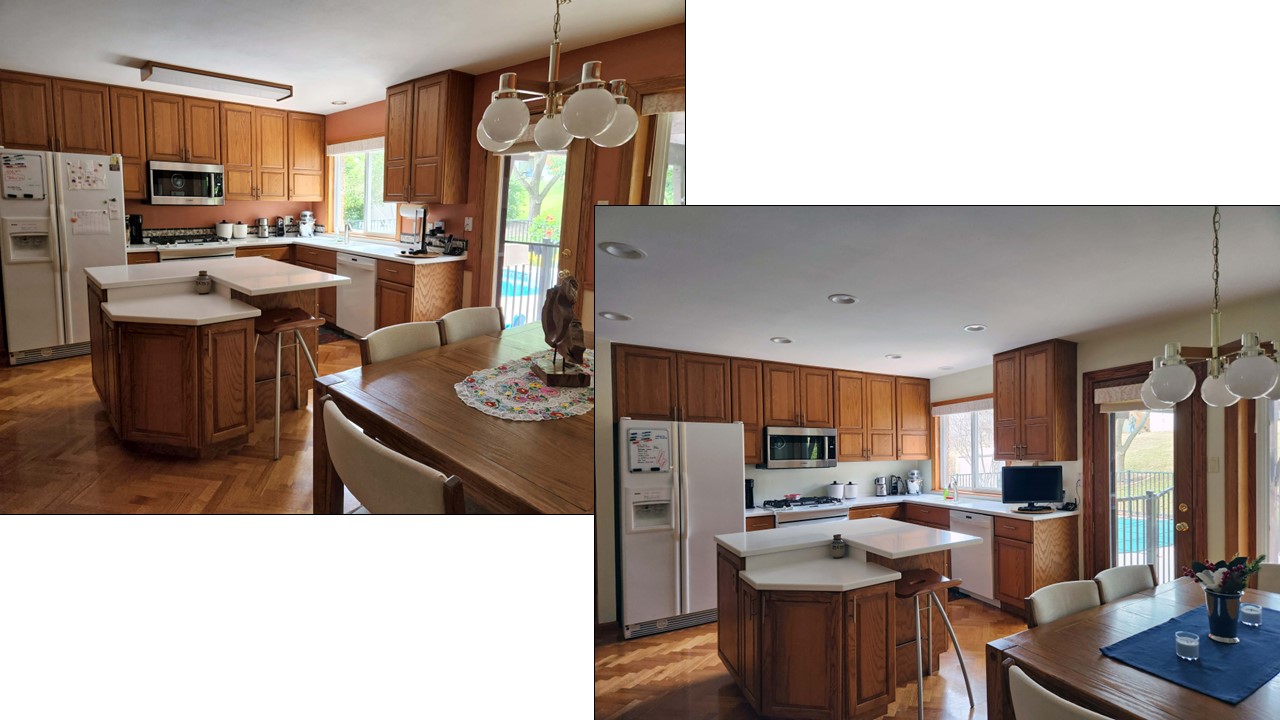
For this update, we ordered upper cabinets of varied depths to eliminate the straight-line front edge of the upper cabinets. Compare the old kitchen look (left) with the updated look (right).
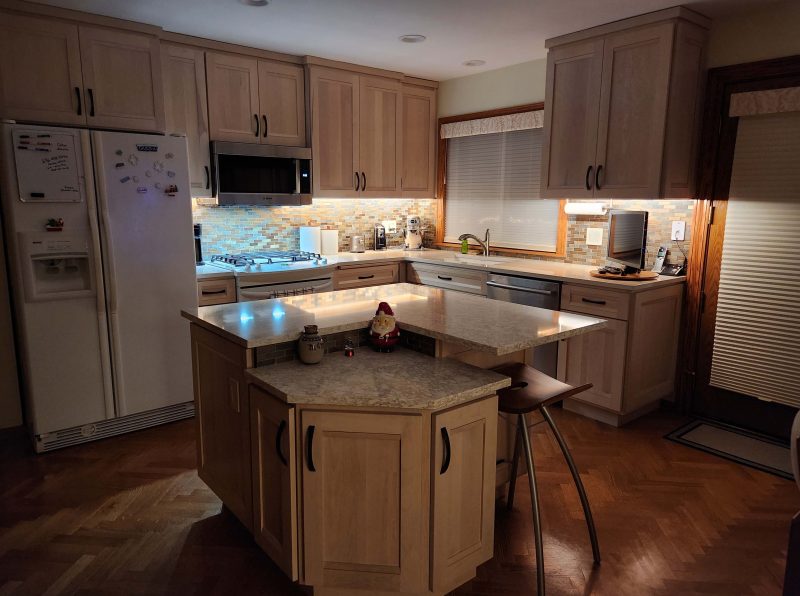
Here’s a picture of Jimmy’s, Christian’s, Craig’s, Ted’s, and my favorite change: the LED strip lighting over the countertops. It’s gorgeous in the evenings when the random bronze-colored backsplash tiles shine softly in the light.
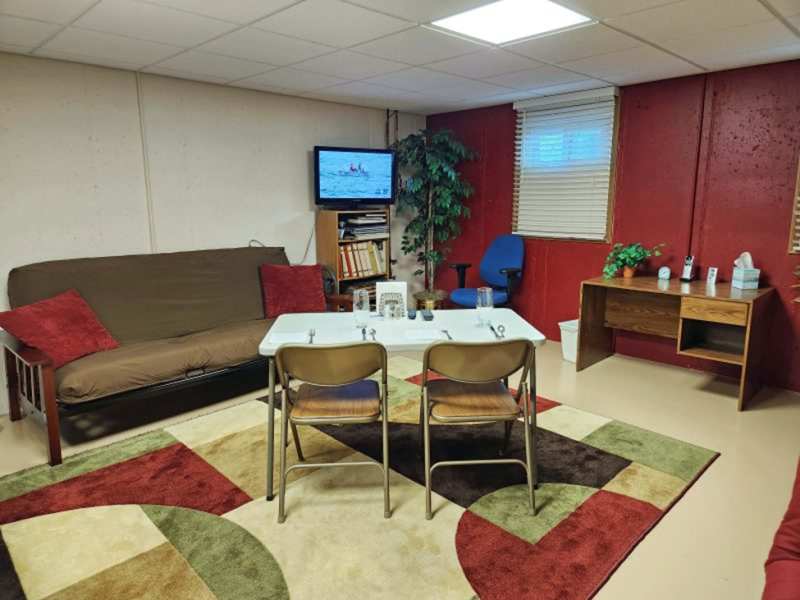
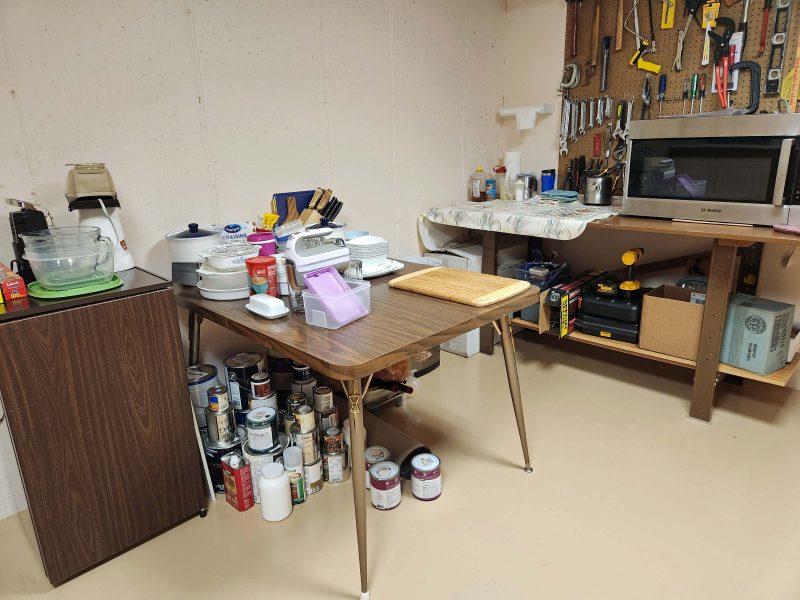
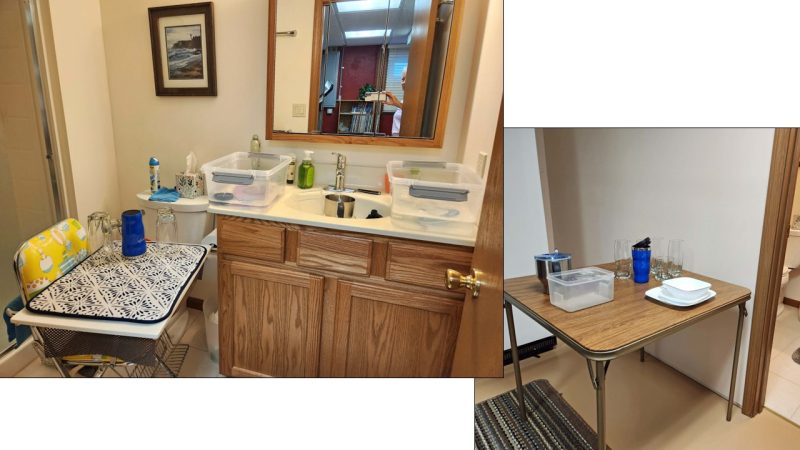
In addition to setting up temporary kitchen/dining areas in the basement, we had to empty all of the kitchen cabinets before the crew could begin their work.
Just like closets, you can get a lot of stuff in cabinets!
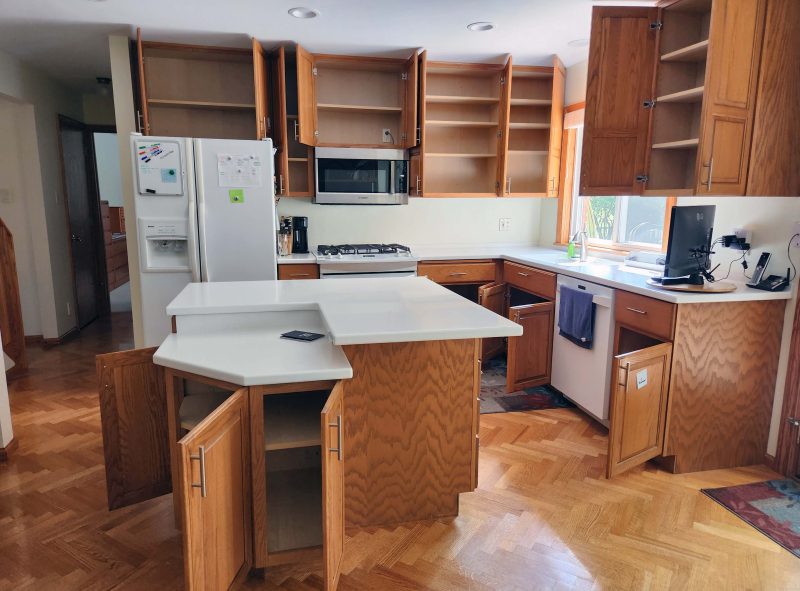
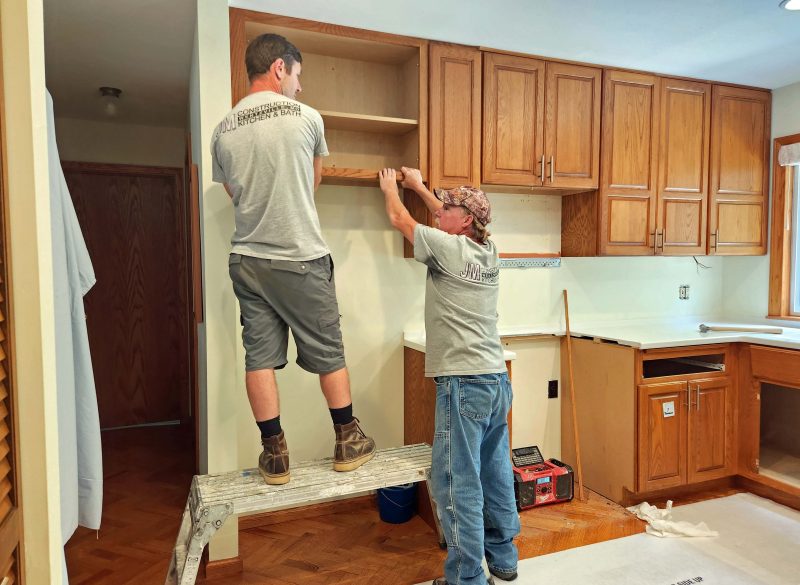
Jimmy, the company owner, sent Christian (left) and Craig (obviously, right) to start working on our kitchen on June 21. The two guys worked daily through July 16. They started by removing our old (20+ years) cabinets. The cabinets were installed from right to left, so needed to be removed in the opposite direction.
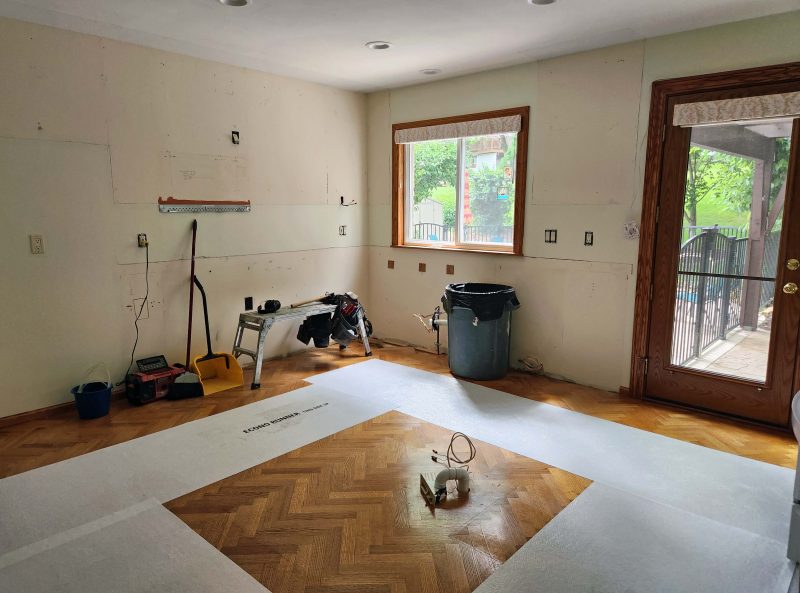
The cabinets are gone and the hardwood floor is well-protected. The kitchen looks so spacious!
When we replaced the original kitchen cabinets in our house, we put some of them in the basement to provide closed/covered storage. They are now 44 years old and definitely show their age. In our current kitchen contract, we included removing those original cabinets and replacing them with some of our current (now old) cabinets.
During this project, the guys made their mess in the garage and in the driveway, and cleaned it up every day. In the photo below, the truck is delivering the new cabinets and Christian is cutting one of our current/now old countertops to fit the new/old cabinet arrangement in the basement.
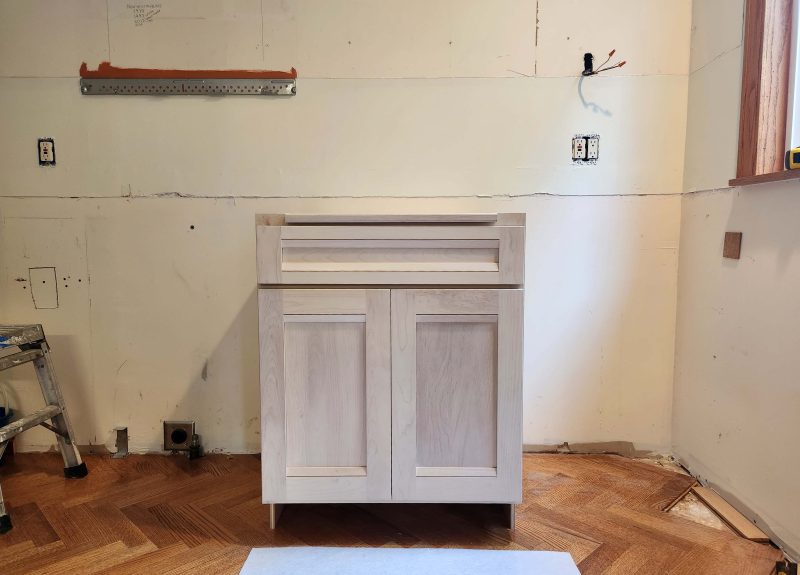
The first cabinet is installed. The wood is birch.
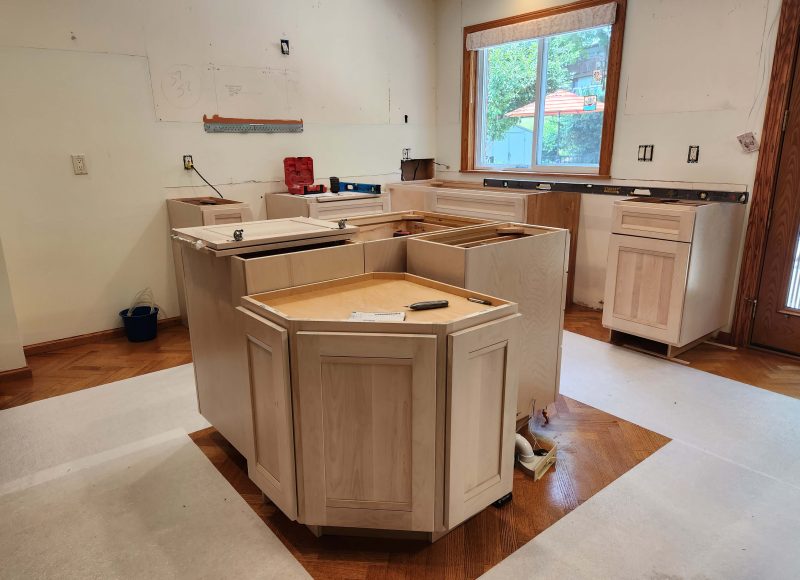
All of the base cabinets are installed. By doing the lower cabinets first, the guys can keep busy working on the upper cabinets while waiting for the countertops to be measured, manufactured, and installed. The island is actually four cabinets. It looks like a cabinet puzzle fitted together in this photo.
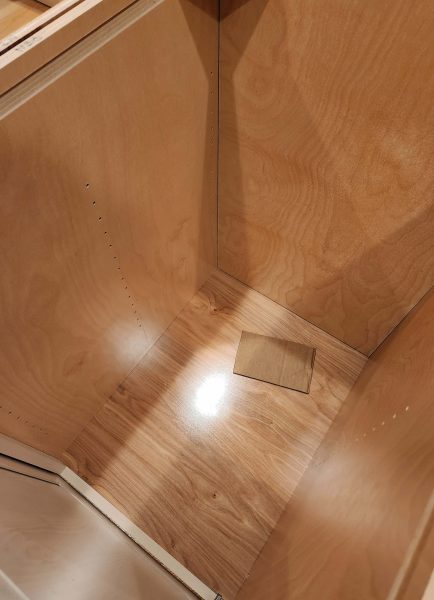
Even the interiors of the cabinets are beautifully finished.
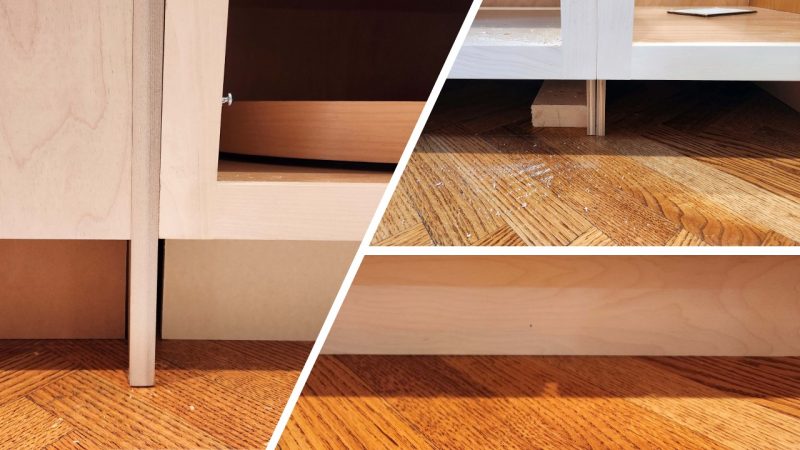
Some of the separate cabinets for the island were built with full-length side panels. When two cabinets were placed side-by-side, this created a great place to stub toes while working at the island (left image). Fortunately, Christian had a neat little toe kick saw that could cut a square corner under the cabinet (upper right image) to allow for a continuous toe kick all the way around the island (lower right image).
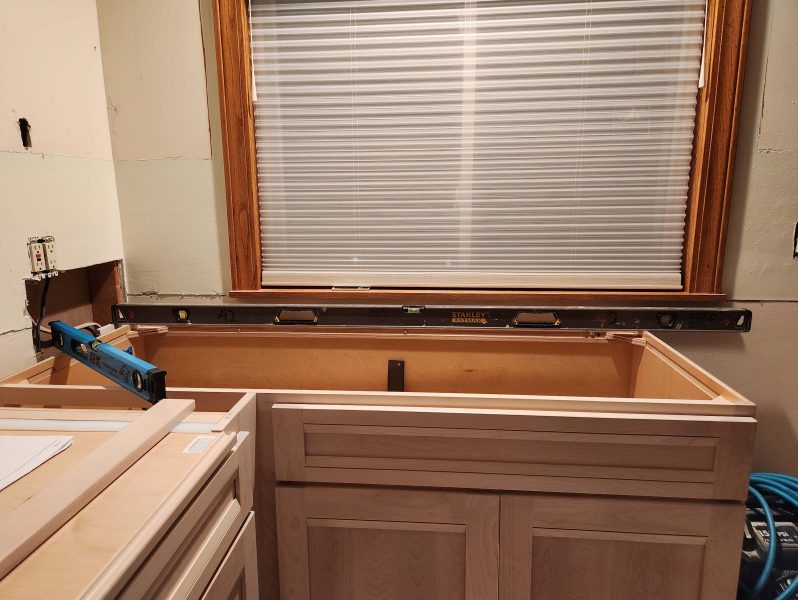
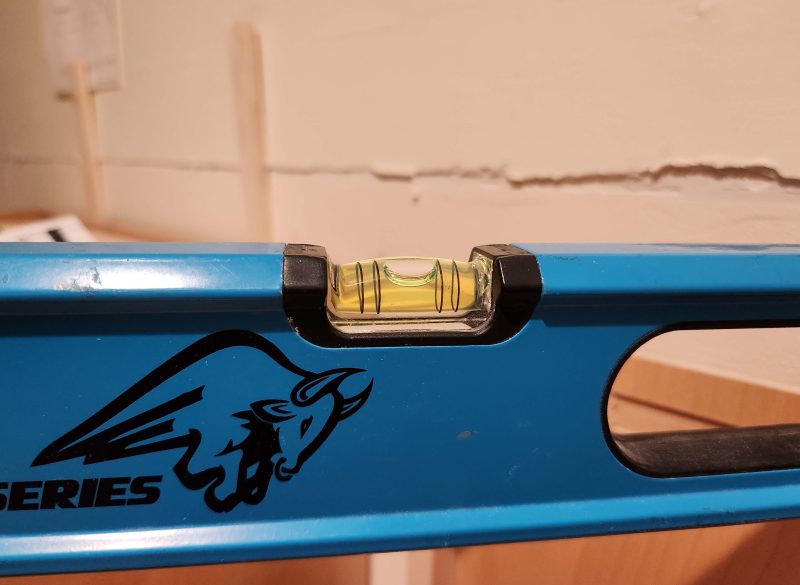
Christian was at least as picky as I am about details. His level was his constant companion. Are these cabinets level by themselves as well as with each other? . . .
. . . You bet they are!
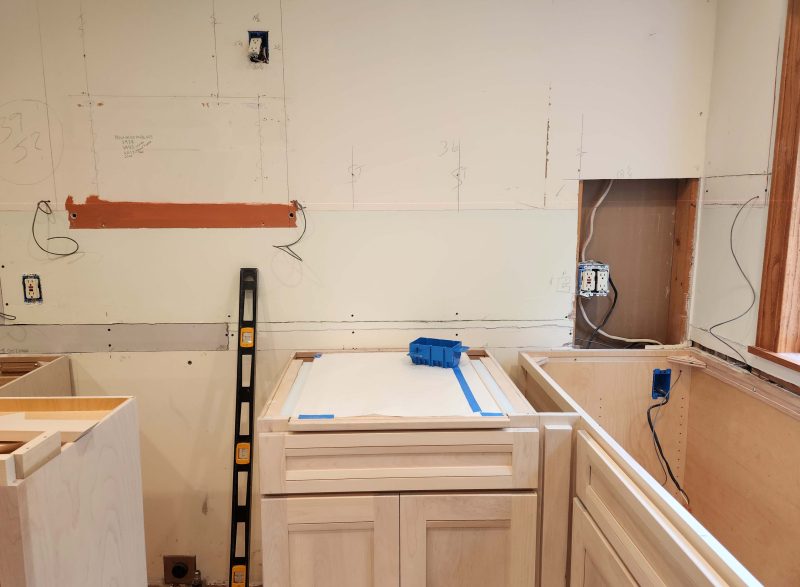
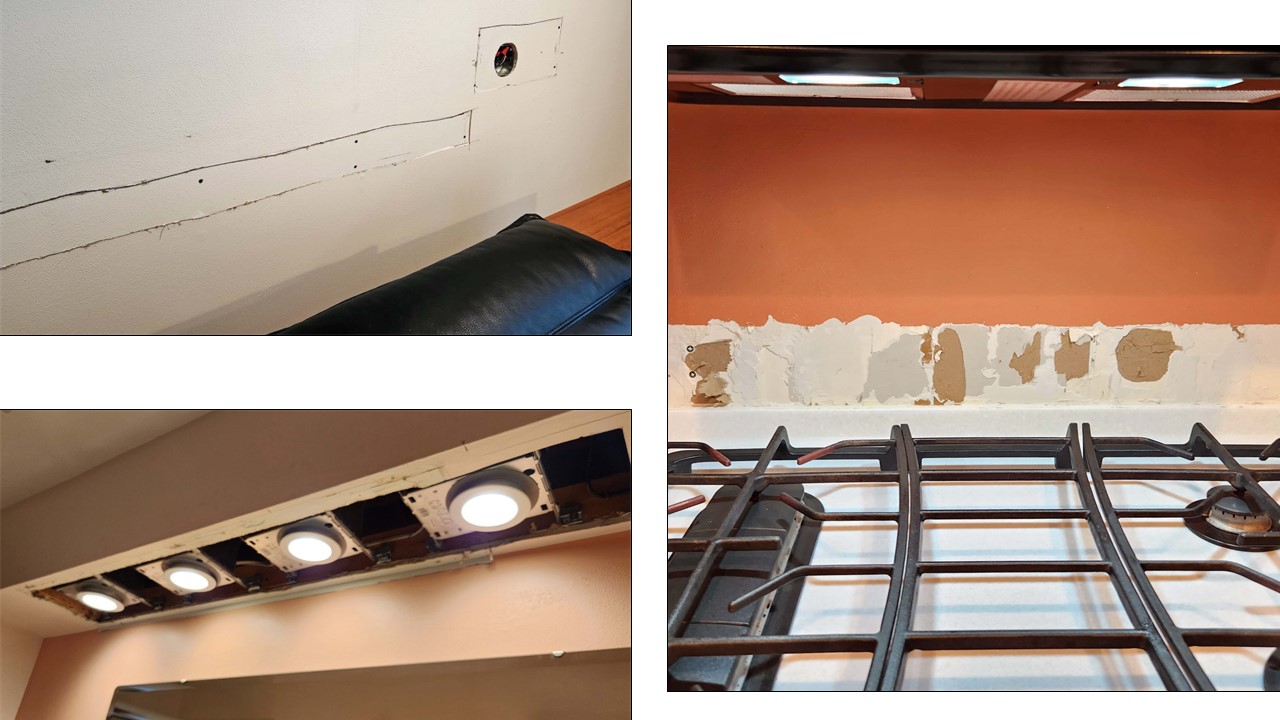
Under-cabinet lighting for all the upper cabinets was part of our design and required new electrical work. You can see the large hole in the wall and wires extending from the walls where the lights will be connected to the switch.
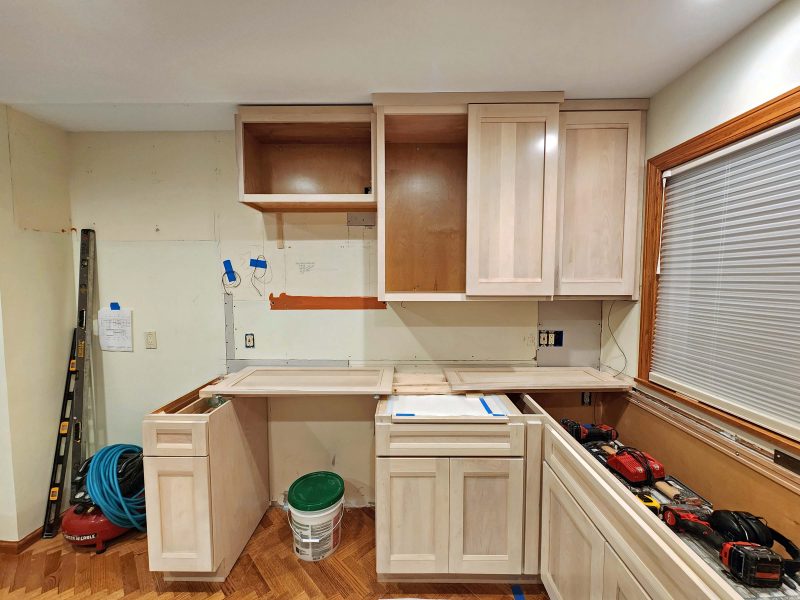
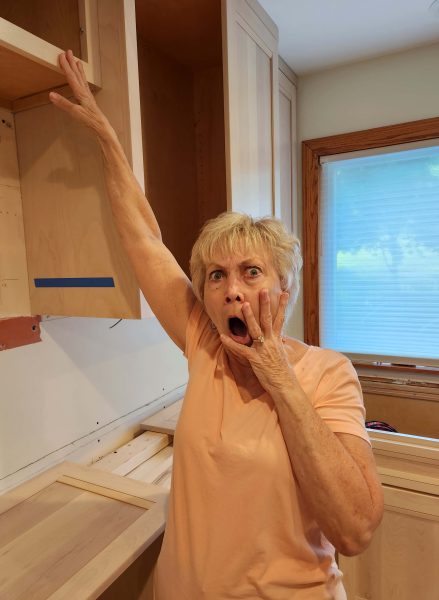
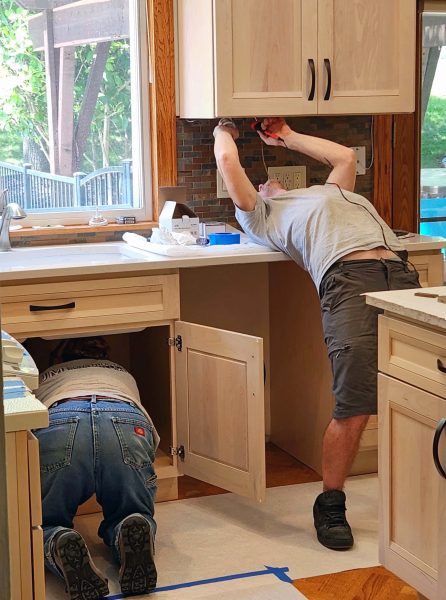
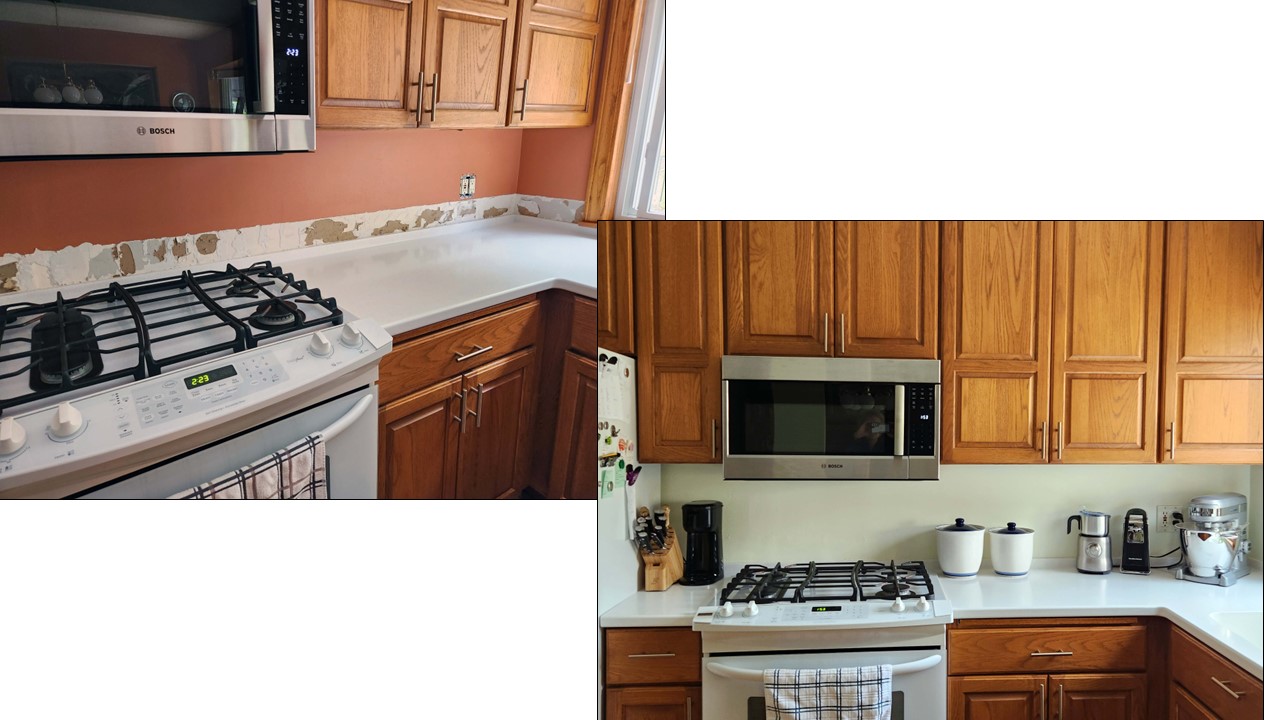
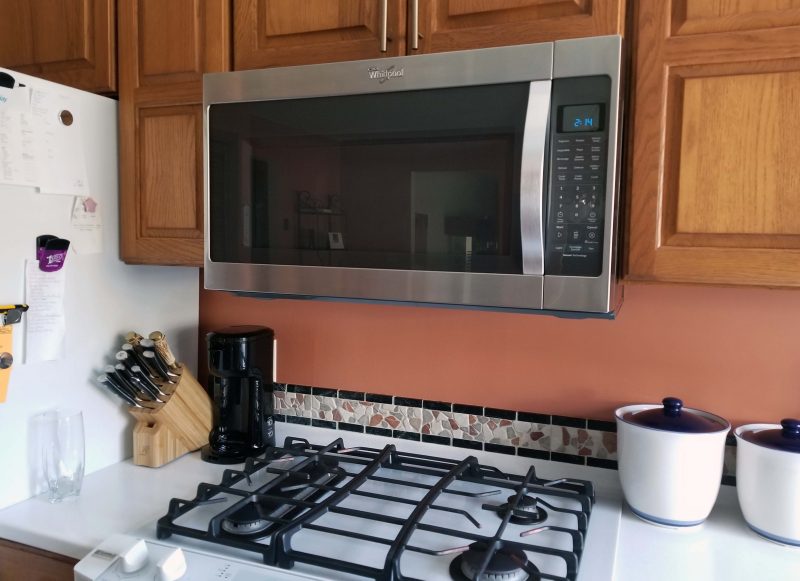
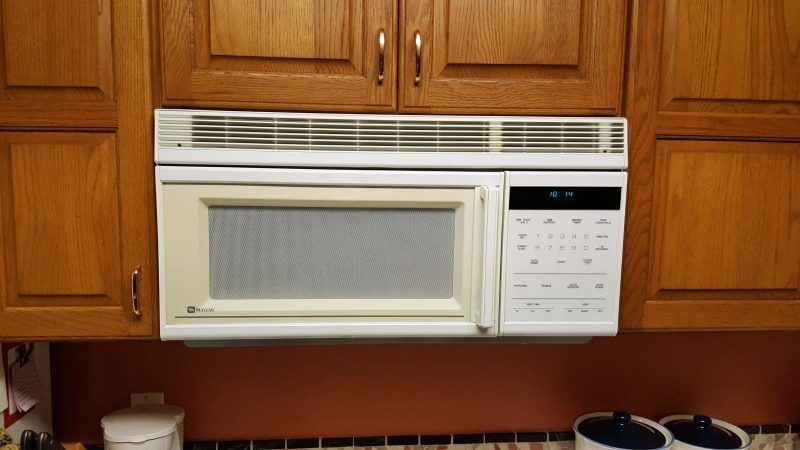
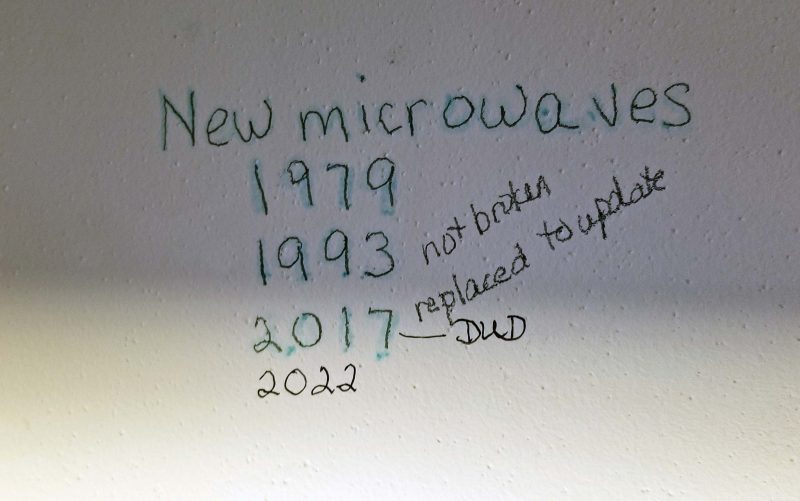
At this point, we ran into a problem and the guys had to pause their work for ten days while we waited for the countertops and a new cabinet to be made and delivered. Notice that rust-colored stripe of paint in the left center of the above photo. That was formerly covered by our microwave, which was mounted beneath a 24-inch long cabinet. You can also see the outline of the microwave installation template in that photo as well as the handwritten dates for each new microwave oven we installed. The delivered cabinet (short upper one, below) was only 18 inches long. Christian said he called the designer to verify the size because it seemed high to him. She verified an 18-inch long cabinet, so he installed it.
Why was that a problem? If we’d installed the microwave beneath that 18-inch cabinet, the bottom edge of the microwave would be where the top edge of the blue tape is in the photo below. The microwave cooking tray would be three inches above that line and the top edges of the cooking dishes in the microwave would be even higher. Check the blue tape line and my line of sight. I would have been unable to see whatever was in the microwave! Christian and Craig removed the 18-inch cabinet and the contractor ordered a longer one.
The mystery is why the designer planned an 18-inch cabinet for that space and why Jimmy, the boss man, who came to measure the cabinet dimensions in person didn’t catch the error either. As for Ted and me, cabinet length never came up in our design conversations, and we made the assumptions that the experts used standard lengths, and that the length of the two 24-inch long cabinets we’ve had above the microwave over the past 44 years was a standard length.
After the ten-day hiatus, work resumed on July 26 with the installation of the countertops.
After the countertops were installed (still waiting for that over-the-microwave cabinet), Christian got started on the backsplash. You can see it below on the island between the two countertop levels and to the left of the exterior door. The wall above the cabinets on the left is multi-colored because there was another problem.
After Christian and Craig installed the stove, I noticed that its back edge was more than one-quarter inch farther from the wall on the left than on the right. Even to a non-perfectionist, the stove looked like it wasn’t pushed in all the way on the left. I tried pushing it in, but it was tight against the front edge of the lower cabinets and didn’t budge. I told Christian it was going to drive me crazy to have the stove looking crooked every day for the next 20 (?) years and he agreed. He explained that he (as a fellow perfectionist) squared that line of cabinets with the line of cabinets under the window. Doing that revealed that the two walls formed a greater-than-90-degree corner. This didn’t affect the line of the cabinets, because the countertop was measured and fitted after they were installed and it fit tightly against the fronts of the cabinets and against the wall.
To compensate for the crooked wall, Christian painstakingly built up the wall surface (the dark-colored stuff) that would be behind the backsplash. When the backsplash was installed, the back edge of the stove was in parallel with the backsplash. The refrigerator covers the left edge of the backsplash, but if you move the refrigerator and examine that backsplash edge, you’ll see that there’s one-quarter inch of built-up surface material visible behind the standard backsplash trim piece. Christian is my kind of project worker!
In this photo, Craig is installing the garbage disposal and Christian is finishing up the under-cabinet lighting. He admitted it was hard on his back and he was glad to be finished with that task.
The guys worked through August 1 and then went on another hiatus and worked on other jobs. The cabinet for over the microwave had not yet arrived, and Ted and I needed to prepare for our overseas trip. The remaining upper cabinets and some finishing work were completed on October 21 after we returned home.
Most of our interior house update was completed by December 2022. In February 2023, Ted and I got serious about updating the kitchen. We updated the lighting and had the room painted in 2022, but that’s all. We had our first appointment with our kitchen designer on February 21. The planning, selection, and ordering processes took awhile, and we were finally scheduled for the professional workers to arrive on June 21.
Before giving the pros permission to demolish our kitchen, we had to set up an alternate eating and cooking space. Just like 25 years ago, that space was in the basement. We got out my old Wal-Mart craft table and some of the folding chairs we acquired in the early 1970s with grocery store trading stamps, and voilà! we had a dining room.
We also needed a prep/storage area. We set that up in the shop, where we have a table with a power outlet for the microwave. We won’t have the convenience of a stove for awhile, so I cooked and froze some meals in advance. We’re going to count on the microwave and eating out until the kitchen update is functional again. We used the shop table and our wedding gift kitchen table for prepping food and for storing the things we needed while the upstairs kitchen was unavailable. The paint cans under the table are not food-related. They are waiting to be put into “new” cabinets coming from our current kitchen.
Dishwashing was a challenge, but not impossible. Since we didn’t do any big cooking projects, we didn’t have many pots or pans to wash. Our system was to scrape the dirty dishes, then stack them in the bathroom sink. A dishpan on the right worked for washing and one on the left took care of rinsing the dishes. A large cutting board on our 1972 vintage baby high chair served as a place to drain the rinsed dishes before drying them. Then we stacked the clean, dry dishes on our trading stamp card table just outside the bathroom door before taking them back to the shop and putting them in the prep/storage area. (Photographer visible in mirror.)
The crew had to pause our job for ten days while we waited for the delivery of a cabinet. It had already been five weeks since the work started, and my frozen dinner supply was running very low (i.e., gone). Fortunately, the guys were at a point at which they could connect the stove. (Still no sink or water source in the kitchen.) By then, we appreciated the luxury of having a stove and an oven. We had no countertops, so the microwave had to stay in the basement. All but two of the cabinets were installed and off the floor, so there was room for us to collapse our kitchen table and to eat beside our soon-to-be installed dishwasher. We’re moving up in the world–literally up–from the basement.
We laid some of the shelving from the yet-to-be-installed cabinets over the unfinished island to create some surface space. That made it possible for us to set things down somewhere in the room. Some 2x4s and two doors from our old cabinets covered with plastic tablecloths gave us counter space under the window and beside the stove.
Even dishwashing became a little easier. We didn’t have running water or a drain in the kitchen yet, but at least the dirty dishes could be set on the stove, washed and rinsed in our trusty dishpans, and set to dry where the future sink would be installed. Clean, dry dishes could be put on the shelf-covered island. That’s a lot more space than we had for doing dishes in the basement! We could work side-by-side and move our elbows!
All of the above was inconvenient, but not especially difficult. In fact, it worked well enough that we decided we could entertain guests. We didn’t have enough space in the kitchen yet, but we invited Kari’s family to join us for a pizza party in our basement dining room. With paper plates and cups and carry-out pizzas, it was easy and fun.
During our interior update, Ted and I replaced our old futon and wanted a new mattress cover for it too. We found one in an acceptable color for only $20 at a going-out-of-business futon store. Oops! When we unpacked it to put in on the mattress, I discovered that the zipper was hopelessly broken. There were no other identical covers at the store, and I didn’t see any other colors or patterns I wanted online, so I decided to replace the zipper.
Nylon zippers can be “repaired” by simply sliding the zipper pull downward on the zipper. Problem #1: In this case, the zipper teeth were so far out of alignment that the zipper pull wouldn’t move. Problem #2: All along the length of the zipper, the nylon coils were so badly bent that the zipper could not possibly move smoothly in either direction. Problem #3: The bottom end of the zipper was completely separated, making it impossible to ever match the teeth again.
This is what might have happened to cause such extreme zipper damage. (1) In the factory folding/packaging process, the zipper was sharply folded in a variety of places. (2) Someone bought the mattress cover and unzipped it to put in on their futon mattress. Because of all the sharp bends in the zipper teeth, the movement of the zipper head caused the teeth to separate. (3) The buyer returned the mattress cover to the store without mentioning the damage. (4) The store re-sold the mattress cover–to us. Luckily, and thanks to my mother, I’m an expert seamstress.
I bought some black zipper-by-the-yard (color choices were white, brown, and black), ripped out the damaged zipper, and replaced it with my new zipper yardage. I don’t think I’ve used the zipper foot on my sewing machine since I bought it. All zipper feet are based on the same design principle, but this one is awesome. It’s the best zipper foot I’ve ever used! It sits very comfortably on the fabric and effortlessly guides itself along the zipper teeth. I wish I had another zipper-style project to sew because it would be fun to use the zipper foot again.
It didn’t take long to finish putting in the zipper. Then it was time to put the mattress cover on the mattress. Voilà! We now have a new futon with a new mattress cover.
As part of our interior house update, Ted and I decided to replace our many-years-old baker’s shelf in the kitchen with a nicer piece of furniture. We shopped, and we shopped some more before we finally selected a cabinet that we liked and that would fit in the corner. Then we eagerly looked forward to its delivery.
Included with the delivered cabinet was a duly checked and signed checklist–for bed parts. Huh?
The delivery men brought the cabinet in, removed the protective bubble wrap, laid out the parts (shelves, doors, legs, etc.), and discovered that the 12 screws needed to attach the legs had not been included. “Hardware” was checked on the list, but “Legs” does not appear. We had the unmentioned legs, but not the checked-off hardware. Go figure! Here’s the cabinet, standing on the floor with the legs waiting to be attached.
One of the men called the boss man, explained the problem, and told us they would send someone out within the next two weeks to attach the legs. Okay, things happen. Everything will be fine in two more weeks. Or will it?
As promised and scheduled, two more delivery men arrived–without screws. I offered to let them select screws from our collection, and I made the alternate suggestion that they could go to Home Depot to purchase new screws. “No,” they said, “we can’t do that.” Apparently, the screws have to be the manufacturer-provided screws or the store’s responsibility for assembly becomes null and void. I would have attached the legs myself, but Crate & Barrel would not allow us to pick up the cabinet to save the delivery cost. Instead, they charged us $250 to deliver and assemble it. For that, I decided they could work this out themselves.
Ted followed up with a call to our salesperson to explain the situation and to express our disappointment that we’d had two delivery/assembly appointments and neither one had the screws needed to complete the assembly. Ted mentioned that we were disappointed at receiving this kind of service from a reputable store. To make up for the problem, the salesman sent us a $200 Crate & Barrel gift certificate. That made us feel a little better while we waited another two weeks for the next two delivery men, who arrived with a surprise.
Instead of bringing 12 screws and a screwdriver, they brought a replacement cabinet. Again: Huh? There was nothing wrong with the first cabinet; it simply needed screws to attach the legs. However, Team #3 not only had the replacement cabinet, but the screws as well. Whoopee! They attached the replacement legs to the replacement cabinet and, three delivery appointments after we bought the first cabinet, we have a cabinet standing on its legs.
As part of our house update, Ted and I ordered a new fireplace screen in February, and it was installed this week. Our fireplace has a curved arch, so it requires a custom-made screen. Our old screen has served us for 40+ years, and it was time for a new look. The old screen had folding doors, and obvious signs of use along the lower edge.
The new screen is similar, but in a different color, with one-piece doors, and a vent on the lower edge. The doors also seal more tightly than the old doors.
The fireplace season is over, but we’ll be using the new screen next fall.
Just so Ted and I could see the difference after we finished our interior update, I took “before” pictures around the house. Now that we have “after” pictures as well, it’s good to see that all the work was worth it.
LIBRARY
When I was in grad school, I kept my textbooks and research materials on a bookshelf in the living room near our computer so that I could easily reference them. I’ve only occasionally looked at a few of those books since I finished my last advanced degree in 2005, so it seemed logical to move that bookshelf to the library where the other bookshelves live. Here’s the library before and after we made the update changes. The washstand originally belonged to my great-grandparents. Ted and I bought the rocking chair unfinished when we were expecting Jeff. I finished it and made cushions for it. The big clay lamp is no longer with us. “Before” is on the left; “after” is on the right.
CLOSETS
Emptying the closets for the painters gave us a chance to throw things away, to give things to Goodwill, and to remove/reorganize some shelving. As a result, our closets have 17 fewer shelves and empty spaces on the remaining shelves. (We got rid of a lot of stuff!) You can see that the closet shelves on the left are pretty bare. That closet used to have three more filled shelves–one above the current shelf over the clothing rod, plus two additional shelves on the back wall. The closet on the right is in the project room. We removed the unneeded clothing rod and the six smaller shelves that were on the side wall (pictured) plus four shelves from the back wall. Then we filled the side wall with these five new, longer shelves. I love it! Now I can easily find everything I need when I work in that room.
PROJECT ROOM
The desk on the left has a new life–probably as firewood. I started shopping for a desk to replace it in January 2020. There isn’t room for a full-sized desk because of the extendable work table beside it, and I don’t need a full-sized desk anyway. I only need some shelf space (or a drawer) for a few office supplies (to make sketches and to calculate measurements for projects) and a surface large enough to hold my serger. It’s surprisingly difficult to find a desk in a 30-35″ size that includes a drawer or shelves, but I found one I liked at IKEA. Unfortunately, it was out of stock, like everything else in 2020. Every few months, I checked the website, but it was always out of stock. Two weeks ago, I checked the website for the umpteenth time, and there it was! Only 36 months later! Ted and I went to IKEA, picked it up, and retired the old desk.
We also replaced the futon in the project room, which doubles as a guest room when needed. The old futon served us well, but the mattress had become very hard over the years and the frame didn’t match any of our current furniture. The new mattress has inner springs, so it will be more comfortable for us to sit on and for guests to sleep on, and the frame matches the other furniture in the room.
After the contractors left, Dean and Dylan installed the bar light above my sewing machine. I just finished a sewing project and the bar light works well. It’s also much cooler than the 1980s pole lamp with its 300w halogen bulb.
In the photos below, you can see the project room before and after the new desk and desk lamp were added and after the ceiling lighting and ceiling fan were installed. Now I don’t need the box fan that’s hiding in the corner behind the table (left).
GALLERY
There’s a code for homeowners to use for professional painters: leave the nails in the walls if you’re going to re-use them and don’t want the holes filled. You can see place-saving nails in the photo on the left. That made it much easier to re-hang the 100+ photos in our gallery/upstairs hallway. In case you’re counting photos, there are two walls of photos that don’t show in the picture on the right.
STAIRS
The carpeted stairs are much safer than the slippery hardwood stairs were. We didn’t want to eliminate the look of hardwood completely, so the carpet folks suggested a cap-and-band style of carpeting on the stairs. We like it.
MASTER BEDROOM AND BATHROOM
Here’s our bedroom with our old Wal-Mart bed lamps and with the new wired bed lamps. Ted and I extend our thanks to the professionals who installed the wiring and to Dean and Dylan who installed the lamps.
The master bathroom has always had a fluorescent light above the sink. We changed that to recessed halo lamps. They look a lot more modern, and that’s what an update is about, right?
DINING ROOM
Our last update (20+ years ago) included carpet art in the living room, dining room, foyer, and family room. We loved that look, but were ready for new colors and a different design. Here’s the new carpet art in the dining room (right).
LIVING ROOM
We removed two of the blue leather chairs and footstools from the living room and replaced them with off-white chairs. Without all that footstool clutter, the new carpet art shows well. We bought a smaller desk chair and also replaced the bookshelf with a much smaller display unit. Lighter paint and chairs, fewer footstools, and smaller pieces of furniture opened up the room very nicely.
FOYER
When we mentioned replacing the carpet art, our listeners always remarked that it didn’t look like it needed to be replaced. Closer inspection easily shows how faded the colors had become. Some of the peach-colored art in the foyer carpet (left) was nearly colorless from sunlight shining through the front door. It really was time for an update.
LAUNDRY ROOM
The photo on the left shows the laundry room ceiling light installed by our builders. I never liked it, but we don’t spend a lot of time in the laundry room, so we never bothered to replace it. Now it was time. Thanks again, Dean and Dylan, for helping Dylan gain experience for his future career.
KITCHEN
The holes and gashes in the kitchen ceiling from installing the lighting, and the damage above the countertops from ripping off the ceramic tile backsplash gave the drywall repair man a chance to show off his camouflaging skills. The newly painted ceiling and the wall above the countertops look much better now. We’ll replace the backsplash after we have new cabinets installed.
Our kitchen originally had a fluorescent ceiling light in the work area (left). We replaced that with recessed halo lights. We always used warm fluorescent bulbs, so the kitchen didn’t have a blue glow, but the halo lights provide much better lighting–and they’re dimmable, if desired.
Ted and I have never come up with a reason why our builder wired the kitchen eating area ceiling light where he did. It’s not centered over the table (or anything else), so we always had to have a lamp with a chain to center the lighting over the table (left). We asked the electricians to center the electrical box for that lamp over the table. We shortened the chain and re-hung the lamp, but when we replace the lamp, a chain won’t be a requirement. Our interior designer said that removing the chair rail and painting the kitchen walls a single, lighter color would open up the room. She knows her stuff!
FAMILY ROOM
We have an 8-foot window wall on the near end of the family room, but that leaves the far end dark. In 2019, we had an electrician install an art light to highlight our 50th anniversary family picture. Without the art light, that end of the room would look even darker in the photo below (left). Our interior designer suggested limewashing the fireplace to lighten things up. We asked the painter about that and he, in turn, asked how often we use the fireplace. I told him that we burn more than a cord of wood each year. In that case, he said, the limewash would turn gray over time and there would be nothing to do about it. He suggested a light wall instead, and we like the row of eyeball lights the electricians installed. The designer was right about our old media center too. It was so big that it shut off the room from the doorway perspective and it didn’t match anything in the room. With a smaller media center, the room feels more spacious.
MORE TO COME
Ted and I still have a lot of finishing touches to add in every room: new valances for all the windows to match our new paint colors; new kitchen cabinets; some new pieces of furniture; some new pieces of wall art; and (my favorite) “more.” With all of this to be done, none of our rooms is completely updated at this point, and most of them have a somewhat stark look that will remain until we find replacements that we like. That stark look will keep us motivated to continue shopping, and to stick to our less talk and more action resolution.
While Ted and I were clearing the walls, emptying the closets, and moving the furniture around for our interior update, we found a lot of things that we either (1) never use, or (2) are simply tired of after so many years. When you have to actively pick up and put so many things into boxes, it makes you pause to wonder, “Do we really need to keep this?” During our interior update process, we donated and trashed a lot of now-useless (to us) stuff, as well as some long-time treasures that have become less treasured. The useless junk was easy to pitch; some of the other things–especially if they had sentimental value of any kind or of any degree–required more decisive thinking to give or throw away.
We bought this hanging wall lamp with trading stamps from the grocery store. Does that give you a clue about its age? Let’s say mid- to late 70s. When this was my sewing room, the light hung over my sewing machine. It was wonderful because I could adjust the weight (the black thing at the bottom of the cord) to drop the lamp closer to my work. It worked just fine and provided additional light in the room, but now, it’s gone.
We bought a pair of these lamps in the mid-1970s and set them on our matching teak end tables. We sold the other lamp and the end tables at a garage sale many years ago, but kept this one just because we needed a lamp. Now, it’s gone.
I started playing clarinet in sixth grade and played first chair clarinet in my high school band. I wanted to play in the University marching band, but in the old days, they didn’t allow women to do that because the drills were “too strenuous” for women. (Back in those days, we had to wear skirts for dinner in the dorms too. 👎) I’ve probably played my clarinet six times since high school. Each time, my embouchure was so bad, it wasn’t fun, so my clarinet has been sitting on a closet shelf for over 50 years. Now, it’s gone!
Ted bought a full set of The Encyclopedia Britannica when he was in college. Before the internet and Google, we and the kids occasionally used it for reference. We asked the kids what they remember about the encyclopedias and they all said the same thing Ted and I said: the transparent layered pages that showed the human anatomy. The first page had an illustration of a naked human; then you could peel back a transparent page at a time to see the nerves, the veins, the muscles, and the internal organs. It was fascinating–kind of like dissecting a body without the gore. At this point, however, we can’t remember the last time we used an encyclopedia for anything except as a weight (those books are heavy!). Now, they’re gone!
I bought this HP LaserJet 2300 printer c. 2000 for the heavy-duty printing required to provide chapter-by-chapter, and revision-by-revision copies of my doctoral dissertation to my four dissertation committee members. It’s a trusty machine, and it prints at a good speed, but it takes so long to warm up that I just press the button on my color printer and finish my print job in less time than it takes to wait for the LaserJet. Now, it’s gone!
We bought this futon in the mid-1990s. We liked the fold-out “tables” on the arms. Unfortunately, the mattress has become quite solid over the years (dry-rotted foam?) and the futon itself was extremely heavy, not to mention that we don’t have any other light-colored wood in the house. We decided to buy a new futon with a more comfortable mattress for our guests. Now, it’s gone!
I bought this desk at R-way Furniture in Sheboygan, WI in the mid-1980s when Kari and I took a trip to visit my Mom and Dad. The desk cost $30 and came in a box, to be assembled at home (IKEA probably got that idea from R-way). The price was so reasonable that I bought two desks: one for the girls’ bedroom, and one for the boys’ bedroom to give the kids a place to do their homework. I don’t remember what we did with the second desk, but when I need to use my serger, I set it on this desk. The leg on the right is no longer stable, so the desk has to be lifted carefully to move it, and cannot be dragged on the floor. The strip of laminate along the right side of the desktop has also peeled off. It’s long past time for a new desk. Now, it’s gone!
I bought this used sewing machine and cabinet for $100 in 1966. It was four years old when I bought it, and I used it a lot. I made all of my own clothes; dress pants and sport coats for Ted; heavy and light jackets for winter and summer for all of us; doll clothes for the girls’ dolls; etc., etc. It’s a Singer Slant-o-Matic (“The best sewing machine ever invented” according to the instruction book) and I still had all the original accessories. In all the time I had this sewing machine (56 years now), it never needed a repair.
In 2016, I bought a new electronic sewing machine and had the cabinet re-fitted for the new machine. After using the new sewing machine several times, I went back to my Singer because I missed the slanted needle. That’s when I realized that, although I loved that old sewing machine, the electronic one is much nicer to use and I will never choose to work with the Singer again. Even knowing that, it took me more than six years to get over my sentimental feelings for the Singer. As Ted and I were emptying closets for the upcoming painting and carpeting, I knew it was time to part ways with the past. Now, it’s gone! (With a tiny teardrop or two and a tiny tug on my heartstrings. I’ll always miss the slanted needle.)
Ted and I bought this media center 20+ years ago for two reasons: (1) We liked the display space; and (2) it was large enough for a 50-inch TV (huge, at that time). When our interior designer suggested that a smaller media center would “open up” the family room, we agreed. and decided to replace this one. It was assembled in place, and it was so large and so heavy that it took four people to take it apart and move it out of the room. Thanks, Jeff and La. Now, it’s gone!
Sometimes, you just have to bite the bullet and get rid of the things that no longer give you joy–even if they did in the past. Now, they’re gone!–but not forgotten, and still good for stories and happy memories.
By July, Ted and I had all of our planned outdoor work contracted. It was time to get moving on the house interior update–things that can be done in bad weather. We kept putting this off mostly because neither of us is good at design or color selection. I mentioned this to Jeff and La and they suggested we do what they did: hire an interior designer. Good idea!
The interior designer (not decorator–there’s a difference) had some very good ideas, and she was honest and tactful enough to guide us without offending us when she pointed out problems and made suggestions. We had never even thought about some of her ideas, but we definitely wanted to include them in our update. What we appreciated most, however, were the dozen paint color samples she gave us. Ted and I hate picking out paint colors. More than once, we’ve painted, then re-painted, a room because the color we chose didn’t look as good as we’d imagined it would. Having to choose from only 12 of the 1,700 Sherwin-Williams interior paint colors (I checked) eliminated 99.3 percent of the possible color decisions just like that! (I did the math, too.)
Although the interior designer narrowed our paint color selections to a dozen light, neutral colors, Ted and I still had to choose which of those colors to use and in which rooms to use them. I’m sure there are people in the world who can make this kind of color decision in a snap, but Ted and I are not among them. I painted multiple color swatches in every room on multiple walls in each room to see how different lighting affected the colors. I labeled each swatch with a piece of blue masking tape so we could remember which color it was. It still wasn’t easy for us to choose our colors. Before the painters arrived, I peeled 117 pieces of blue masking tape off the walls. The photos below show how much lighter our newly painted walls will be. Best of all, even though it took 117 wall swatches, we like the paint colors we chose for every room–on the first try!
With the designer’s ideas in mind and the paint colors selected, we were ready to schedule contractors. On an August afternoon, I called an electrician, a painter, and the carpet company, one after another. Shockingly, all three were immediately available. We had walk-throughs and bids from all of them within three days of my call and the electrical team was scheduled to arrive six days after my call. It was time for Ted and me to get to work!
The three electricians needed three days to do their work for us. We moved things out of their way in the six rooms where they needed space for ladders and tools. They installed recessed halo lights in the master bedroom and bath, the kitchen, and the project room. They also installed a light wall of eyeball lights in the family room, and they wired a bar light over my sewing machine in the project room and two bed lamps in the master bedroom. In addition, they moved the ceiling fan from the family room (where we never used it) to the project room (where it always gets warm while I’m working in it) and–43+ years after we bought this house–centered the kitchen table light over the table.
We already had an 18-day cruise planned, starting three days after the electricians finished, so we scheduled the drywall repairman to arrive the day after we returned from the cruise.
The interior designer suggested that we remove the chair rail from the kitchen. We’re planning to replace the kitchen cabinets, so as long as I was removing the chair rail, I pulled off the backsplash above the kitchen countertops too. We might as well have all the drywall repaired and painted at the same time, right? With that mess and all the electrical cuts and holes, the drywall repairman had plenty to do. I think it took him six hours the first day to repair all the damage and to apply the first coat of mud. The following days were shorter–only mud, then sanding.
While Mark was repairing the drywall damage indoors, our exterior doors (ordered in April) were installed. The day after the door installations and the drywall work were finished, Jeff and La arrived for a visit and Kathy, Annette, and Kari’s family joined us for the weekend. The painters and carpet installers were scheduled to begin their work the following week, so as soon as the kids left, Ted and I started packing things up and moving furniture to clear work areas for the painters and the carpet installers.
The painter said he’d be happy to have the walls cleared and everything else in the center of the room, allowing sufficient access to paint the walls; the carpet installers needed the floors cleared; and Ted and I wanted to have the work done one room at a time so that we’d only have to move everything in and out once. To make all of us happy, Ted and I had to clear every wall, floor, and closet in every room on a rotating basis to keep ahead of the painters and the carpet installers. It was like moving, only worse–taking everything (shelves, clothing rods, drapery rods, electrical switch plates, etc.) out/off, packing everything up, and moving all of it out of the room before reversing the process and putting it all back into place. Emptying the closets was the worst. There is a finite number of pieces of furniture in a given room, but there is a seemingly infinite number of items in a single closet! Because our bedroom was also stripped bare, we moved into our basement “guest suite” for the duration of this process. (Now we know what it’s like for the kids when they visit and sleep down there–it’s pretty comfortable with lots of space and a full bathroom.)
I knew it would be a big job, so I started packing the books first. The five movable bookshelves in the library, plus a sixth one in the living room, needed to be emptied to move them for painting and carpeting. (Note: When Dylan was very young, he was impressed by all the books in a single room. He said the room looked like a library, and we’ve called it that ever since.) Thankfully, I only had to empty the bottom shelf of the built-in bookshelf in the library. I handled every book six times: shelf to floor to box to other room to library to floor to shelf again. Out of curiosity, I weighed one box of books: 50 lb. Multiply 50 lb. x 13 boxes in the library = 650 lb. x 6 moves = 3,900 lb. of books lifted. Nearly 2 tons! The several boxes of books from the sixth bookshelf put the weight total over 2 tons. During this process, I discarded/recycled 106 books that I knew I’d never read again, and Ted decided to get rid of his set of The Encyclopedia Britannica. Now we have more space on the bookshelves, so we can buy more books. 🙂
Ted and I, the painters, and the carpet installers worked well together in a kind of (strenuous, for us) choreographed dance. Before the workmen arrived, Ted and I emptied rooms and put everything into other rooms. Then the painters painted the empty rooms and moved on to an empty, uncarpeted space while the carpet installers worked in the still-empty, already-painted rooms. When the workmen left for the day, Ted and I refilled the newly painted and carpeted rooms, then moved things from unfinished rooms to the newly painted/carpeted rooms, until everything was painted and the carpeting was installed in the bedrooms, hallway, and stairway. The contractors worked from 7:00 a.m.-3:00 p.m., then Ted and I worked from 3:00 p.m.-11:00 p.m. and on weekends.
The painters came with a crew of three: one to paint the ceilings, one to do the cutting in, and one to roll paint on the walls. They averaged a completion rate of two rooms/day. When the painting was finished and we were putting things back into place, we discovered two closets that had not been painted. I contacted the painter on Friday (when we were refilling the closets) and he came back on Monday to paint them.
The workmen always arrived on schedule and Ted and I did a good (dare I say “great”?) job of having all the rooms empty and ready for them so they could come in and get to work immediately. Several pieces of furniture, however, were beyond my ability (i.e., strength) to move. I helped Ted move the 12- and 18-inch bookshelves (about 200-250 lb., respectively) out of the library, but we asked Dean and Dylan to help Ted with the 24-inch bookshelves. We guess-timated their weight at about 300-350 lb. each. The 36-inch and the corner bookshelves felt like 350-400 lb. each, so we left them in the room. The headboard for our bed has four connected pieces and is very difficult to get around corners (it was assembled in place), so we left that as well. By this time, we were getting tired of lifting heavy furniture and said, “Let the carpet installers move that stuff.” Well, surprise! They didn’t want to move it either–they just worked around those pieces in the library and in the master bedroom.
We had the hardwood stairs carpeted in a cap-and-band style. The photo on the right (below) shows one of the custom carpet art pieces we ordered. The carpet art was installed in the family room, living room, dining room, and foyer five weeks after the “plain” carpeting was installed. Those guys were great! They finished the family room carpet first and installed it on Dec.1 so that we could put up the Christmas tree before our kids arrived for a birthday/Christmas visit. The other three pieces of carpet art were delivered and installed a week later–just five days before the kids’ visit.
After the painters and the (plain) carpet installers finished their work, Dean and Dylan came to help put the heavy pieces of furniture back into place and to install some of our new lights. Dylan is learning to be an electrician, so installing our wired bed lamps, the bar light over my sewing machine, and a new ceiling light in the laundry room gave him an opportunity to practice some electrical skills. We thanked the family workers with a pizza dinner and we had a good time together–as usual.
After our Thanksgiving visit with Kathy and Annette, Ted and I combined update work with Christmas preparations and finished everything at 5:10 p.m. on December 12–less than 24 hours before Thom’s family arrived for our family birthday/Christmas celebration. That evening, Ted and I spent time in the hot tub, enjoyed a fire in the fireplace, and watched a movie on Netflix. It felt like a huge weight had been lifted from our shoulders, and it was an especially wonderful feeling because it wasn’t a break; it was finished!
We finally moved from talk to action, and we’re feeling good about that. We knew we’d be working hard on a tight schedule, but we didn’t think we’d be working that hard. We had contractors in the house for 30 days between August 29 and October 24, plus 2 days in December for the carpet art, but Ted and I started the preparations for the contractors on August 22 and didn’t finish putting everything back in place until December 12–92 working days after we first started this update (time out for the cruise, Jeff and La’s visit, and Thanksgiving with Kathy and Annette). Most of our work days were 8-10 hours; too many were 12-14 hours. It was brutal. I don’t remember ever being that tired in my entire life! By the time the contractors finished their work for us and moved on to their next jobs, I felt like I’d used every ounce of energy my body had to give. A side benefit was that Ted lost three pounds and I lost four from all the work we did. The day after the last contracted work was finished, we slept 11 hours and then I crashed again and took a 90-minute nap in the afternoon.
The new lighting is much brighter than what we had, and the new paint and carpets make everything look fresh. Now we can add the finishing touches at our own pace, one thing at a time. Would we do it this way again? Absolutely! Having all the electrical updates, the painting, and the carpeting completed in just over three months was great. Are we glad it’s finished? Even more absolutely!
For a number of years, Ted and I have talked about updating our house and yard. It’s been over 20 years since our last major update, and we’re getting tired of looking at the same old stuff–not to mention that it’s all aging. We decided that 2022 would be the year we’d actually make the update happen. As the song goes, it was time for a little less talk and a lot more action. We decided that, since it was spring, we’d start outdoors so those jobs could be done in nicer weather.
We began by shopping for exterior doors in April. Ours were installed in the mid-1990s and they showed all those years of weathering. We shopped and made our selections, then ordered doors on April 29. The doors arrived only (?) five months later, in time to be installed September 26-27. We planned to re-install our old screen/storm doors because they seemed fine and they fit the new doors. When we saw the new doors being installed, however, it was immediately obvious that the old storm doors would present a very bad look. Check the before (left) and after (right) photos below and you’ll see what I mean. We ordered new storm/screen doors and they were installed on November 29–six months to the day after we ordered the first doors. The pandemic really messed up the supply chains, didn’t it? Not to mention “the Great Retirement” and all the other people (like us) using their “we can’t go anywhere anyway” money to update their homes.
Next, we contacted a company to re-stain our pergola. We’ve stained it ourselves several times in the past and it’s not fun. Now we can afford to have someone else do that crummy (to us) job. We signed a contract for the work in April and, two months later, on June 15, a crew member spent two days pressure washing the pergola. Two more months later, on August 11, a crew of two men spent two more days staining the pergola. It took (again) only (?) four months from the time we signed the contract until the job was finished. The bad news: all summer we sat under the faded pergola. The good news: now it looks fresh instead of faded and we didn’t have to do the crummy (to us) job.
Our final outdoor project was landscaping. We’ve had some struggling bushes for several years. They don’t quite die, but they don’t look good. We decided to meet with a landscape designer to get some better suggestions for hardier plants. For five years, we’ve watched our red-leaved plum bushes struggle to screen our pool (left). The landscape designer suggested fuller, faster-growing viburnum bushes for that area (right).
We had three flowering bushes in front of the house for 13 years, and they started to fail as well. Last year, we pulled the worst-looking bush out; this year, the remaining two bushes looked so bad, we cut them off at the base (left). The landscape designer suggested three English laurel bushes for that location. The arborvitae tree at the left corner of the house doesn’t look bad from the front (left), but the entire back half was dead. That tree has now been replaced with a columnar Norway spruce, complemented by the three new English laurel bushes (right).
For about 35 years, we had a privet hedge for privacy in our back yard. We think it aged out, but whatever the reason, it reached a point where it wasn’t filling out any more and it looked like it was dying. We replaced the privet bushes with arborvitae trees and were pretty satisfied until the middle ones died for the third year in a row (left) and several others were beginning to die. The designer said that arborvitaes aren’t very hardy and that perhaps poor water drainage was contributing to a problem in the middle of the hedge. He suggested raising the bed of the hedge and replacing the arborvitaes with hardier boxwoods, so we did (right).
None of the new bushes/trees looks great yet–or even much different than their dying/dead predecessors. Why? Because we contracted with the nursery for the new plants in mid-July, and they didn’t have time to plant them until December 8-9–five months later. All of the new plants were put into the ground in their dormant state, and we’re looking forward to them greening up in a few months.
I mentioned in an earlier post that Ted and I decided it’s time to give the interior of our house a fresh look. The interior designer we hired gave us some very good ideas, and we’ve been following up on them. If all the stars aligned, we hoped we could have at least 90 percent of the work finished before the kids and grandkids come for a December visit.
My assignment today was to call the carpet lady, the electrician, and the painter to set up appointments for walk-throughs and bids on the work. These are post-pandemic times and contractors have been unusually busy for the past three years, not to mention all the labor shortages we keep hearing about. I crossed my fingers and picked up my phone. Here’s how it went.
The carpet lady. She and her design partner will be here on Friday to get a feel for what kind of designs they should plan for us and to measure all the rooms for carpeting. They can install the master bedroom carpet and all the second floor carpeting next week. Yikes! I wasn’t ready for that. Ted and I are fully booked for the entire month of September and we have plenty to do in the remaining days of August. We scheduled carpet installation for early October.
The electrician. He can do a walk-through tomorrow, submit a bid within 24 hours, and finish the work by the end of next week. Yikes! again. It turns out that I called at a serendipitous time. The company had two electricians assigned to a total house gut and remodel–a job that took a year–and they finished it last week. Four other electricians were working on a huge commercial project which also took a year and also ended last week. This means that six electricians are available for new work. We need the electrical work completed before the painter can start, so Ted and I decided to drop everything we’d planned to do in August that wasn’t necessary to keep the world turning, and we scheduled the electrician for a walk-through and a bid tomorrow, with work to begin ASAP after that.
The painter. No problem. He can fit us in around other jobs and finish ours by next week. Now my jaw is dropping, my head is spinning, and I’m feeling a little giddy. The painter is happy to work with the carpet people so that we only need to move the furniture in and out of each room once while the carpeting and the painting are being done. He’ll be here tomorrow for a walk-through and will give us a bid on the spot. We scheduled him for early October with the carpet crew.
After three years of delays, delays, delays on outdoor house work and yard jobs, if we didn’t already have September completely filled, we could have had the entire interior of our house freshened up with new lighting, new carpeting, and new paint by the end of next week. This time, it’s the customer (us), not the contractor, who is delaying two-thirds of the project until October.
Unbelievably, all the stars aligned. 1-2-3, hat trick!
It’s spring, so Ted made his usual appointment to have our air conditioner inspected to make sure we’re ready for the hot July days. Unfortunately, the technician identified a bad leak in the AC unit. The AC is 19 years old and we already repaired a leak in it four years ago, so we bit the bullet and ordered a new one. The furnace was installed at the same time as the air conditioner and is also showing signs of aging, so we ordered a new furnace too. We should be comfortably warm and cool for the next 20 years.
Before the installer arrived, we received a text from the company identifying the technician who would be coming to our house. Other companies have given us the name of the technician we should expect, but this is the first time we’ve received a picture and a brief bio.
Rick brought a helper with him. The helper set up the air conditioner outside while Rick replaced the furnace and all the indoor conduits, wiring, accessories, etc. There were a lot of boxes and pieces.
It took the guys a little more than six hours to complete their work, When they finished, we had a new AC unit, a new furnace, a new humidifier, a new air scrubber, and a new smart thermostat. They’re not glamourous, but we wouldn’t want to be without them.
You’d think the story would end here, but a few days later, we had a surprise package on our front porch. When we opened it up, we found . . . cookies! We received a dozen chocolate chip cookies and a large insulated water bottle from the HVAC company in appreciation of our business.
We weren’t expecting this, but we remembered the cookies we received from the window company in 2021. Those cookies were so good, I saved the recipe that was included with them. Surprise! Both companies sent the same cookies. This cookie company (in Kansas City, MO) must be successfully targeting businesses to promote customer appreciation. It’s that little added touch that makes you want to call the company for service next time, right? Yum.
About 15 years ago (I don’t remember exactly), I got tired of having our multitude of family portraits in boxes where no one could see them. To get them out of the boxes, I decided to make our upstairs hallway a portrait gallery because: (1) there was nothing hanging on any of those walls; and (2) I didn’t have room for this many portraits anywhere else. I went through the boxes, selected the best pictures, measured and counted them, and bought hundreds of dollars worth of frames ($400+ I think). I framed them and printed identifying labels to attach to the backs of the frames–names, dates, etc. Then I needed a plan to arrange the portraits on the walls.
When Kathy came for a weekend visit, she and I stayed up very late one night, sorting and arranging the framed portraits. We could have quit earlier and gone to bed, but we were really into the project. We measured the hallway walls and laid everything out to scale on the bedroom floors in a variety of ways to construct a pleasing presentation.
The result of Kathy’s and my planning is that Wall #1, at the head of the stairs, is dedicated to our immediate family–Ted, me, and our four children. These are portraits of all six of us as babies, in first grade, and at high school graduation, as well as a few miscellaneous related portraits of our family and Ted’s and my “entire elementary school” pictures. We went to small rural schools, so there was room for everyone in a single picture.
Wall #2, the shortest wall, has just enough room for the two oversized frames in my collection. One is from my Grandma S. and includes the senior pictures of her 1911 high school graduating class of 12 students with three teachers. The other is from Ted’s mom and has the high school graduation pictures of her four children, and the six grandchildren she had at the time she assembled the collage.
Wall #3, the longest, is the wedding and history wall. I have wedding portraits of Ted’s and my parents, our grandparents, ourselves, and our married children. I also have a number of portraits and historically interesting pictures of our parents, grandparents, great-grandparents and a few other relatives.
Wall #4, the last remaining space in the hallway, is the grandchildren wall. We already had a few grandchildren at the time Kathy and I designed the gallery and I thought there would be plenty of room for all the grandchildren’s pictures on that wall. That wasn’t true. With nine grandchildren, and multiple pictures of some at different ages, I was doing ok until 2021, when Hadley (grandchild) and Ollie (great-grandchild) were born. We already have one grandchild who is married and had a baby, and several others are at a marriageable age and are likely to present us with more great-grandchildren. To make room for Hadley, Ollie, and future additions to the family, Ted and I spent the afternoon today re-arranging the grandchildren wall. We think we left enough space for at least six additional babies before we have to worry about a future adjustment.
Walls #1, 2, and 3 don’t change much over time because they’re all past history. Wall #4 was good for a long time and has now been compressed to make more space. As our grandchildren began graduating from high school, however, Ted and I realized we needed more gallery space. We decided to start Wall #5 along the stairway. We began with some portraits of ourselves that we didn’t have room for on Wall #3 and then transitioned to graduation pictures. When Alex got married in 2019, we had to find space for the wedding portraits of our grandchildren too, so we decided that, because the stairway wall is pretty long, we can call it the “growing up” family wall. This wall has lots of room for expansion and it gives us something to look at as we go up and down the stairs.
We bought this Whirlpool microwave in February 2017.
It was a replacement for the Maytag microwave in the photo below. There was nothing mechanically wrong with the Maytag, but it was 24+ years old and outdated. It was only 1.1 cu. ft. in size, had only 850 watts of power, and the plastic parts were yellowing with age. A newer, larger, more powerful microwave sounded like a good idea. Note: I’d like to add that my Maytag washer and dryer are now 26 years old and are still going strong. Go, Maytag!
Unfortunately, we either bought a Whirlpool lemon or they really don’t make them like they used to, since the Whirlpool unit only lasted a little more than four years. Last fall, it started working sporadically. We could re-boot it by unplugging it, then plugging it back in, but by November, we were doing that trick nearly every day, so we decided it was time to replace the unit. “Supply chain” is becoming a phrase we’d all like to erase from the lexicon, but it’s a fact of life these days. We ordered a new microwave on November 27, 2021 (naturally, it wasn’t in stock) and it finally arrived, ready for installation on January 14, 2022–seven weeks later.
After they removed the old microwave, the installation guys commented on my notations on the wall behind it. When we moved into this house in 1979, microwaves were new and not everyone had one. We updated the kitchen in 1993 and replaced our original 14-year-old microwave with a new model–the white Maytag pictured above. That workhorse was still going 24 years later when we (mistakenly?) retired it in 2017. I noted on the wall that the 1993 Maytag was “not broken” but “replaced to update.” You can see what I thought of the one we replaced it with–the Whirlpool that only lasted a little more than four years. Does “dud” clearly convey my opinion?
Ted and I installed the Whirlpool, but the new Bosch came with free installation (Total Tech benefits from Best Buy), so we let the pros do the work this time. They finished in 30 minutes–much faster than Ted and I did four years ago. It helped that: (1) they knew what to do without reading the step-by-step installation instructions; and (2) there were two of them to hold the weight of the unit while the third one screwed it in place, compared to only Ted and me working.
Frankly, Ted and I didn’t realize how much we use the microwave until it went completely dead about a month before the new one arrived. Without a microwave, we had to adjust menus to avoid needing the microwave, and we became adept at heating some foods in a double boiler to keep them from drying out in a pot or a fry pan. (A double boiler takes a lot longer than a microwave!) The Bosch looks very similar to the Whirlpool, but everything about it feels more substantial. We’re happy to have a working microwave again and we hope this Bosch model will be good for the long haul.
We run a dehumidifier in the basement over the summer to keep the concrete walls and floor nice and dry in the St. Louis humidity. About ten days ago, we received a letter informing us that the dehumidifier we’ve been happily running 24/7 for six consecutive summers could unexpectedly burst into flame. We qualified for a settlement equal to half the price of the dehumidifier. To claim the money, I had to submit the usual information–name, email address, model and serial number, etc. as well as a photo of the dehumidifier showing the specification sticker, model number, serial number, my name, the date of the photo, and evidence that I had cut the power cord on the device.
I emailed that information to the specified address on (see below) October 17. Today, only seven days later, a check for close to $150 arrived in the mail. That’s the fastest re-imbursement I’ve ever experienced! We’ll buy a new dehumidifier next spring, but we already have half the cost of it covered by this refund. Whoopee!
The exterior of the entire first floor of our house, as well as our beehive-style chimney, is made of antique bricks. (Antique = recovered from a torn-down structure.) Ted and I like the look of the antique bricks, but they’ve been here for 42 years and we noticed there are some bricks in the chimney that appeared to be loose, as well as some on the house that have broken edges from weathering. We called Mr. T, our chimney sweeper, and asked him to check things out and to do whatever tuckpointing is necessary. He replaced the loose bricks in the chimney about a week ago. After an entire week, I happened to look upward to the roofline and saw something on the roof ridge. It’s on the right end of the ridge.
Ted got out his ladder, climbed up on the roof, and removed the half-full can of diet 7-Up. Way to go, Ted!
Last summer, as we biked and biked and biked through the neighboring subdivisions, Ted and I noticed that quite a few homes have planting borders by Curb Appeal. We talked to some of the homeowners and they were all very pleased with the work they had done. In spring, we went to Curb Appeal, made our selections, and signed a contract to have the work done. John, the manager, said they would schedule us when our concrete work was completed because the curbs butt up to the concrete edges in some places and it’s easier to do them last. The concrete work wasn’t finished until September 23, so Curb Appeal scheduled us for the prep work October 1 and installation the following week. It was an interesting process to watch.
Prepping meant cutting away the sod where the curbs would be laid.
HOW TO LAY CURBING
There’s a machine in one of the trucks that mixes the concrete blend. Then it gets dumped into the yellow wheelbarrows you can see in the photo below and taken to where it’s needed. Those wheelbarrows have a little motor (you can see it on the wheelbarrow in the photo above) that is engaged by a lever on the handle. I bet that makes it a lot easier to haul concrete around! One guy shovels the mix into the curbing machine (below) and the machine operator (John) works backward as the machine releases and forms the curbing. The machine also lays two lines of rebar within the curbing as it moves.
After the curbing is laid, the finishing guy smooths it out and gently sweeps off the scraps.
The next step is to cover the curbing with release.
Then the finishing guy takes a roller with a pattern on it and rolls it over the curbing, first in one direction, then in the opposite direction, to create a pattern on the finished curb.
The expansion joints are cut about two inches deep on three sides–front, top, and inside edges.
Then the excess release is blown off. This mess isn’t bad at all. Check the following picture to see how much dust the concrete crew raised.
The guys did a nice clean-up job, raking the lawn and picking up the stray crumbs of concrete from inside the curbing as well.
The final step is to spray a sealant on the curbing and to tape off the area to avoid anyone stepping on it while it dries.
HOW TO LAY STEPPING STONES
When John was here for his final check before beginning the prep work, I mentioned that we didn’t realize we needed a sidewalk from the hot tub to the existing sidewalk at the house until the concrete job was finished and we walked around the hot tub. We can go around the hot tub, a pergola post, and the patio furniture (four turns) to reach the existing sidewalk, but a direct route toward the driveway/garage (no turns) would be much nicer. John said they also lay stepping stones. We checked out his displays and decided that would be even nicer than a regular sidewalk, so John marked where the stones would be placed.
To keep the stones at ground level, the ground had to be dug out along the lines John marked. Then he re-marked the edges for a reason unknown to me.
John (right) and Trevor (left) placed heavy-duty plastic in each hole where a stone would be poured. Then the guy in the center brought the motorized wheelbarrows over and shoveled the concrete mix onto the plastic in the holes. John and Trevor moved the concrete around to fill the holes completely and flattened the tops to ground level.
Trevor sprinkled release on the stones and then pressed a stamp on each one to give it a stone-like texture. When he finished, John used a little blow-torch to melt the excess plastic away from the edges of the stones. I guess, in theory, we could dig down a few inches and lift the stones out of their plastic beds.
Of course, the excess release had to be blown away. Of course, we had to clean the excess dust off the surrounding concrete, furniture, etc. It wasn’t nearly as awful as the clean-up after the concrete work.
Just like the curbing, the last step was to spray sealant on the stones and to tape off the area.
We really like the results and have been getting a lot of compliments from passers-by on how nice the concrete and the curbing look.
This area (curbing around the trees in the left center and around the arbor vitae hedge on the right) looks even nicer now because the grass has come in and the stepping stones are surrounded by green. They provide a great shortcut from the storage shed and the hot tub to the driveway and the garage. That’s one more home improvement job checked off the list.
In March, Ted and I signed a contract to replace our concrete. That contractor backed out in early July and returned our deposit. We signed another contract for the same job and, on August 16, we got The Call: “The crew will be starting the work on your job next week Monday.” It was time to do our prep work–removing and relocating our decorative rock from areas scheduled to be covered with concrete, getting all the outdoor furniture out of the way, moving the firewood, etc. Picking up the rock was the crummiest job. Ted shoveled what he could and I sat on the green gardening mat and tossed all the rock his shovel missed–about a third of it–into the wheelbarrow, which he then dumped into a different (unthreatened) rock bed.
The contractor for the hot tub pad poured a few extra inches on each side so we wouldn’t have to carefully balance the hot tub on the pad. Beginning with the first time we got into the hot tub, we wished we had enough concrete to walk around the hot tub and to slide the cover back without standing in the sometimes wet and (in the winter) always cold grass. We marked a larger area for hot tub concrete. Notice that the beds on each side of the hot tub are bare of rock. Thanks, Ted and Diane.
It didn’t take long to get tired of hearing a jackhammer. When the crew broke up the front porch, the entire house trembled. We might have to watch for cracks in our drywall. When I walked past the dining room door, I noticed a casualty of the jackhammer vibrations.
At the end of the first day, the patio was rubble. Patio party, anyone?
Whenever a concrete truck arrived, the name of the game was “hustle!” A full crew of five guys showed up and everyone moved as quickly as they could. It was impossible to bring the concrete truck into the back yard, so two guys were in charge of toting wheelbarrows filled with concrete from the truck to the patio area. If the guys pushing the concrete into place finished pushing before the next wheelbarrow load arrived, they shouted “Pour!” which I think translated to “Hurry up, we’re waiting for you.” When I complimented the boss on their choreography, he laughed and said, “And we didn’t even bump elbows, did we?” No, they didn’t.
Yes, everyone hustled–except the truck driver. He relaxed while waiting for a wheelbarrow to arrive, then opened the chute to fill the wheelbarrow with concrete. The temperature was in the middle 90s, but this guy didn’t break a sweat.
Dusty opened packages of new stamps and they looked like flowers lying on the lawn. Within minutes, the new stamps were coated with release and looked like the older gray stamps on the left.
Ted and I wanted to watch the stamping process, so we set up a peanut gallery (Howdy Doody reference) for ourselves. In the earlier photo (above), the Christmas-wrapped hot tub looked pretty clean. Not any more. Notice the dust around the crew members as they tamp the stamps into the concrete, forcing the release to poof out in every direction.
The stamps butted against each other like a puzzle. This corner is stamped, and Eddie is putting a stamp marked with texture only–no lines–against the side of the hot tub (upper right). After stamping the texture, Matt and/or Rick used finishing wheels to draw lines by hand in the texture pattern to match the stamps all the way to the edge of the previously installed hot tub concrete.
Ted and I thought the stamping process was dusty, but that was nothing compared to the dust raised when Matt cut the expansion joints. The dust is going higher than the house! This is the day we decided to schedule a power wash company to clean off the house. There’s not much wind, so Dusty (green shirt, standing on the patio at the fence) is visible, even though Matt (using the saw) is not. These guys picked up the broken concrete pieces with bare hands and never wore masks while they worked in all this dust. I can’t help wondering what their lungs look like.
Breaking up the front sidewalks and the driveway was easier because there was room for Matt to use the bobcat. First you lift a section of the sidewalk and break it away from the adjoining sections.
Then you load it onto the forklift.
And then you dump it into the dump truck. The guys filled six dump trucks with concrete rubble plus one trash bag. On this day (and most others) there were trucks with equipment trailers, pickup trucks, and the dump truck parked along the street on both sides of our yard. Add the concrete truck on the days they poured concrete. Our neighbor generously allowed us to park our cars in his driveway for the duration. This was trash day, and Ted and I were looking for a place to put the trash can so the trash pickup guys could find it among all the big trucks. We usually set it where the dump truck is parked. Matt (in the bobcat) saw us with the trash can and said “Put the trash bag in my scoop and I’ll put it in the truck.” Problem solved.
It was disconcerting to open the front door and see a huge concrete truck pulled up to the front porch. Two layers of 3/4-inch plywood covered the area where the truck drove.
There were some concrete glitches. One day, a truck arrived with plain–not colored–concrete, so there was a delay waiting for another truck. The crew filled the time by prepping other areas for the following day. The day the patio was poured, there wasn’t enough concrete to finish the job. The unstamped tan concrete in the photo below shows how much they were short. The tan color is Ted’s and my goal, but the stamped work is currently all charcoal gray with release powder. Matt (the foreman and the owner’s son) assured us that our finished concrete will be tan. It was hard to keep the faith. Unbelievably, people walking by complimented us on how great that gray, powder-covered concrete looked for the week it was curing! Note: Check the dust level on the hot tub now. You can’t even see the hot tub through the (formerly) clear plastic. Picture everything in the yard and on the house similarly covered with release dust.
Here’s Dusty, using the hand wheel to trace all the stamping lines, making sure they are even. I had to take the picture through the window screen to keep out of Dusty’s way.
All the sheet-covered stuff in the left half of the photo below is our outdoor furniture and pool toy shed. When Eddie saw the Star Wars bedsheet, he asked if we have the full set. I told him, “We used to.” It reminded me of a high school field trip Kari’s class took to the Science Center. A Star Wars exhibit was on display and she said everyone was saying “My brother had those sheets.” So did Eddie. The posts on the sawbucks were supporting the front porch roof. As long as they were down, Ted and I decided it would be easy to stain them before the guys re-install them–we just ran a roller over the four flat sides of each post. While we were staining, we noticed that the posts are rotting on the bottoms from sitting on 42 years of rainfall on the porch, so we added “new porch posts” to our to-do list.
The spot where Matt is kneeling has always formed a puddle when it rains, or when Ted washes cars, or when I hose off the driveway. We’ve always had a low spot in the back yard too. Rick (the boss man and owner) suggested a French drain beginning at the low spot in the back yard, then running under the driveway and the front lawn to the street to eliminate the wet area in the back yard and the puddle in the driveway. He connected the driveway drain and both downspouts on this end of the house to the drainpipe. Again, problem solved. In the photo below, Matt asked for a small amount of concrete from the truck and pushed it into place around the drain before they poured the driveway.
Here we have Matt, Eddie, Todd, and Dusty, roughly smoothing the first section of the driveway. They poured the driveway in three parts on three days. The light square in the lower right is the covered drain, safe from the rest of the concrete.
It was interesting to see how the back doorstep was framed. Matt drilled holes for the rebar posts, cut the posts off to be shorter than the finished step, wired them to the frame, and held everything in place with wooden spacers. They’re ready to pour the step.
Lunch break. Most days, the guys had Jimmy John’s for lunch. One day, they skipped lunch because they were busy pouring, smoothing, and stamping a load of concrete. Sometimes they sat in the shade of a tree. On this day, Eddie used the hot tub as a table and the other guys sat on our tipped-over wood rack. The plastic wrapping has been removed from the hot tub at this point. Even with the protection of plastic wrapping, you can see a layer of gray dust on the hot tub cover. For most of the nine days the guys were pouring and stamping, the temperatures were in the mid- to upper 90s and the heat indices ranged from 100-110 degrees. Matt told me that when they removed the protective plastic from the hot tub, they discovered it had melted to itself and they had to cut it off.
After the last pour, two guys stuck around for an eleven-hour day and hosed the loose release off the dry concrete. The sections poured on this day couldn’t be hosed yet. That’s why the end of the driveway near our cars is more gray than that in the lower part of the photo.
After everything was hosed off, the concrete needed two days to dry so moisture would not be sealed into it Then the sealing process began. It took a crew of three most of two days to apply three coats of seal. The seal added depth to the tan color of the concrete. The first coat was thinned with Xylene to remove any remaining moisture in the concrete. The second coat could be applied within 30 minutes, because the first coat dried so quickly. The third coat was applied more heavily and we were advised not to walk on it for 24 hours. We were allowed to put the lawn furniture back on the patio after 48 hours and to drive the cars into the garage after 72 hours.
First, Ted needed to wash the cars. Both were filthy and his water ran black. They are now touchable again. Note: The newly installed drain worked. There was no car-washing puddle in the driveway. Here’s a before and after photo of the old and the new concrete in the driveway.
And here’s a before-and-after look at the concrete on the patio–from terra cotta rectangles to tan flagstones. Rick (the concrete company owner) stained the edges of the hot tub pad to make them look nicer with the new concrete. You can’t see it in the photo below, but it’s dark brown and provides a decorative contrast to the new tan concrete.
With the fascia, shutters, and windows all updated on the exterior of the house last year and with the new concrete this year, Ted and I decided we needed a new mailbox to complete the fresh look of the house. We wanted a brown mailbox mounted on a stained cedar post with gold-toned house numbers. Apparently, most other people want a black or white plastic mailbox and post with black or silver house numbers. We did a lot of shopping. Mission accomplished. The new mailbox looks better than the old one.
The concrete truck, the digging, the release, and everything else that went with the job created an unbelievable mess. It was a huge relief when the power washing guys came and cleaned everything off so that we now have a touchable outdoor space that we can enjoy again. The old concrete needed to be replaced, the new concrete looks good, and Ted and I are so-o-o-o glad this project is finished. Halleluja!
When Ted and I bought our first house and felt “settled,” one of the things I wanted was a set of good kitchen knives. We shopped and bought Gerber knives. After 48 years of use and sharpening, they have become notched at the handle end of the blade. The arrow shows where the blade edge used to be flush with the visible portion of the tang. I decided it’s time for new knives.
I checked all my knives and noted which ones I use a lot, which ones I might not replace, and which other styles of knives I might want. I decided to keep the bone-handled knife and honing steel Ted and I received as a wedding gift because they are so beautiful. And yes, that’s the honing steel I was using when I sliced my wrist.
I liked my Gerber knives, so I went online to see if I could get some more. The answer is “no.” I learned that, in the 1970s, sometime after I bought my kitchen knives, Gerber dropped its kitchen line and now makes only hunting knives. I don’t hunt, so I did some more online research, went to Williams-Sonoma to see what they had to offer, and decided to go with Wüsthof. I kept the wedding gift knife and the Miyabi rocker knife I bought several years ago and added eight new knives. I treated myself to a new knife block as well. Of course, the supply chain is still out of whack from the COVID pandemic, so I only took one knife home with me. The rest trickled in, one knife at a time, over a period of three months. (Don’t you just love the supply chain?) Each knife arrived over-packaged. Does Wüsthof have only one size shipping box? On the other hand, none of the knives had shipping damage.
The new knives are amazingly sharp! Wüsthof sharpens its knives to a 14-degree edge; most knives are sharpened to a 15-degree edge. That single degree of difference is definitely noticeable.
Now that I have new knives, what shall I do with the old ones? I asked Kathy and Kari if they were interested in them. Kathy already has a set of knives and a knife block, but Kari said my old knives will be better than what she currently has and she’ll take the block too. That was easy!
When I removed the knives from my old block to replace it with the new one, the old one looked pretty bad. That’s not surprising, since it’s 48 years old and has been used daily. You can see how putting the knives and the honing steel in and out created wear on the openings, and how the finish at the bottom edge is worn from years of wiping the countertop beside the block.
I felt badly about giving something that looked so worn to Kari, so I decided to refinish the block for her. It was easy to sand the finish off with my power sander. You can see more damage on this side of the block where it rubbed against the side of the refrigerator for many years. The bare wood shows where I’ve partially sanded the block.
When I had the block sanded clean, the wood was beautiful. I finished the sanding portion of the project with a 600 grit sandpaper, and that made the surface feel as smooth as glass.
The next step was stain. I almost hated to put stain on the wood because the bare wood looked so pretty. I debated leaving the natural finish but, in the end, I went with a wiping stain and rubbed it in as much as I could.
When the stain dried, it was time for varnish. I tried spray-on varnish for the first time. I wanted only a thin coat of varnish, and I thought it would be easier to apply a thin coat with a spray than with a brush. Luckily, we just bought a storage shed. Ted suggested we use the shed box to form a wall to catch the overspray.
The spray varnish dried to touch in about five minutes and was thoroughly dry in four hours. With such a short drying time, it was possible for me to spray all sides of the block right away, rather than waiting a day to do whichever side had been on the bottom. When the entire varnished block was dry to touch (roughly 30 minutes), I fed a wire through the honing steel opening and suspended the block from two nails in a ceiling joist to finish drying. I hung the drying block over a step stool so that if the wire hanger failed for any reason, the block wouldn’t have far to fall.
And here’s the re-finished block–not looking shabby–for Kari. I haven’t re-finished anything for a few years, so this was fun for me. Now Kari and I both have updated kitchen knives and blocks.
I’ve mentioned before how much I’m enjoying the little hibiscus tree I bought for the summer. It was worth every penny for the joy it brings with its daily blooms. The blooms only last one day, but it’s always covered with buds. They begin to open when the sun rises and they begin to close at dusk. The following day, they self-deadhead and drop to the ground. We usually have 4-6 blooms at a time but, one day, we had eight and today we set a record of nine blooms. I’m planning to buy another hibiscus tree next spring.
The severe thunderstorm that struck our area a few days ago destroyed our pool toy storage shed, so we had to buy a new one. Assembling the new shed provided us with an afternoon outdoor project in beautiful weather, so it was (mostly) fun.
The basic shed assembly wasn’t too tough. There were eight pieces: a floor, two side panels, two back panels, a roof, and two doors. I like putting things together and Ted is a Master Assistant when I’m working on stuff. He let me do most of the assembly work while he handed me tools like a surgical aide and held pieces in place while I joined them together.
Everything was pretty straightforward except attaching the doors and finishing the roof. The black metal hinges on the doors (photo below) snapped into place and then required a bolt through each hinge for extra security. With one of us working on each door, I think Ted and I spent more than 45 minutes trying to get those 6 bolts screwed into place. We managed to get the top and bottom ones in tightly, but eventually gave up on the middle ones. It looked and felt like the metal exit holes for the bolts were smaller than the diameter of the bolts. We could see the ends of the bolts in the holes, but we couldn’t make the bolt threads turn their way through those holes. We finally made an executive decision to let the top and bottom bolts do the heavy hinge work on the doors and to let the snapped-in-place middle hinges go along for the ride.
It was easy to snap the roof onto the two hinges on the back panel, but we wondered what would prevent the front of the roof from blowing upward in a breeze. The pictures and directions for finishing the roof were confusing, but we finally figured out how to position the steel support bar in the surface maze of the roof. The roof locking piece was more of a mystery. Eventually, we found a place on the roof where it would fit and a notch on the side panel that would hold it and lock the front of the roof to the top of the side panel. Now it won’t flap up and down in the wind.
With everything feeling secure and looking good, we put the shed on our flat dolly, wheeled it into place, and added the pool toys.
All set! It looks good and it’s guaranteed for 10 years. We had a good run of 11 years on the old shed, which is now at the recycle center, preparing for its next life.
While we’re here, look at how the storage shed fits into the corner of the chimney and the house. The storm winds pulled the old shed out of this nook, ripped off the padlocked doors, turned the shed around, flipped it over, and threw it into the open area in the right center of the picture, all while keeping the pool toys inside. Mother Nature is a crafty old gal!
According to Alfred Lord Tennyson, “In the spring, a young man’s fancy lightly turns to thoughts of love.” A homeowner’s fancy, on the other hand, turns to thoughts of outdoor spring clean-up. That’s what Ted and I have been doing for the past few weeks.
We had a new pool liner installed.
We had a new pool pump installed.
We drained and cleaned the hot tub.
We had the air conditioner inspected and cleaned.
We had the irrigation system turned on.
We bought a redbud tree to replace the maple tree that was removed last summer. The nursery planted it, but Ted and I removed grass from around the tree and replaced it with weed-resistant fabric and decorative rock.
We planted flowers. I shopped for and selected flowers while Ted ran other errands. I fell for a hibiscus tree (center, ahead of Ted). It won’t survive the Missouri winter, but it should be gorgeous all summer.
We hauled the lawn furniture out of the storage shed and washed it.
We took the covers off and chased the bugs out of the outdoor umbrellas.
I washed all the dirt off the concrete while Ted put things away.
We’re finished and ready to relax in our backyard resort while we let our fancy lightly turn to thoughts of something else.