While I was doing laundry before Ted and I left home to spend Christmas with Thom’s family, I noticed water on the floor at one corner of my washer. It didn’t look like a “gusher” leak, and I only had two more loads to wash, so I put a towel on the floor to absorb the leaking water and finished the job. Afterward, Ted and I pulled the washer away from the wall to see what might be leaking. We saw this black circle on the floor. It looked like something was spinning (probably the tub) and threw out some black stuff. It wasn’t oily, and it wiped up easily, but that didn’t seem like a good sign, given that my washer and dryer were 30 years old–almost to the day! (Ted’s and my first washer and dryer–when we bought our first house–were Lady Kenmore appliances from Sears and lasted 22 years.)
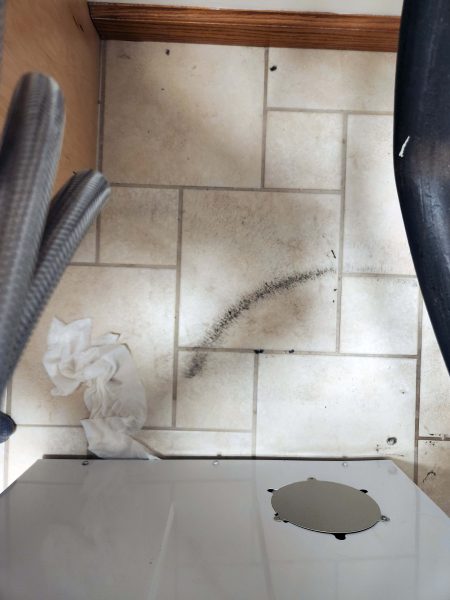
I called Henry, my go-to appliance repairman (who we hardly ever need, because we buy brands he recommends), to ask if he thought the black stuff and the leak were fixable. He offered to take a look, but he thought it was probably something coming from the motor and being blown around.
For years, my washer has been missing a solenoid that shuts off the water supply when the washer is not in use. Without the solenoid, there is a constant slow drip into the washer tub. I solve the problem by flipping the handle on the water supply shut-off valve behind the top of the washer to “on” to do laundry and to “off” when I’m finished. The reason the solenoid is missing is that Henry couldn’t find the right part to replace it because solenoids now have a different number contact points than our old one. What are the odds that, 7-10 years after the solenoid part became obsolete, Henry will be able to find the parts he needs to fix the motor? Answer: Low. What are the odds, if he does find the parts, that it will cost less than $500 to repair a 30-year-old washer with a (possibly) failing motor that cost $630 new? Answer: Low. What are the odds that this is only the first in a series of failures for such an old appliance? Answer: High. Ted and I decided it’s probably smarter to buy a new washer and dryer.
Henry has constantly marveled at my old washer. One time, his son came to our house with him and asked, “Is this that old Maytag you tell me about?!” I only remember two repairs on the washer–a new hose, and a leak near the tub–and two repairs on the dryer–2 replacement thermostats–in the 30 years we’ve had these appliances. When we bought them, Maytag advertised that the Maytag repairman was “the loneliest man in town.” No one ever called him. I remember ads like the picture below (I found it online) where he sat at his desk, waiting for the phone to ring. In one ad, his dog led him to an empty dog food bowl and the repairman said, “Finally! Something I can fix!”
When we bought the washer and dryer, the store had a Maytag washer running constantly. Customers could enter a lottery in which they would win a new Maytag washer if they accurately guessed when it would stop running. Ted and I didn’t enter the lottery because we had just purchased a new Maytag washer and dryer. I don’t know how long that washer ran, but the store is out of business and my washer lasted 30 years.

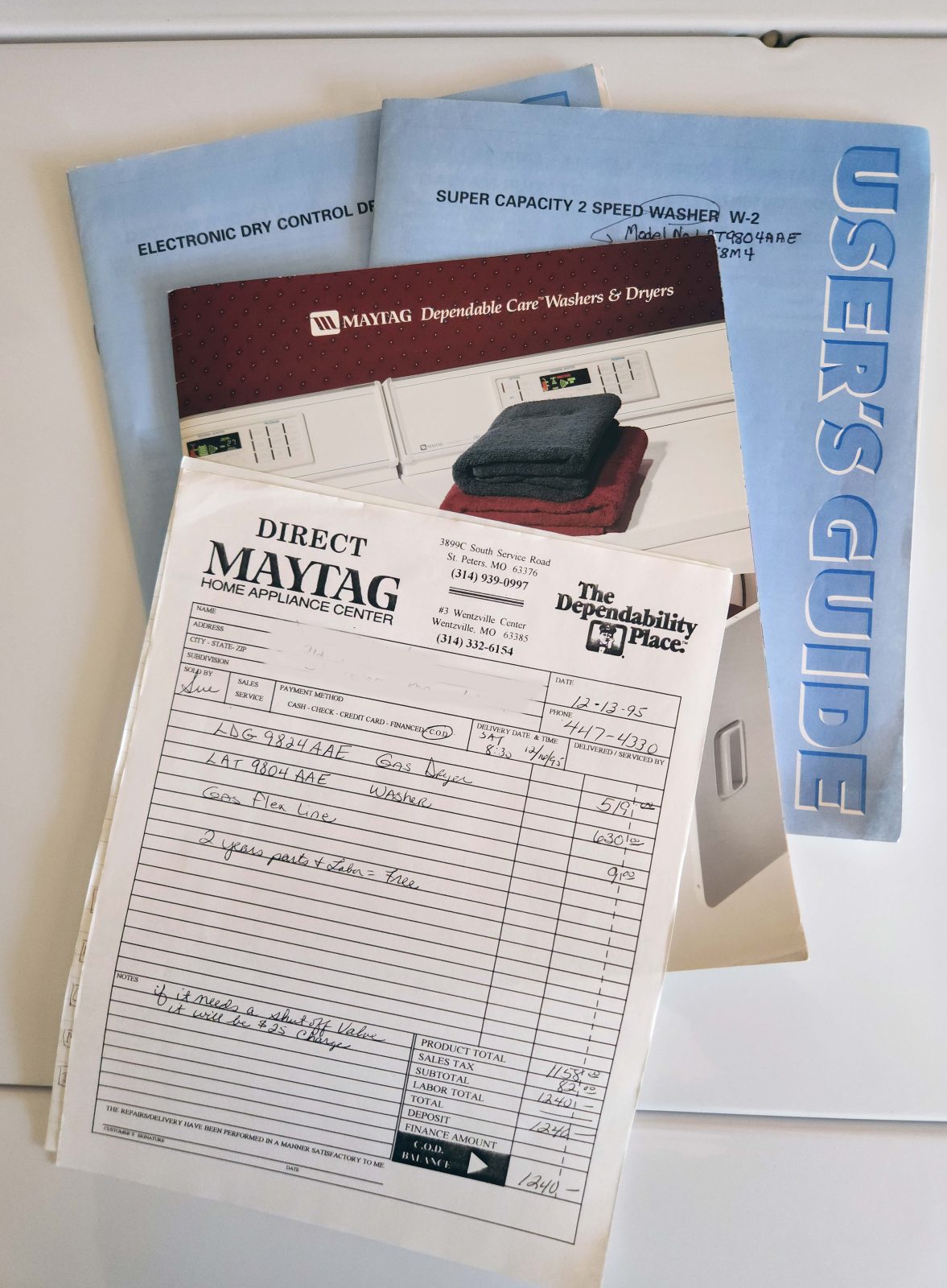
We still have all the user’s manuals and the receipt from the washer and dryer. Anyone who has shopped recently knows you can no longer buy a washer and a dryer for a total of $1,240. Note the date on the receipt: 12-12-95. I noticed the leak and the black stuff on 12-19-2025.
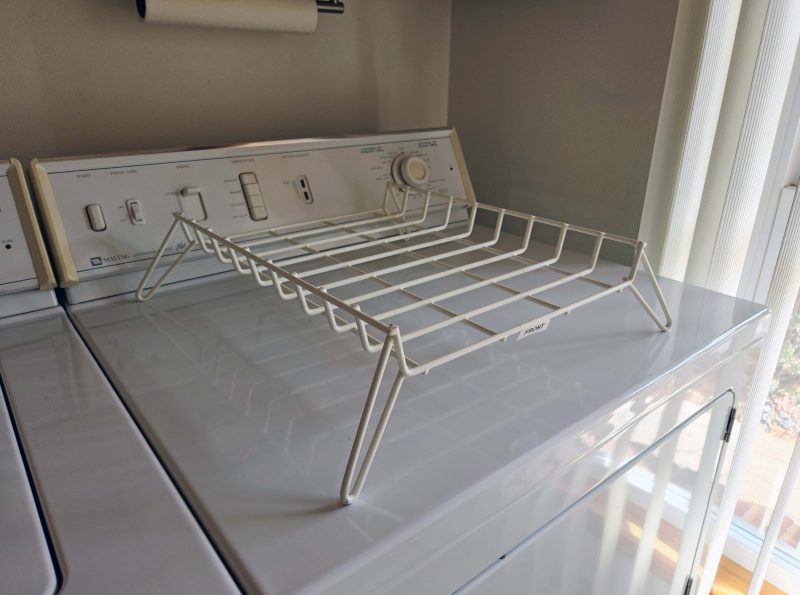
This rack was one of my favorite features on my dryer.
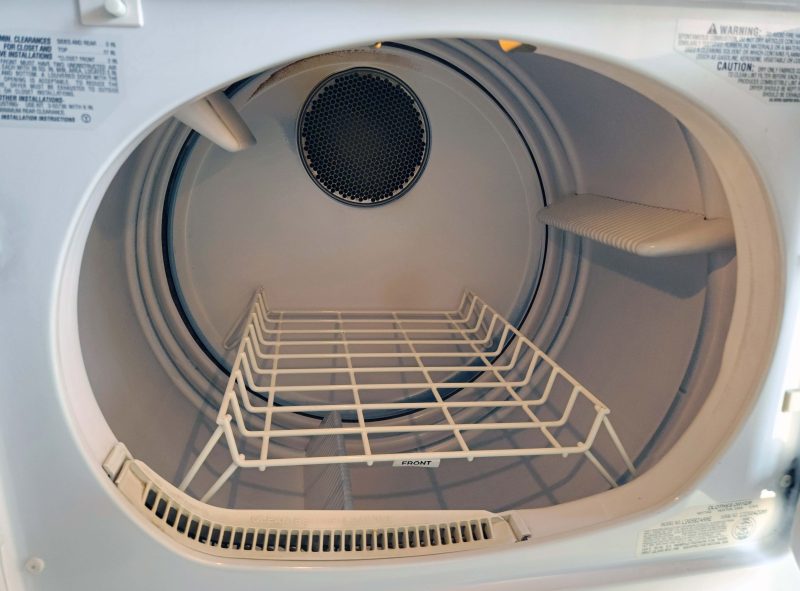
The rack fit inside the dryer without touching the drum, so I could set things on it to dry without tumbling. I used it for garments that need to be laid flat to dry (e.g., sweaters) and for drying athletic shoes. (Yes, I’ve thrown athletic shoes in the washer for as long as I can remember. I laugh when I see articles about how to keep your athletic shoes from smelling bad. Wash them!)
For years–probably since front-loading home washers became popular–I’ve heard nothing but bad things about new appliances from friends, family, and Henry. Henry told me he regularly fixes new appliances that are still under warranty! For a while, it was hard to even find a top-loading washer, and I hoped that my washer would last until people figured out that front-loading is a pain, and until stores included more top-loading machines in their stock. With a front-loading washer, you can’t add an additional item to the load; you can’t remove an item you put in by mistake; and, unless you leave the door ajar to dry out the interior, it stinks.
Before buying a new washer and dryer, I did some online research, hoping to find one that would last more than five years. I checked at least five consumer sites for “best washer and dryer,” and every single one had Speed Queen as the top choice, with information indicating it is expected to last 25 years. It’s not the brand I would have guessed, but when I looked into why Speed Queen lasted so long compared to other washers/dryers, I learned that it’s because they are built for commercial use and do not use electronic panels for cycle selections–just simple knobs and dials. As a result, the mechanisms are simple and have few problems. Ok, Speed Queen it is!
The next problem was finding a retailer that carried Speed Queen. I found one–one!–that had a store within five miles of us: the Slyman Brothers. Anyone who’s lived in the St. Louis metro area during the last 50 years, like Ted and I have, will recognize the Slyman Brothers as the guys who sit on top of the Arch in their ads. Yes, those goofs! I never took them seriously because of the dopey ads, but they are apparently a very reliable–as well as memorable!–dealer, and they were pleasant to work with. Ted and I went to Slyman Brothers when we returned from our Christmas visit with Thom’s family, and they delivered the new appliances two days later.
Here goes my 30-year-old washer. It made me a little bit sad, like watching an old (inanimate) friend going to its end-of-life. It was a trusty machine, and it worked hard and well for me. Thank you, Maytag washer.
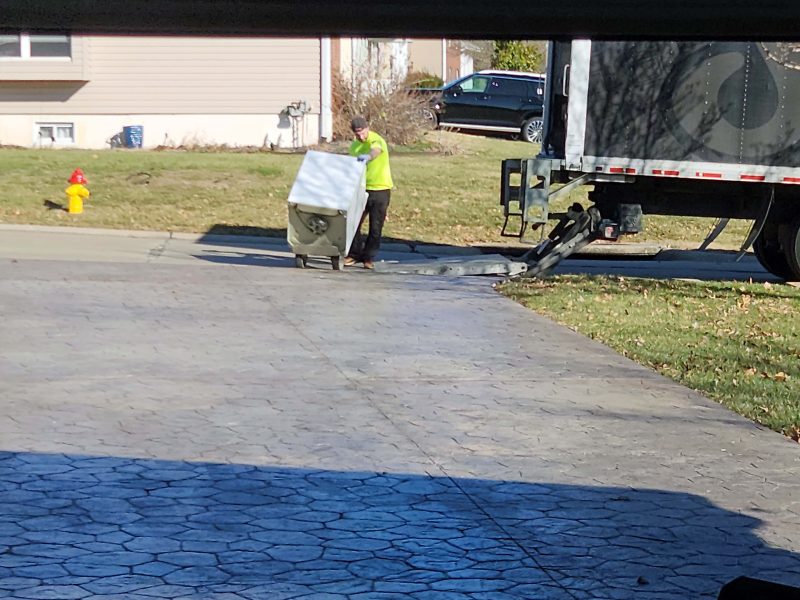
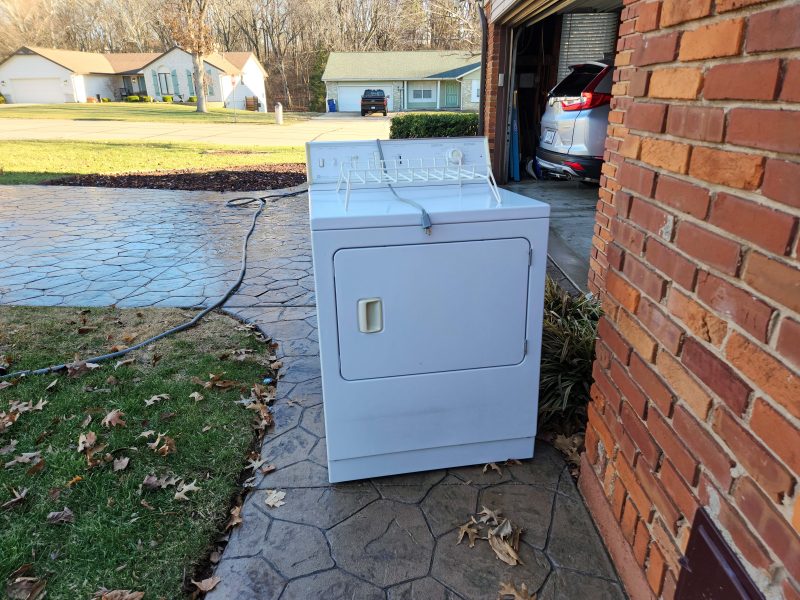
Henry repairs appliances, and he also sells used (repaired) appliances in his store. When I told him we were going to buy a new washer and dryer, he said he’d love to get his hands on my dryer, so we asked the delivery guys to leave it on the sidewalk and to deduct the dryer disposal fee from our bill. Henry’s son picked it up within an hour.
Here’s one of the delivery guys connecting whatever needs to be connected on the new appliances.
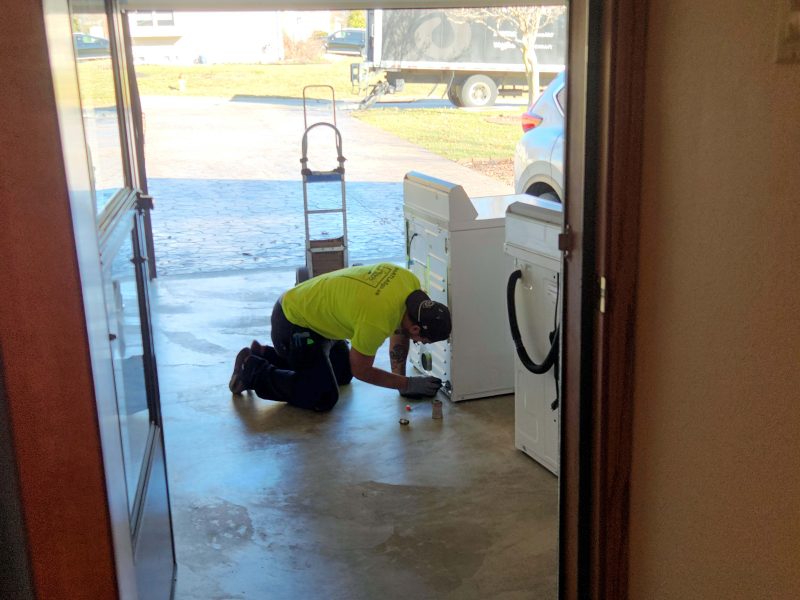
Here, they’re connecting the water line to the washer.

This is my last photo of our old Maytag washer and dryer.
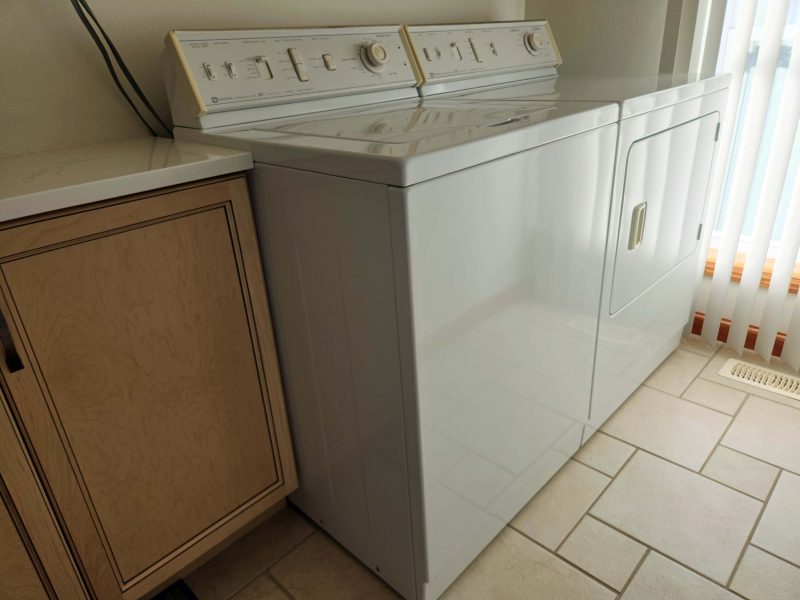
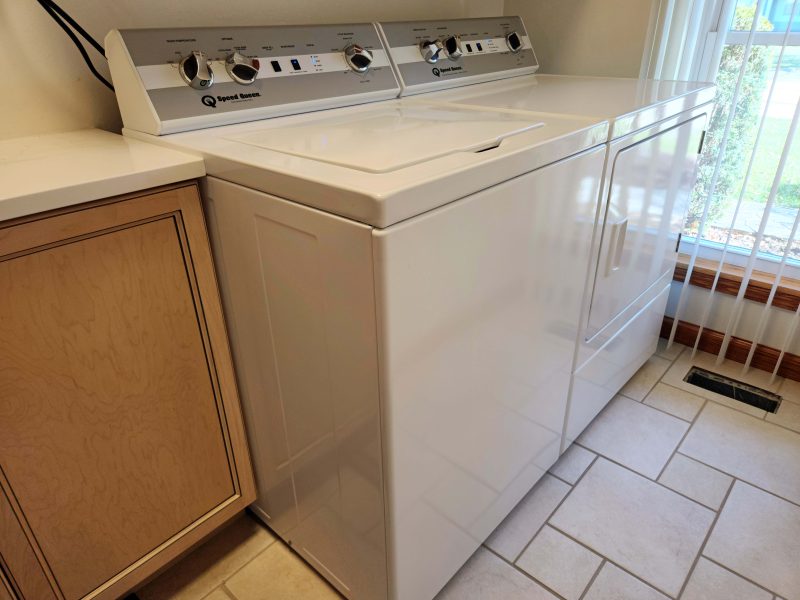
Here are my third (in 52 years) brand new washer and dryer. Except for the updated appearance of the panels, they look and operate almost exactly like my old ones. Will it be 22-30 more years before I need to replace these?
Of course, there are some things I’ll miss on my old washer and dryer. For example, the drying rack (above) and also the dials with timers. When I set the dryer timer on my old models, the dial would turn and I would know exactly where it was in the cycle. The new ones don’t turn during the cycle. I set them and, unless I watch the clock, I have no idea how close the load is to being dry. On the other hand, there are things I like on the new washer and dryer, especially the larger tub/drum, so our flannel bedsheets fit better.
The fact that our washer and dryer lasted 30 years is probably more surprising than the fact that the washer failed after 30 years. (The dryer still works perfectly.) Puzzling over this, Ted and I reached a possible cause. When we updated our laundry room cabinets, the carpenters took our washer and dryer out to the garage to make room for them to install the new cabinets. Then, of course, they moved them back into the laundry room. Ted and I suspect that the two moves jiggled an old, fragile part loose on the washer. (Not the carpenters’ fault.) Maybe if we’d left the laundry room with its dated appearance, the washer would still be washing clothes for us, and we’d still have the dryer too. Oh well, they had a good run at an average cost of $41.00/year.