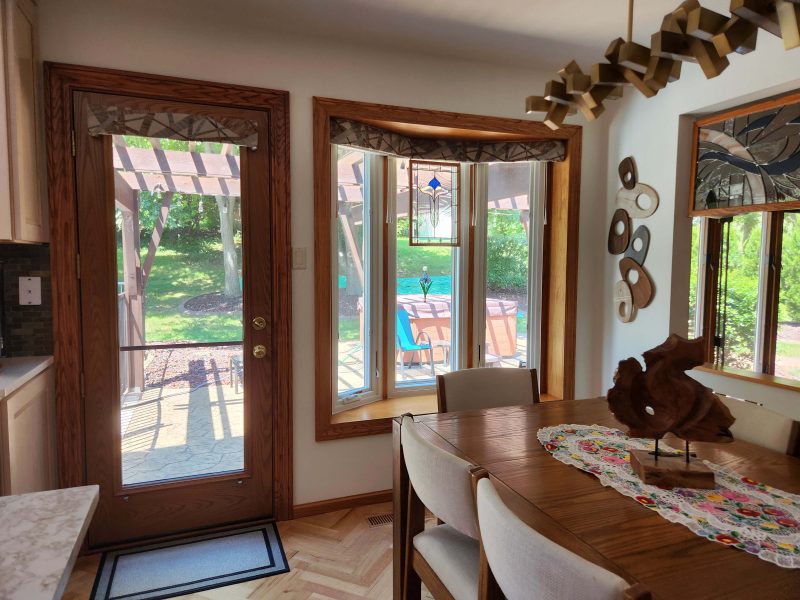
Now that the hardwood floor in the kitchen looks so nice, I decided we needed new coverings for the blind headers on the windows. Ted and I went shopping for fabric and found a piece with a design and colors that were perfect for our kitchen. There was just one problem: it was upholstery fabric, not drapery fabric. That means it was thicker, had an applied backing, and frayed more easily than drapery fabric. I’m an excellent seamstress, so I took on the challenge. I didn’t know it would turn out to be a bigger challenge than I’d expected.
Even though I only wanted to wrap the fabric around the blind headers, there were problems to solve. With drapery fabric, I’d cut a long rectangle, fold it in half lengthwise, sew that long seam together, turn over each end to sew hems, and slide the tube I’d made over the header. Upholstery fabric is a different story. One problem is that upholstery fabric is thicker so it can take the wear and tear of furniture use, where draperies and curtains simply hang against the wall–or window–and get dusty. My “wrap” (as I call it) also had to turn two corners from the front of the header onto the returns that attach the front piece to the window frame. The thicker fabric bunched up heavily at the corners and, if it fit the header, it was too tight to slide over the returns. My solution was to make the wrap slightly wider from the corners to the window frames to make it fit around the corners and the return pieces.
The wrap at the bay window was longer than the width of the fabric, so I had to match the fabric pattern at a seam. That seam was bulky where it folded over the top and bottom of the header. My solution? I notched it at the folds to allow it to bend more easily with less bulk.
Folding over a hem at each end was tricky too. I usually double-fold the ends, but that was far too thick with upholstery fabric, so I zigzagged the edges to prevent future fraying and settled for a single fold-over. The double layer of fabric at the hemlines made the wrap even tighter over the returns. That’s where my solution to make the wrap a little wider in that area really helped. My finished pieces weren’t simple rectangles; they were long rectangles with flared ends.
It didn’t surprise me that I triumphed over the challenges. I’d have given up if Ted and I hadn’t liked the fabric color and the pattern so much, and if we hadn’t agreed that a runner-up piece of drapery fabric would always be second-best. Still, making everything work was more frustrating than fun, so in the future, I’ve decided to avoid buying upholstery fabric for window hangings! That is, unless it’s this perfect for the look we want.
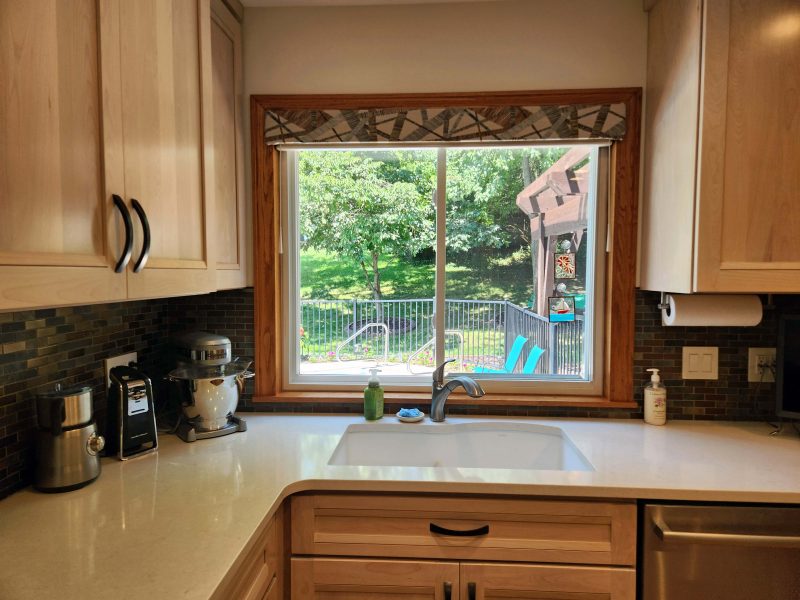
Here are before and after photos of the new wraps–old, then new.
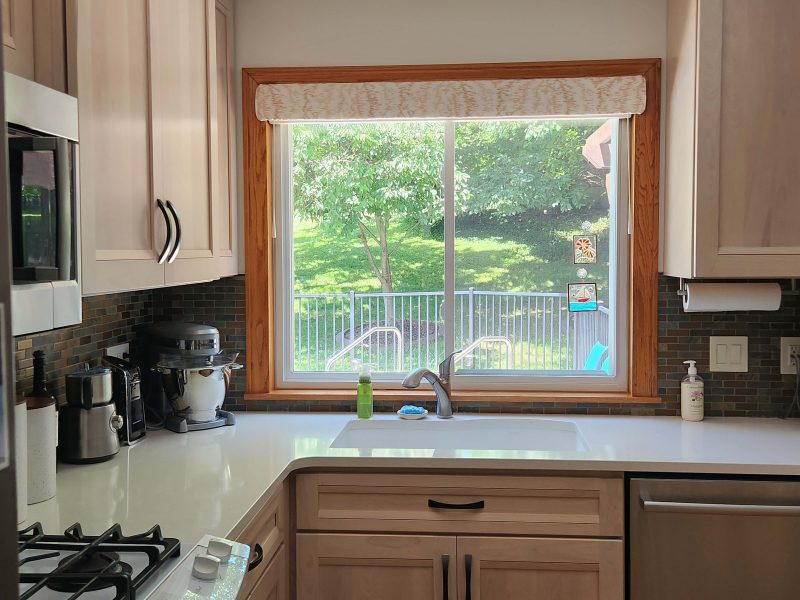
We like the colors of the new wraps with the new cabinets. They look warmer and less “washed out.”
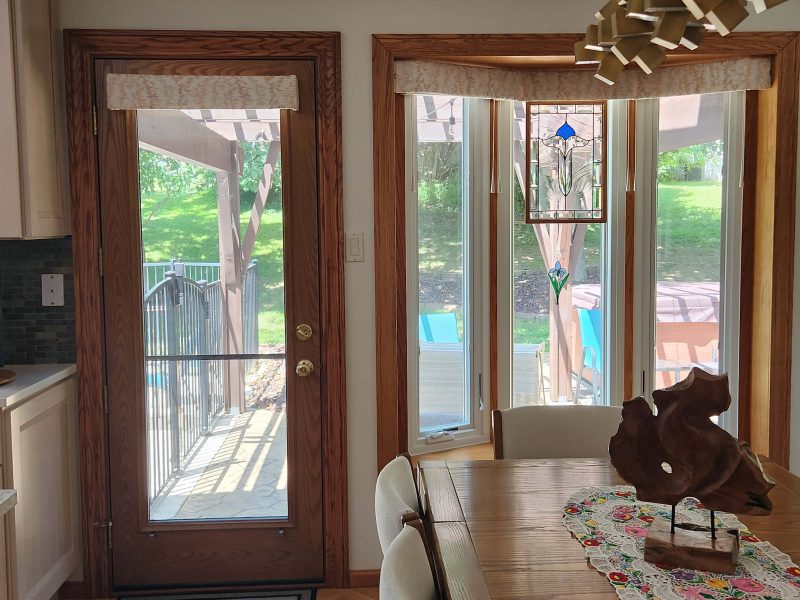
See how well that pattern matches our new light (part of the 2022 update) and the colors in the wall sculpture? I couldn’t say “no” and I’m glad it worked out.